Mixed-use density calculation ordinance postponed; council adopts board appointment process

Council adopts employee social media policy

Brief confusion over revised agenda

MANDEVILLE — The Mandeville City Council on Thursday postponed a proposed zoning ordinance affecting mixed-use density calculations while approving several other measures, including a new employee social media policy and a resolution establishing a formal process for appointments to city boards and commissions.

The council also introduced two budget amendments and approved a series of routine items on its consent agenda during the March 12 meeting at City Hall. 

Density calculation zoning ordinance delayed

The most significant action of the evening involved Ordinance 26-03, which proposes amendments to definitions and regulations affecting the city’s PM-1 and PM-2 marina districts and planned districts.

After discussion, the council voted to postpone the ordinance until April 9 to allow additional feedback from residents and stakeholders.

Councilman-at-Large Jason Zuckerman, who authored the ordinance, encouraged members of the public to contact him with comments before the item returns for consideration.

The ordinance would amend provisions of the city’s Comprehensive Land Use Regulations Ordinance (CLURO) related to marina districts and planned developments.

Appointment process for boards and commissions approved

Earlier in the meeting, the council unanimously adopted Resolution 26-08, establishing a formal, multi-stage process for appointments and reappointments to city boards and commissions.

The measure, introduced by District I Councilwoman Cynthia Strong-Thompson, is intended to create a clearer and more transparent process for reviewing applicants before the council votes on appointments.

Strong-Thompson said the proposal grew out of long-running discussions among council members about how appointments are handled and whether all applicants receive equal consideration.

“A lot of where this comes from is that this has been kind of a sticking point for the city council — trying to figure out how to appoint people in a fair process,” Strong-Thompson said during the meeting.

Under the resolution, applications would first be reviewed at a council meeting or work session where resumes and qualifications could be discussed. The council would then wait until the next regularly scheduled meeting to vote on appointments, giving members additional time to review applicants.

Strong-Thompson said the approach was modeled in part after the process used by the city’s Planning and Zoning Commission, where items are first discussed before a later vote.

“By creating one meeting where all resumes that have applied are discussed and then waiting until the next meeting to vote, I think it gives all applicants a fair chance to be heard,” she said, adding that the process could be revised if issues arise.

The other council members voiced support for the proposal.

Zuckerman thanked Strong-Thompson for bringing the measure forward, saying the council has struggled for years with how to handle appointments.

“I’m really appreciative that you took the initiative to put this together,” Zuckerman said. “We have struggled with this for a long time, and I’m excited that we actually have something in place now.”

Councilman-at-Large Scott Discon and District III Councilwoman Jill Lane also expressed support, with Lane saying the process would be an improvement over past practices.

District II Councilman Kevin Vogeltanz also said he supported the measure but first proposed postponing the vote, saying he wanted additional time to consider possible amendments that could improve it.

The resolution was adopted unanimously.

Employee social media policy adopted

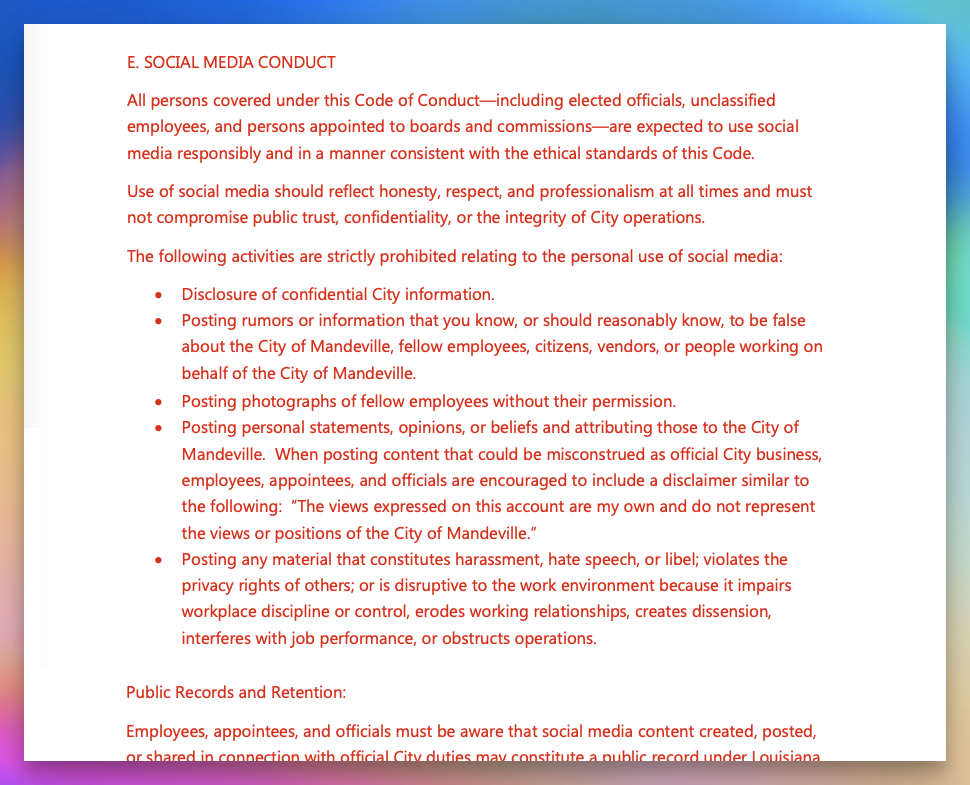
The council also approved Ordinance 26-07, establishing a social media policy for municipal employees within the city’s civil service system.

City officials said the policy is designed to clarify expectations for employees’ use of social media, including guidance on confidentiality, representing the city publicly and complying with public-records retention rules.

Human Resources Director Joanna Anderson said the policy is similar to those used by other municipalities and parishes and aims to set clear boundaries as social media becomes increasingly common in government operations.

The employee policy is separate from Ordinance 26-08, a similar proposal that would have created a social media policy for elected and appointed officials but included broader language. The council voted to table that ordinance during its Feb. 26 meeting after several members raised concerns about its expanded scope and potential First Amendment implications.

Under Robert’s Rules of Order, a motion to table effectively halts consideration of the measure unless the council later votes to take it back up — something that has not occurred. As a result, the proposal is widely expected to remain inactive. See previous coverage: Council tables proposed social media policy for elected, appointed officials.

Budget amendments introduced

The council introduced two ordinances that would amend the city’s operating and capital budgets to address roadway and drainage maintenance projects:

Both measures were introduced for future consideration and will return for adoption at a later meeting. 

Presentation and project updates

During the meeting, Curtis Environmental Services Inc. delivered an audit presentation related to the city’s Municipal Water Pollution Prevention program.

Public Works Director Keith LaGrange also provided updates on several ongoing infrastructure projects, including:

  • Seawall repairs
  • The Harbor gazebo project
  • Drainage improvements along Louisiana Highway 22
  • Replacement of Old Mandeville waterlines
  • Multiple roadway, striping and maintenance contracts

Consent agenda items approved

The council approved most items on its 12-item consent agenda without discussion.

Two items were broken out from the consent agenda to be considered individually at the request of Strong-Thompson, who sought clarification from the administration before voting.

After city staff answered questions related to those items, the council voted to approve them as well.

The remaining consent agenda items — which included special event permits for several community events, certificates of substantial completion and change orders for public works projects, and Resolution 26-06 authorizing an amendment to the city’s professional services agreement with CSRS LLC — were approved unanimously.

The two items removed for discussion were also approved unanimously once questions were addressed.

Agenda revision caused brief confusion at meeting

There was a brief moment of confusion early in the meeting over which version of the March 12 agenda was being considered.

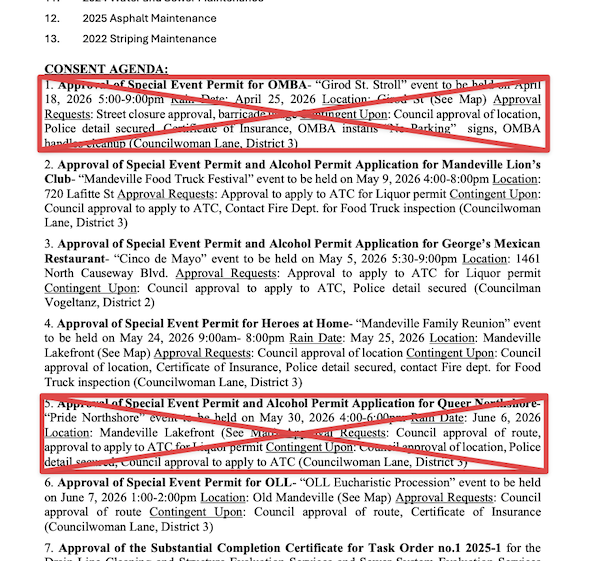
The agenda was revised after it was originally published. A revised version posted by the city on March 9 removed several special event permits — including the application from Queer Northshore for the Pride Northshore parade — from the consent agenda.
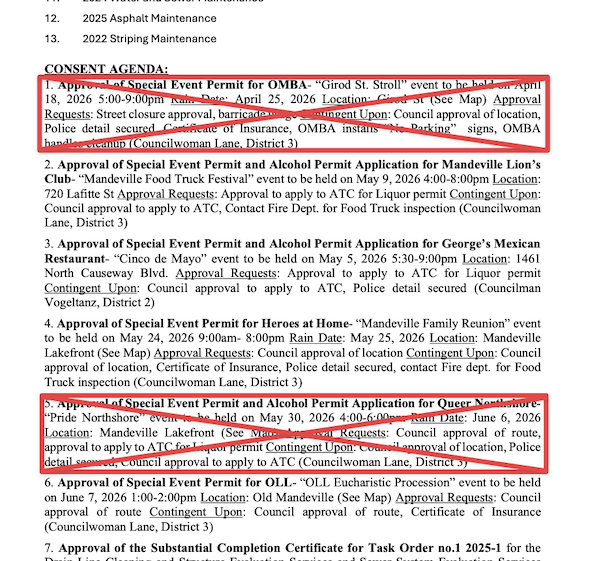
An updated agenda for the March 12 City Council meeting removes two special event applications from consideration due to a request from the administration’s event committee for more time. (Mandeville Daily)

Some attendees, however, still had copies of the earlier agenda that had been posted March 6 and were available in the lobby at City Hall, which still listed those items.

When a resident asked about the permits during the meeting, Zuckerman clarified that none of the items had been approved and that several event applications had been removed from the agenda for further review.

Zuckerman had told Mandeville Daily earlier in the week that the items were pulled at the request of the city administration because the city’s events committee had not yet completed its review of the applications.

As a result, permits for both the Pride Northshore parade and the Old Mandeville Business Association’s Girod Street Stroll were not considered at Thursday’s meeting and are expected to return on a future agenda once that review is completed.

-30-

Mixed-use density calculations targeted in CLURO amendment up for vote

Proposal would clarify how developers calculate density in planned and marina districts

Planning commission voted to recommend ordinance

MANDEVILLE — The Mandeville City Council is scheduled to vote Thursday, March 12, on a proposed amendment to the city’s Comprehensive Land Use Regulations Ordinance that supporters say would clarify how development density is calculated on mixed-use sites.

Ordinance 26-03, sponsored by Councilmen-at-Large Jason Zuckerman and District II Councilman Kevin Vogeltanz, would amend several sections of the CLURO related to lot area definitions and site-development regulations in Planned District and marina zoning districts.

The measure received a favorable recommendation from the city’s Planning and Zoning Commission with minor technical revisions before advancing to the council for final consideration.

Clarifying density calculations

The ordinance focuses on how density, building area and other site-development standards are calculated when multiple uses are proposed on a single property.

Under the proposal, only the portion of a site designated for a particular use could be counted when calculating allowable building area, the number of residential units and other development criteria. Areas dedicated to other uses on the same property could not be used to increase density for a separate portion of the site. 

The ordinance also specifies that portions of property that extend into Lake Pontchartrain or other water bodies — as well as wetlands or areas subject to periodic inundation — cannot be included in those calculations. 

City officials said the changes are intended to reinforce existing regulations governing mixed-use developments in the Planned Marina (PM-1 and PM-2) districts and Planned District zoning category.

Graphic illustrating purpose of Ordinance 26-03. (Mandeville Daily)

Sponsor says measure prevents “overdevelopment”

In a public statement posted ahead of the vote, Zuckerman said the ordinance clarifies what he believes the CLURO already requires regarding mixed-use developments.

“When calculating allowable building areas for new developments, the number of residential units allowed, and other site development criteria, only the area of the site designated for each use within the mixed-use site can be used in those calculations,” he wrote.

Zuckerman said the measure is intended to prevent situations in which developers might attempt to increase density for one part of a project by using the total acreage of a mixed-use property — even when much of the site is devoted to other uses.

“This ordinance is aimed to prevent overdevelopment when multiple uses are proposed on a single piece of property by using the entire property size … to increase density beyond what would be allowed by the CLURO if a single use was proposed for the entire site,” he said.

No change to existing marinas

Zuckerman also emphasized that the proposal does not alter the operation of existing marinas within the PM-1 zoning district.

According to the sponsor, the amendment would apply only when new mixed-use developments are proposed in marina or planned districts and would simply clarify how site-development calculations must be performed.

The measure follows the adoption of the city’s Mandeville Thrives 2045 Comprehensive Plan in December, which identified challenges related to mixed-use developments, including land-use compatibility, density and traffic concerns. 

Part of broader CLURO update

Ordinance 26-03 is one of several proposed updates to the city’s land-use regulations discussed in recent months as officials review how the CLURO applies to complex mixed-use projects.

If adopted Thursday, the ordinance would formally amend definitions and site-development provisions within multiple sections of the CLURO governing marina districts and planned developments.

The council meeting is scheduled for Thursday evening at Mandeville City Hall.

-30-

New process proposed for Mandeville board and commission appointments

Resolution outlines application period, public review meeting and separate vote

Proposal requires public disclosure of all applicants before nominations

MANDEVILLE — A proposal before the Mandeville City Council at the March 12 meeting would establish a formal, multi-stage process for appointing members to city boards and commissions, an effort intended to standardize how the council reviews applicants and conducts nominations.

Resolution 26-08, sponsored by District I Councilwoman Cynthia Strong-Thompson, seeks to replace the council’s current mix of informal practices with a structured procedure designed to ensure that all applicants receive full consideration and that the public has advance notice of candidates being considered. 

The measure also applies to commissioners seeking reappointment, requiring them to go through the same application and nomination process as new candidates.

Proposed multi-stage appointment process

Under the resolution, the council would begin each appointment cycle by announcing at a public meeting that applications are being accepted for a specific board or commission vacancy.

Within 48 hours of that announcement, the council clerk would be required to post the request for resumes on the city’s website and on the front door of City Hall, as well as publish the notice in the city’s official journal. 

Applicants would then have a minimum of 14 business days to submit resumes. Those resumes must include information such as how long the applicant has lived in Mandeville, career history, relevant experience and a statement explaining why they are seeking appointment.

The resumes would be treated as public records, with only personal telephone numbers redacted. 

Work session before any vote

Once the application period closes, the resolution requires the council to hold a dedicated work session to review all applicants.

After the application period closes, the council clerk would publish the names of all applicants on the agenda for the next council meeting where the review session will occur. The resumes of those applicants would also be included in the publicly available meeting materials, with limited redactions for personal information.

In past appointment processes, the names of applicants were not always publicly disclosed in advance of council deliberations. In several instances, Mandeville Daily obtained the identities of applicants only after submitting public records requests to the city seeking resumes or other materials submitted for board and commission vacancies.

Excerpt from Louisiana’s Public Records Law, Revised Statutes 44:12.1 (Mandeville Daily)

Louisiana’s Public Records Law “requires that the name, related qualifications, relevant employment history or experience of each applicant for a public position of authority or a public position with policymaking duties shall be available for public inspection, examination, copying, or reproduction…”

Applicants themselves would also be allowed to address the council during the discussion phase if they wish.

The resolution then requires a second meeting — the next regularly scheduled council meeting — for nominations and voting.

Majority vote with elimination rounds

During the action meeting, council members would nominate candidates from the applicant pool. Each council member could nominate only one person for an open seat.

If multiple candidates are nominated, the council clerk would conduct a roll-call vote. A candidate must receive a majority of the members present to be appointed.

If no candidate receives a majority on the first vote, the nominee with the fewest votes would be eliminated and additional rounds of voting would continue until a majority winner is reached. 

The proposal also seeks to eliminate what it describes as a “first to nominate” bias, in which the first candidate placed into nomination can effectively limit consideration of other applicants.

Addressing past appointment disputes

Strong-Thompson’s proposal appears aimed at addressing recurring disputes over how the council handles nominations to boards and commissions.

Over the years, the council has relied on a variety of informal practices when filling seats, sometimes leading to confusion about the nomination process and whether all potential candidates were being fully considered.

Those questions surfaced during several past appointments to the Planning and Zoning Commission. In 2021, council members debated whether two open seats on the commission could be filled during the same meeting after nominations were made from the floor.

Similar issues arose in 2023 when the council began considering candidates to fill a vacant Planning and Zoning seat. The nomination process unfolded over multiple meetings as council members debated potential candidates before ultimately confirming an appointee.

The new resolution seeks to formalize that process by requiring a defined application period, a public review session to discuss the full pool of applicants and a separate meeting for nominations and voting.

Supporters say the approach would ensure that all applicants are publicly identified in advance and that council members have time to review their qualifications before taking action.

If adopted, Resolution 26-08 would supersede previous resolutions and informal methods used by the council when filling seats on boards and commissions.


Related Stories:

Field of 9 applicants vie for 2 P&Z vacancies

P&Z applicant résumés available for inspection

Cressy appointed to P&Z, confirmation vote set for Aug. 24th

Council could fill both P&Z vacancies tonight, not just one

City Council scheduled to vote on unnamed P&Z nominee


-30-

Committee debates salary survey, employee costs and reserve targets

Zuckerman to author ordinance mandating minimum, target fund balances

Salary survey update indicates 2022 pay overhaul ’terribly successful’

Strong-Thompson outlines full cost of city employee compensation

Employees urge caution on benefits and COLA

MANDEVILLE — Members of the city’s Income Strategies Committee on Monday examined employee compensation, health insurance costs and the city’s large fund balances as they continued discussions about the city’s long-term fiscal strategy.

The roughly hourlong meeting focused on the cost of employee benefits and the size of the city’s reserves, while several employees urged officials not to reduce benefits or freeze cost-of-living raises.

The committee did not take any votes and will meet again after additional financial comparisons are prepared.

Download the meeting transcript here.

Salary survey finds most pay competitive

Human Resources Director Joanna Anderson presented highlights of a draft compensation study conducted by consulting firm SSA.

The survey found the city’s current pay plan is generally competitive with the market, a result Anderson attributed largely to cost-of-living adjustments implemented in recent years. 

The study identified only a few positions where entry-level pay was more than 3 percent below market levels, including planner positions, maintenance workers and entry-level police officers. 

Committee member Becky Rohrbaugh, however, said her own review of the report showed that only four positions out of 51 analyzed were below market benchmarks.

“That sort of confirms what I suspected,” Rohrbaugh said, adding that the city’s compensation plan overhaul, which was initiated by Mayor Clay Madden and adopted by the City Council in 2022, had been “terribly successful” in bringing employees within market ranges.

Council member highlights rising benefit costs

Councilwoman Cynthia Strong-Thompson presented a separate analysis examining the full cost of employing city workers, including benefits and taxes.

Her analysis suggested the total cost of employing an entry-level police officer could reach roughly $85,000 annually with individual health coverage and more than $106,000 with family coverage. 

A clerk position, she said, carries total compensation costs of about $56,000 with individual coverage and $78,000 with family coverage. 

Strong-Thompson said benefits significantly increase the cost of employment.

According to her calculations, the city spends about 219 percent of salary to employ an entry-level police officer and roughly 250 percent for a clerk position once benefits and taxes are included. 

She said healthcare costs were a major driver and suggested the city explore alternatives or different plan structures.

Zuckerman calls for comparisons with other cities

Councilman-at-Large Jason Zuckerman said the numbers were useful but argued they must be compared with other municipalities before policy changes are considered.

Employers routinely pay substantial costs beyond wages, he said, and the key question is how Mandeville compares with similar governments.

“I want to know how we compare to other municipalities,” Zuckerman said.

Without that context, he said, large figures showing total employment costs can appear misleading.

Anderson said the city currently pays about 93 percent of health insurance premiums for employees, compared with roughly 80 to 85 percent paid by many other government employers. 

About 115 city employees currently participate in the health plan, she said. 

Fund balance policy proposed

Based on a suggestion from Zuckerman at the Feb. 9 committee meeting, Finance Director Jessica Farno presented a draft policy establishing guidelines for the city’s reserve funds.

The Government Finance Officers Association (GFAO) recommends that local governments maintain reserves equal to roughly two months of operating expenses, or about 16 to 17 percent of expenditures. 

Using the city’s 2025 figures, that would equal roughly $4.4 million.

However, the city’s projected ending fund balance is about $14.8 million, or roughly 67 percent of annual operating expenses. 

Zuckerman has been advocating for the establishment of a formal reserve policy during budget hearings over the past few budget cycles. He believes that this policy, which would specify minimums and targets, could provide valuable insights into whether downward tax adjustments are necessary in the future.

“It’s this line of at what point are we taxing people too much,” he said.

Zuckerman to author fund balance ordinance, repeating warning of overtaxing citizens

Zuckerman told the committee that he plans to introduce an ordinance for council consideration that would codify the fund balance principles for which he has advocated and are outlined in Farno’s draft policy. The measure would establish minimum and target reserve levels and outline circumstances — such as natural disasters or major matching-grant opportunities — under which reserves could be used.

He noted that the city relies heavily on sales taxes for revenue and that many of those taxes are dedicated to specific purposes. Much of that revenue, he said, flows into restricted funds that continue to grow because the city does not spend the money as quickly as it is collected.

“This is a piece of the puzzle,” Zuckerman said. “What should our target fund balances be? We’ve never really established that.”

Without clear guidelines, he said, reserves can grow to levels that prompt concerns about over-taxation.

“Have we taken too much money from our taxpayers?” he asked.

Zuckerman said the question will become unavoidable in the coming years because several of the city’s dedicated sales taxes are scheduled to expire and will have to return to voters for renewal.

“That’s a conversation we’re going to have to have anyway,” he said. “Are we going to keep asking voters to renew the same taxes that are filling restricted funds we never spend, or are we going to look at rededicating those revenues to the areas where they’re actually needed?”

He said adopting a policy establishing target reserve levels could help guide those decisions and determine whether current tax collections exceed what the city needs to operate.

“It’s time we look at that,” Zuckerman said. “At some point we have to ask whether we’re continuing to collect money just to put it in the mattress.”

Employees defend benefits

Several city employees addressed the committee during public comment, urging officials not to reduce benefits.

City employee Kathleen Sides said the city has accumulated large reserves while choosing not to collect millions in potential property tax revenue.

Freezing cost-of-living adjustments, she said, would shift the burden of inflation onto employees rather than addressing it through broader fiscal policy. 

Police officer James Gilbert also asked the committee to consider the unique risks faced by law enforcement officers when evaluating benefits.

Another employee described relying on city health coverage to afford medication costing about $6,000 every eight weeks.

Next steps

Madden said the committee will meet again after the compensation consultant presents the full salary study to the City Council.

Officials also plan to gather comparisons with other municipalities on employee benefits and labor costs before making recommendations. 

-30-

Pride Northshore parade permit expected before Mandeville council

Application lists 1,500 attendees despite reported 3,000 last year

City police estimate $12,420 in staffing costs for parade of 1,500

Queer Northshore say they paid only $5,500 last year

Police cost estimate aligns closely with previous Mandeville Daily analysis


UPDATE: Permit removed from consideration March 12

Editor’s note:

The agenda for the March 12 meeting of the Mandeville City Council was revised after this story was originally published. A revised agenda posted by the city March 9 removed several special event permits — including the application from Queer Northshore for the Pride Northshore parade — from the consent agenda.

Council Chairman Jason Zuckerman told Mandeville Daily that the items were removed after the agenda was published March 6 at the request of the city administration because the city’s events committee had not yet completed its review of the applications. As a result, the permits for both the Pride Northshore parade and the Old Mandeville Business Association’s Girod Street Stroll event will not be considered by the council at Thursday’s meeting but would likely be placed on a future agenda.

An updated agenda for the March 12 City Council meeting removes two special event applications from consideration due to a request from the administration’s event committee for more time. (Mandeville Daily)

MANDEVILLE — The Queer Northshore Pride Northshore parade is expected to come before the Mandeville City Council for approval at its March 12 meeting, marking one of the first major events to test the city’s newly adopted parade and event ordinance.

Representatives of Queer Northshore — Mel Manuel, Jeremy Thompson and Layla Hekmatdoost — previously spoke against the ordinance earlier this year, arguing the new rules could increase costs and administrative hurdles for community events. Despite those objections, the organization has now formally applied for a permit to hold the 2026 Pride Northshore parade.

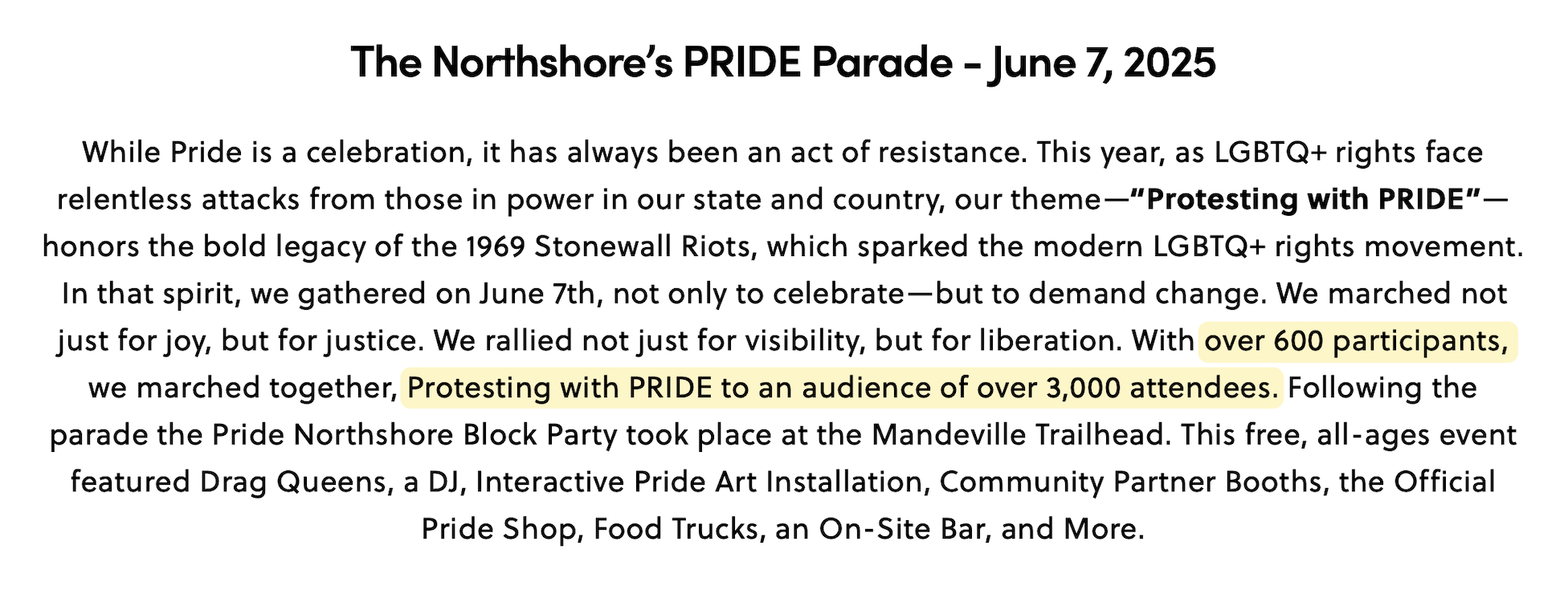
The application lists an expected attendance of 1,500 people, according to the agenda packet for Thursday’s meeting. However, Queer Northshore previously stated on its website that the 2025 Pride Northshore event attracted more than 3,000 attendees, and other media coverage similarly reported turnout in that range.

The Pride Northshore parade would likely be impacted by these changes, according to the group’s self-reported attendance from 2025, as found on the Queer Northshore website. (Mandeville Daily)

Police estimate aligns with prior Mandeville Daily analysis

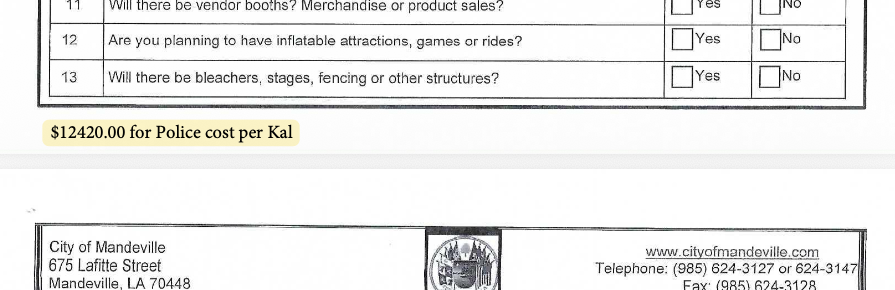
Documents included with the council agenda show a police cost estimate of $12,420 associated with the parade if 1,500 is the approved attendance estimate.

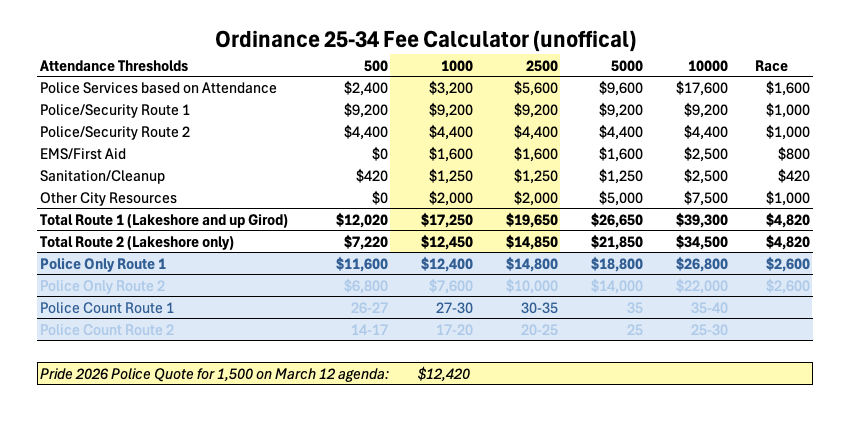
Mandeville Daily fee estimate worksheet based on adopted text of Ordinance 25-34, police pay rates found in previous adopted city budgets, and real-world cost estimates for sanitation and EMS. (Mandeville Daily)

That estimate closely aligns with prior projections at various attendance levels calculated by Mandeville Daily using a cost-estimation worksheet built from historical budget data and real-world staffing levels from past lakefront events.

Using the same methodology outlined in earlier reporting, the publication’s spreadsheet estimated police costs of approximately $12,400 for a 1,500-attendee event — nearly identical to the city’s estimate included in the agenda packet for the upcoming meeting.

The close match suggests the worksheet used by Mandeville Daily accurately modeled the city’s underlying cost structure for policing large lakefront events.

Excerpt from the March 12 agenda posted on the City of Mandeville website March 6 showing the 'police cost' estimate. (City of Mandeville)
Excerpt from the March 12 agenda posted on the City of Mandeville website March 6 showing the ‘police cost’ estimate. (City of Mandeville)

Prior event costs cited during ordinance debate

During the Jan. 8 meeting when the ordinance was adopted, Layla Hekmatdoost told the Mandeville City Council that the organization had previously paid about $5,500 in city-related costs for the Pride Northshore event.

Later in the meeting, Queer Northshore representatives Mel Manuel and Jeremy Thompson warned that the proposed fee structure could significantly increase the cost of hosting the parade and said the organization might be forced to consider moving the event elsewhere if the ordinance were adopted.

Leyla Hekmatdoost, executive director of Queer Northshore, said the new fee structure could ultimately force the organization to move its Pride Parade — having rolled two years in a row — out of Mandeville due to the now-required fee structure. She argued that the event provides tangible economic benefits to the city, particularly for local businesses along the parade route. (City of Mandeville)

If the city’s current estimates hold, the total municipal cost for a 1,500-attendee event could reach roughly $17,250, according to the Mandeville Daily cost worksheet.

That would represent more than triple the amount Queer Northshore said it previously paid for the event, though the city has not yet publicly itemized the full breakdown of non-police service costs for this year’s parade.

Some council members could also question whether the 1,500-person attendance estimate is too low, a concern that could potentially jeopardize approval of the permit.

Total costs likely higher when other services included

The police estimate included in the agenda packet accounts only for law enforcement staffing.

Additional municipal services — including emergency medical services, sanitation, traffic control support and other operational costs — have not yet been publicly itemized for the Pride Northshore event.

Based on the Mandeville Daily cost worksheet, a 1,500-attendee event would likely generate total municipal service costs of roughly $17,250 once those additional services are included.

Earlier reporting estimated that an event drawing closer to 3,000 attendees could push the total cost of city services into the $15,000 to $20,000 range, depending on final staffing levels and operational needs.

New ordinance reshaped event approvals

The parade application arrives just weeks after the council unanimously approved a sweeping overhaul of the city’s parade and special-event regulations.

Under the ordinance adopted earlier this year, the city implemented a new cost-estimation process tied to expected attendance levels. The policy was adopted following public pressure from residents who raised concerns about the city subsidizing large lakefront events without clear accounting of municipal costs.

City officials said the changes were intended to create a more transparent and consistent system for estimating the public-safety and operational expenses associated with parades and festivals.

Council vote expected Thursday

The Pride Northshore parade permit is listed on the consent agenda for the March 12 meeting, meaning it could be approved as part of a single vote along with other routine items unless a council member requests separate discussion.

Under Ordinance 25-34, once the Mandeville City Council approves a permit, the event organizer is required to pay the estimated cost of city services as the permit fee.

Even if approved Thursday, questions remain about the full cost of city services required for the event, particularly non-police expenses that have not yet been publicly disclosed in the agenda materials.

Those figures could ultimately determine how closely the new ordinance aligns with the council’s stated goal of ensuring that large public events cover the municipal costs they generate.

-30-

Developers appeal dismissal of Sucette Harbor lawsuit

Case heads to Fifth Circuit as attorney-fee motions remain pending

NEW ORLEANS — The developers behind the failed Sucette Harbor project have appealed a federal judge’s decision dismissing their lawsuit against the City of Mandeville and Councilman-at-Large Jason Zuckerman.

Woodward Harbor LLC and LSU Health Foundation New Orleans each filed notices of appeal Thursday in the U.S. District Court for the Eastern District of Louisiana, asking the U.S. Court of Appeals for the Fifth Circuit to review the court’s Feb. 5 final judgment and all related rulings in the case.  

The lawsuit challenged the Mandeville City Council’s rejection of the proposed Sucette Harbor development. U.S. District Judge Brandon S. Long dismissed the claims earlier this year, ruling that Zuckerman was entitled to qualified immunity and that the plaintiffs failed to state viable federal claims against him in his individual capacity.

A notice of appeal does not present legal arguments but formally informs the court that a party intends to seek review by an appellate court. The appeals now move the dispute to the Fifth Circuit, which will determine whether the district court’s rulings should stand.

The litigation is expected to continue while the appeal proceeds. Motions filed by Zuckerman and the City of Mandeville seeking to recover attorney fees from the plaintiffs remain pending before the district court. Under federal procedure, the filing of an appeal does not automatically prevent a district judge from ruling on collateral matters such as attorney-fee requests.

Zuckerman and the city have argued the claims against them were legally unsupported and have asked the court to order reimbursement of legal costs incurred defending the case. Judge Long has not yet issued a ruling on those motions.

The Fifth Circuit will next assign the appeal a docket number and set a briefing schedule for the parties.

-30-

Sucette developers oppose Zuckerman fee request; city maintains lawsuit was frivolous

Reply brief argues plaintiffs still cannot identify precedent overcoming qualified immunity

Judge to decide if Sucette plaintiffs must pay additional $45K in legal fees

Motion claims lawsuit interfered with Zuckerman’s official duties during re-election bid

NEW ORLEANS — The developers behind the failed Sucette Harbor project are urging a federal judge to deny a renewed request for attorneys’ fees filed by Mandeville Councilman-at-Large Jason Zuckerman, arguing their civil rights lawsuit was not frivolous even though it was dismissed.

In a Feb. 24 opposition, Woodward Harbor LLC asked U.S. District Judge Brandon S. Long to reject Zuckerman’s motion for $42,926.18 in attorneys’ fees and $2,321.87 in costs, contending the claims were brought in good faith and were supported by facts surrounding the City Council’s denial of the proposed development. 


Background:

Woodward Motion in Opposition to Fees Request (Feb. 24)

Zuckerman/City Reply Motion (March 2)

City, Zuckerman seek $277K from Sucette developers after lawsuit dismissal

Judge dismisses all Sucette Harbor lawsuits, orders sanctions hearing over fake case citations

Sucette Harbor killed, 5-0


Zuckerman and the City of Mandeville filed a reply March 2 asserting the plaintiffs’ claims against him in his individual capacity were “frivolous, unreasonable, and without foundation” because they failed to identify any clearly established constitutional right that would overcome qualified immunity. 

The reply brief emphasizes that nearly a year after the court dismissed the claims at the Rule 12 stage, the plaintiffs still have not cited controlling precedent that would have placed the alleged violation “beyond debate,” the standard required to defeat qualified immunity. The defendants argue that suing a public official personally without such precedent renders the claims legally unsupported from the outset.

Woodward Harbor, in its opposition, argues that losing on qualified immunity does not automatically render a lawsuit frivolous under federal fee-shifting standards. The developers cite prior cases in which courts declined to award fees to prevailing defendants, stressing that unsuccessful claims are not necessarily groundless.

The defendants also challenge Woodward’s assertion that it was required to file suit within 30 days under the city’s Comprehensive Land Use Regulations Ordinance, arguing that provision instead governs administrative appeals, not federal litigation.

In addition, the reply brief argues that naming Zuckerman individually served no legal purpose because any recovery could have been obtained from the city itself. The defendants contend the personal-capacity claims were filed during a contested municipal election cycle in which Zuckerman ultimately secured one of two at-large council seats with 33% of the vote, narrowly ahead of a challenger who received 31%. They argue the lawsuit interfered with his official duties and should not result in additional costs to taxpayers.

Judge Long has not yet ruled on the renewed motion for attorneys’ fees.

-30-

Council tables proposed social media policy for elected, appointed officials

Approves PILOT agreement to preserve Rouquette Lodge senior housing

Advances budget amendments related to striping maintenance

MANDEVILLE — The City Council unanimously tabled indefinitely a proposed ordinance Thursday that would have added a social media policy to the city’s code of conduct for elected officials, appointed board and commission members, unclassified employees and contractors. The measure, Ordinance 26-08, had drawn scrutiny following prior reporting and was set aside on a 5-0 vote after a motion by District II Councilman Kevin Vogeltanz.

In contrast, the Council advanced a series of budget-related ordinances and resolutions without opposition, approving multiple amendments tied to striping maintenance and the “Keep Mandeville Beautiful” program, and adopting a resolution supporting a state PILOT agreement to preserve affordable senior housing at Rouquette Lodge. Another proposed social media policy, Ordinance 26-07 — applicable to municipal civil service employees — was postponed to the next regular meeting to allow revisions.


City Council Meeting Results: February 26, 2026


CONSENT AGENDA:

  1. Approval of Substantial Completion of Task Order No. 5 for the 2022 Striping Maintenance Contract. (Councilman Zuckerman, At-Large)
  2. Adoption of Resolution 26-04: A resolution adopting the 2026 St. Tammany Parish multi-jurisdiction hazard mitigation plan and providing for other matters in connection therewith.(Councilman Zuckerman, At-Large)
  3. Adoption of Resolution 26-05: A resolution authorizing the mayor of the City of Mandeville to execute Amendment No. 1 to the 2022 striping maintenance contract between the City of Mandeville and Pavement Markings LLC and providing for other matters in connection therewith. (Councilman Zuckerman, At-Large)

Outcome: Adopted 5-0


UNFINISHED BUSINESS:

(none)


NEW BUSINESS:


  1. Adoption of Ordinance 26-04: An ordinance to execute Amendment No. 2 to Ordinance No. 25-25, the operating budget of the City of Mandeville, and for other matters in connection therewith (striping maintenance). (Councilman Zuckerman, At-Large)

Note: This is part 1 of a budget adjustment to correct miscategorization of work performed under the striping maintenance contract.

Outcome: Adopted 5-0


  1. Adoption of Ordinance 26-05: An ordinance to execute Amendment No. 3 to Ordinance No. 25-25, the operating budget of the City of Mandeville, and for other matters in connection therewith (Keep Mandeville Beautiful). (Councilman Zuckerman, At-Large)

Note: Funding for “Keep Mandeville Beautiful” project.

Outcome: Adopted 5-0


  1. Adoption of Ordinance 26-06: An ordinance to execute Amendment No. 2 to Ordinance No. 25-26, the capital budget of the City of Mandeville, and for other matters in connection therewith (striping maintenance). (Councilman Zuckerman, At-Large)

Note: This is part 2 of a budget adjustment to correct miscategorization of work performed under the striping maintenance contract.

Outcome: Adopted 5-0


  1. Adoption of Ordinance 26-07: An ordinance amending and adopting the personnel policies, Part I, Rule 2, General Administration, adding Section 2.12, Social Media Policy for the municipal employees’ civil service system and its employee rules and regulations, and providing for other matters in connection therewith. (Councilman Zuckerman, At-Large)

Note: Originating from the administration, this would add a social media policy to the code of ethics for police and civil service employees.

Outcome: On a motion from District II Councilman Kevin Vogeltanz, this was postponed with a 5-0 vote to the next regular City Council meeting.


  1. Adoption of Ordinance 26-08: An ordinance amending the code of conduct for elected officials, unclassified employees, persons appointed or elected to various boards and commissions of the City of Mandeville, and contractors with the City of Mandeville, and providing for other matters in connection therewith. (Councilman Zuckerman, At-Large)

Note: Originating from the administration, this would add a social media policy to the code of ethics for elected officials, appointed members of commissions, committees and boards, and unclassified employees.

Outcome: On a motion from District II Councilman Kevin Vogeltanz, this was tabled indefinitely with a 5-0 vote.


  1. Adoption of Resolution 26-09: A resolution of the City Council of Mandeville authorizing participation in a state “payment in lieu of taxes,” or PILOT, program to facilitate the sale and continued operation of Rouquette Lodge, an income-restricted senior housing complex at 4300 U.S. Highway 22. The property, long owned by an entity controlled by the Archdiocese of New Orleans, is being sold as part of the archdiocese’s bankruptcy-related asset liquidation. In order for the new owner to maintain the complex’s affordable, HUD-regulated senior housing model, the purchaser must enter into a state-authorized PILOT agreement administered through a public trust. The resolution provides the required local governing authority support to allow the transaction to proceed under that structure. Under the arrangement, the property will be transferred through a public entity and leased back to the operator, removing it from the traditional tax rolls in exchange for a structured payment in lieu of taxes. Council members emphasized that the buyer has committed to maintaining the development’s affordable housing mission, including keeping rents capped at no more than 30% of a resident’s income in accordance with federal guidelines. The agreement carries a 40-year commitment to remain in the program, with provisions that would return the property to full taxation if program obligations are not met.

Note: The measure was added to the agenda as a time-sensitive item under Robert’s Rules of Order.

Outcome: Adopted 5-0


-30-

Proposed social media policy could limit how council members speak online, conduct campaigns

Ordinance 26-08 would apply broad online speech rules to mayor, council members

Concerns policy could disadvantage incumbents against challengers

Proposal stands in contrast to national guidance

MANDEVILLE — The Mandeville City Council will consider a proposal Thursday that would add a detailed social media policy to the city’s existing Code of Conduct — a move that could significantly affect how elected officials communicate with voters online and conduct reelection campaigns, according to some who have read the proposal.

Ordinance 26-08 would amend the city’s 2010 Code of Conduct by adding an entirely new section titled “Social Media Conduct.” The new language applies to elected officials, unclassified employees and persons appointed to boards, committees and commissions, placing them under the same set of online speech standards.

Some say the policy would have a chilling effect during election cycles. A political opponent seeking to unseat a council member or mayor could file a Code of Conduct complaint over campaign-related social media posts.

That possibility, critics argue, would discourage robust policy debate during an active campaign, undermine public confidence in an incumbent or, at minimum, complicate an official’s ability to respond forcefully to political attacks and defend their record.

Broad prohibitions would extend to personal accounts

Under the proposed language, elected officials, appointed members of boards and committees, and unclassified employees are prohibited from:

  • Posting “rumors or information” they know or “should reasonably know” to be false about the city or others;
  • Posting photographs of fellow employees without permission;
  • Posting material that is “disruptive to the work environment” or “damaging to the City’s reputation”;
  • Disclosing confidential information.
Excerpt from proposed Ordinance 26-08, Exhibit A. (City of Mandeville)

The ordinance also warns that violations could result in disciplinary action for employees, removal from appointed office or referral to the Louisiana Board of Ethics when it pertains to council members. 

Because several of the prohibitions rely on subjective standards, critics argue this creates a mechanism for “lawfare” during reelection bids. Because the policy allows anyone to file a complaint regarding “rumors” or “disruptive” material, opponents can use the formal process to create a public record of “ethical violations” that may not be resolved until after an election.

While the section does include a statement that nothing in the policy is intended to infringe upon First Amendment rights, that sentence, however, is immediately followed by language stating that “the City retains the right to address conduct that disrupts City operations, undermines public trust, or violates applicable law or policy.”

Critics say that pairing a constitutional disclaimer with broad, subjective enforcement standards is contradictory to the stated protection of speech considering the city says it retains authority to discipline conduct deemed disruptive or damaging.

Comparison to national guidance

Guidance from the National League of Cities, a Washington-based organization that provides policy resources to municipalities nationwide, outlines recommended best practices for local government social media policies.

In its guidance materials, the NLC addresses elected officials separately from employees, recognizing that elected leaders use social media as a primary means of communicating with constituents on matters of public concern.

Rather than recommending broad speech prohibitions for elected and appointed officials, the NLC’s materials generally emphasize transparency, clarity about when an official is speaking in a personal capacity and compliance with existing legal requirements.

By contrast, Ordinance 26-08 makes no such distinction and would apply the same set of online speech standards — including restrictions on posting information one “should reasonably know” to be false or damaging to the city’s reputation — not only to employees but also to elected officials and appointed board and commission members. 

That structural difference has prompted questions about whether employee-oriented policy language is being extended to officials whose roles are constitutionally different and protected.

While municipalities routinely regulate employee conduct on social media, it is less common for identical standards to be imposed on elected officials, who are directly accountable to voters rather than subject to traditional employment discipline.

Supreme Court draws line between official and private accounts

A recent U.S. Supreme Court decision further underscores the legal contrast between an elected official’s personal social media activity and official government communications.

In Lindke v. Freed (2024), the Court addressed when a public official’s social media account constitutes “state action” subject to First Amendment limits. The Court unanimously held that an official’s social media activity is not automatically considered government action simply because the individual holds public office.

Instead, the Court adopted a two-step test. First, the official must have actual authority to speak on behalf of the government. Second, the official must have purported to exercise that authority in the specific social media activity at issue.

Legal observers note that this test may be relevant when municipalities craft social media policies, particularly when policies seek to regulate the personal speech of elected officials rather than the administration of official city accounts.

Ordinance 26-08 would apply “to the personal use of social media,” making no distinction between personal or official accounts.

Hypothetical scenarios applied to proposal

Several provisions in the proposal use subjective standards such as “rumors,” “should reasonably know,” and “disruptive to the work environment.” Applied to elected officials, those terms could create uncertainty about what political speech might trigger a complaint.

For example, during debate over a proposed large-scale development, a council member might post on social media that certain zoning provisions are being misinterpreted or that a city official’s determination is legally incorrect. Under the proposed policy’s prohibition on posting information one “should reasonably know” to be false or damaging to the city’s reputation, such commentary could become the subject of a complaint. Even if the dispute reflects a legitimate disagreement over the interpretation of city zoning regulations, a complaint alleging misinformation would trigger review under the Code of Conduct, possibly hampering or disrupting the Council’s deliberations on the aforementioned development.

Another scenario could involve a mayor seeking reelection who posts videos highlighting what he or she describes as their policy successes while in office. If those characterizations are later disputed — for example, by critics or challengers in the upcoming election who interpret those outcomes differently — the posts could potentially prompt a complaint alleging misinformation under Ordinance 26-08. Even if the disagreement centers on competing interpretations of public data, the complaint process itself would be triggered, and hence the potential for reputational harm that likely would not be adjudicated until after the election.

Yet another scenario could involve an appointed member of a volunteer board or committee who oversees one area of city operations but comments on a controversy involving a different department. If that appointee posts criticism outside the scope of his or her assigned committee duties, someone who disagrees with the characterization could allege that the post violates the social media policy. Even though the appointee is speaking as a private citizen on a matter of public concern completely unrelated to the office they serve, the complaint process outlined in the Code of Conduct would be triggered and could result in removal.

Such disputes are common in political debate, particularly in small municipalities where officials frequently use personal social media accounts to communicate directly with constituents, often in blunt or sarcastic language.

Enforcement structure raises ‘separation’ concerns

Under the existing Code of Conduct framework, all complaints must be submitted in writing to the City Attorney’s Office, where a log is to be maintained. If a complaint alleges ethical violations, the city attorney recommends to the mayor whether the matter should be forwarded to the Louisiana Board of Ethics.

Because the proposed social media policy would be incorporated into that same Code of Conduct, enforcement would appear to follow the same process.

That structure has prompted concerns that an appointed executive-branch official — the city attorney — would be the arbiter of whether an elected council member’s speech (or their appointees’) violates the policy, which in the wrong hands could be used to punish or silence political adversaries.

While referral to the state ethics board does not itself constitute punishment, the process can carry reputational and political consequences. Some observers argue that placing interpretive authority over elected and appointed officials’ speech within the executive branch risks creating separation-of-powers issues between the executive and the legislative, which would be the city council in this case.

Photography and public meetings

The proposal also prohibits posting photographs of fellow employees without their permission. The language does not distinguish between private settings and public meetings.

Council members often document city events, workshops and council meetings on social media. Without clarification, the provision could limit how elected officials visually report on city operations.

Because officials often repost images from public meetings or city events, the policy could create ambiguity about whether separate permission is required for each posting. That ambiguity, critics say, could open the door to complaints based not on the content of the photo itself, but on disputes over consent, or literally who shared it as opposed to what was shared.

Policy expansion beyond 2010 code

The city’s original Code of Conduct, adopted in 2010, focused largely on ethics training, conflicts of interest and compliance with the Louisiana Code of Governmental Ethics. 

Ordinance 26-08 represents a substantial expansion by adding explicit online speech restrictions that did not previously exist.

The ordinance was introduced at the council’s February 12th meeting. Under Louisiana law, introduction is the required first step in the adoption process and triggers public notice requirements before a final vote.

The measure now appears on the February 26th meeting agenda. If approved at that time, the ordinance would take effect upon the mayor’s signature.

-30-

City, Zuckerman seek $277K from Sucette developers after lawsuit dismissal

Mandeville, councilman file motions for attorneys’ fees, arguing constitutional claims were ‘frivolous’

City cites fabricated case citations as further evidence ahead of Feb. 24 sanctions hearing

Updated 2/20/2026: Expands coverage to include Councilman-at-Large Jason Zuckerman’s motion for attorney’s fees.

NEW ORLEANS — The City of Mandeville is seeking $231,844.38 in attorneys’ fees from the developers behind the failed Sucette Harbor project after a federal judge dismissed all claims in the lawsuit with prejudice.

In a motion filed Wednesday in the U.S. District Court for the Eastern District of Louisiana, the city asked Judge Brandon S. Long to award the legal fees and costs incurred while defending the lawsuit brought by Woodward Harbor LLC and LSU Health Foundation New Orleans.

The city argues it is entitled to recover those fees under federal civil rights law because the plaintiffs’ constitutional claims were “frivolous, unreasonable, or without foundation.”

Read the City of Mandeville’s motion here…


Zuckerman joins request

In a separate filing, Councilman-at-Large Jason Zuckerman also renewed his request for attorneys’ fees related to the claims asserted against him individually. Zuckerman seeks $42,926.18 in legal fees and $2,321.87 in costs, arguing that the federal court’s earlier dismissal of all claims against him with prejudice establishes that he is the prevailing party under 42 U.S.C. § 1988.

The motion contends that the plaintiffs’ personal-capacity claims against Zuckerman were “frivolous, unreasonable, and without foundation,” citing the court’s ruling that he was entitled to qualified immunity. The City of Mandeville joined the request, noting that under the city’s indemnification ordinance it paid the legal fees incurred in Zuckerman’s defense. If granted, the renewed motion would add roughly $45,000 to the total amount the city is seeking to recover in attorneys’ fees.

Read Zuckerman’s motion here…


Dismissal with prejudice

Earlier this month, Long dismissed all remaining claims in the Sucette Harbor case with prejudice, concluding the plaintiffs failed to plausibly plead viable constitutional violations related to the Mandeville City Council’s 2023 rejection of the proposed mixed-use development.

The court had previously dismissed claims against Councilman-at-Large Jason Zuckerman individually and later dismissed the remaining claims against the city, including equal protection allegations. The judge also denied leave to amend, finding the legal deficiencies could not be cured.

Because the city prevailed on all claims, it now seeks reimbursement under 42 U.S.C. § 1988, a statute that allows prevailing parties in certain civil rights cases to recover reasonable attorneys’ fees.


City argues claims lacked merit

In its filing, the city contends the lawsuit never had a factual or legal basis and notes that the court dismissed the claims at the Rule 12(b)(6) stage, before any trial or evidentiary proceedings.

The motion also references the court’s earlier finding that the plaintiffs’ opposition brief contained fabricated or inaccurately cited cases — an issue that prompted a separate order requiring plaintiffs’ counsel to appear at a sanctions hearing scheduled for Feb. 24 in New Orleans.

The city states it paid $213,084.38 to the law firm Liskow & Lewis and $18,760 to Breaux Law LLC in defending the case.


High bar for fee awards

Under federal law, prevailing defendants in civil rights cases may recover attorneys’ fees only if the plaintiff’s claims are determined to be frivolous or without foundation. Courts have described that standard as a high bar intended to avoid discouraging legitimate civil rights litigation.

Judge Long will determine whether the plaintiffs’ claims meet that threshold and whether to award the requested fees.

-30-

Sucette attorneys admit AI use, deny knowledge in responses to sanctions order over ‘hallucinated’ citations

One attorney drafted brief at center of sanctions hearing; others cite limited review, involvement

Lawyer says he did not appreciate ‘pitfalls’ of using ChatGPT

NEW ORLEANS — In a case that underscores the growing risks tied to the use of generative artificial intelligence in the legal profession, attorneys representing the developers behind the failed Sucette Harbor project filed sworn responses this week in federal court, addressing a judge’s order requiring them to explain why they should not be sanctioned for submitting a brief containing fabricated case citations.

In separate filings, attorney John R. Walker acknowledged using AI tools — including ChatGPT — to help draft the opposition brief at issue.

Two co-counsel, Michael R. C. Riess and Johanna Elizabeth Lambert, who also signed the filing said they were unaware AI had been used and argued they reasonably relied on the attorney who prepared the document.

A fourth attorney, Thomas H. Huval, filed a separate declaration stating he did not draft, sign or submit the opposition brief and was out of the office without internet access during the period it was prepared. Huval said he was unaware that artificial intelligence had been used, expressing regret over the filing.

The responses were submitted in the U.S. District Court for the Eastern District of Louisiana after Judge Brandon S. Long directed four attorneys to show cause why they should not face sanctions under Federal Rule of Civil Procedure 11.


The responses can be downloaded here: Walker, Riess and Lambert, and Huval.

Related: Judge dismisses all Sucette Harbor lawsuits…


Drafter admits using AI tools

In his sworn declaration, Walker, a partner at Jones Fussell LLP and co-counsel for LSU Health Foundation, stated that he used “WESTLAW Precision AI and ChatGPT” in preparing the Joint Opposition to the City of Mandeville’s motion to dismiss.

Walker wrote he was “new to using these tools” and did not appreciate the risk that generative AI systems could produce fabricated case citations, inaccurate holdings, or quotations that did not exist in reported decisions. He said he failed to independently verify all case citations and quotations, required under Rule 11.

“I sincerely apologize to the Court and to counsel for all parties for the problems I created by filing a brief with false AI generated content,” Walker wrote, adding that he accepts responsibility and pledging not to rely on generative AI tools to produce legal authorities without independently confirming their accuracy.

Walker further stated that verification of citations “rested solely with me.”


Co-counsel deny knowledge of AI use

Riess and Lambert, who signed the filing on behalf of Woodward Harbor LLC, submitted a separate response stating they neither used artificial intelligence nor knew it had been used.

They said their role was limited to a “high-level review” of form and argument structure under a division of labor between the two firms, with Jones Fussell taking the lead on drafting the zoning and land-use arguments. They acknowledged receiving a draft the afternoon before it was due and conceded they did not independently verify every case citation.

Riess and Lambert argued that reliance on experienced co-counsel can satisfy Rule 11’s requirement of a reasonable pre-filing inquiry. They also said they retained legal ethics expert Dane Ciolino, who concluded their conduct was objectively reasonable, and stated that their firm has since implemented new internal safeguards governing the use of artificial intelligence in legal drafting.


Sanctions hearing set

Judge Long previously dismissed all claims in the Sucette Harbor lawsuit with prejudice and, in the same order, cited “hallucinated case citations, incorrect quotations, and false summaries of cases and legal rules” in the plaintiffs’ opposition brief.

The court ordered Walker, Riess, Lambert and Huval to file written explanations and to appear in person at a sanctions hearing scheduled for Feb. 24 in New Orleans.

The judge will determine whether the attorneys violated Rule 11, which requires lawyers to ensure that legal arguments are warranted by existing law and supported by a reasonable inquiry before filing.

Possible sanctions can range from public admonishment to monetary penalties or other disciplinary measures.

The Sucette Harbor litigation stemmed from the Mandeville City Council’s 5-0 vote in September 2023 rejecting the proposed mixed-use lakefront development. All federal claims in the case have now been dismissed.

-30-

Mayor signals shift away from tax rededication, urges cost controls and COLA pause

Income Strategies Committee focuses on spending discipline as dedicated funds continue to grow

MANDEVILLE — Mayor Clay Madden said Monday night he is not prepared to pursue a sales tax rededication for the City of Mandeville, citing repeated voter rejection of similar measures in neighboring municipalities and a belief that the city must first demonstrate tighter control over its cost structure.

Speaking as chairman of the Income Strategies Committee at its February 9th meeting, Madden said recent failures of tax reallocation initiatives in St. Tammany, Tangipahoa and East Baton Rouge parishes show a lack of public trust that government is spending tax dollars wisely. Instead of advancing a ballot proposal, he said the city will focus on internal reforms first, including possibly pausing the cost-of-living adjustment adopted in 2021.

“I agree wholeheartedly that the imbalance needs to be addressed,” Madden said, referring to the growing gap between restricted funds and the general fund. “However, I feel that we need to exhaust every feasible option in adjusting our cost structure before taking on a reallocation ballot initiative.”

Dedicated funds grow as general fund faces pressure

Madden said Mandeville is experiencing a financial dynamic common to many municipalities: dedicated fund balances continuing to swell while the general fund struggles to keep pace with rising operating costs.

He pointed to significant growth in several restricted funds since he took office in 2020. The Streets Fund has grown from $17.7 million to a projected $23.7 million by the end of fiscal year 2025, a 34% increase, even while $9.6 million has been invested in street and capital projects. The District 3 Fund rose from $4.9 million to an expected $7.1 million over the same period, a 45% increase, while still funding $4.6 million in capital improvements.

The Special Tax Fund, Madden said, declined early in his term due to one-time expenditures such as land acquisitions and the Bayou Castine bulkhead repair, dropping from $11.1 million to $7.7 million by the end of 2022. Since then, it has rebounded sharply, growing by $4.9 million to a projected $12.6 million by 2025 — $1.7 million higher than when he took office, even after $14.2 million in capital spending.

Overall, Madden said total governmental fund balances have increased by $9.8 million since 2020, rising from $57.5 million to $66.7 million.

COLA pause and salary review

Madden said a recent review of the city’s cost structure, conducted with Finance Director Jessica Farno and committee members, led him to conclude that the city’s cost-of-living adjustment should be paused, at least temporarily.

Human Resources Director Joanna Anderson presented findings from a recently completed “micro” salary study and the Social Security Index. She said most city positions fall within 3% of market averages, though several positions — particularly police officers, public works, planning staff and some clerical roles — lag behind the market.

Anderson said the Social Security Administration set the COLA at 2.8% this year, but the city’s compensation consultant suggested a compromise increase of roughly 1.4% to maintain competitiveness while slowing growth in personnel costs.

Committee members questioned whether benefits were included in the salary analysis and discussed whether future cost savings should focus on salaries, benefits or both. Madden cautioned against undermining recruitment and retention gains made since the city’s 2021 compensation adjustments.

Push for clearer financial reporting

The committee also reviewed a proposed financial “dashboard” designed to make city finances easier to understand for council members and the public. The dashboard would track revenues, expenditures, headcount, overtime, capital outlays and fund balances in a private-sector-style format, while remaining supplemental to legally required financial reports.

Farno said the dashboard could be populated from existing accounting systems and used as a recurring reporting tool, even if it does not replace reports required by state law.

Discussion also focused on overtime reporting, particularly for police, where holiday pay is currently categorized as overtime. Farno said staff are working with the city’s IT department to better separate true overtime from holiday pay in future reports.

Fund balance policy debated

The final agenda item centered on whether the City Council should formally establish minimum fund balance targets, rather than debating balances each year during the budget process.

Councilman-at-Large Jason Zuckerman argued that excessive restricted fund balances limit the city’s ability to address operational needs and force recurring budget debates over the general fund.

Farno cited Government Finance Officers Association guidelines recommending that local governments maintain at least two months of operating expenditures in unrestricted general fund reserves. She said Mandeville’s projected general fund balance represents more than seven months of operating costs, well above industry standards, while the city carries no debt.

Committee members discussed whether fund balance targets should be adopted by ordinance to provide long-term consistency across councils, while allowing future councils to amend the policy as needed.

Next steps

Madden said no immediate action will be taken on tax rededication and emphasized that upcoming months will focus on cost controls, organizational review and budget preparation ahead of the July budget cycle.

The committee plans to meet again after Mardi Gras, likely in early March, to continue discussions on cost structure, financial reporting and long-term fiscal policy.

-30-

Judge dismisses all Sucette Harbor lawsuits, orders sanctions hearing over fake case citations

Judge finds Sucette lawyers cited non-existent court cases in opposition brief

Federal court orders attorneys to explain ‘hallucinated’ legal citations at rare sanctions hearing

City Council had lawful, ‘rational’ grounds to reject Sucette Harbor

Updated 2/6/2026: Expands coverage of sanctions hearing, corrects date or orders.

MANDEVILLE — A federal judge on Thursday dismissed all remaining claims in the Sucette Harbor lawsuits against the City of Mandeville and City Councilman Jason Zuckerman, issuing final judgment in favor of the defendants and ordering a separate hearing to determine whether the plaintiffs’ attorneys should be sanctioned for citing fabricated court cases.

(Download dismissal order here.)

U.S. District Judge Brandon S. Long dismissed the last surviving federal claims with prejudice, meaning they cannot be refiled. The ruling fully resolves the lawsuits brought by Woodward Harbor LLC and LSU Health Foundation New Orleans over the rejected Sucette Harbor development.

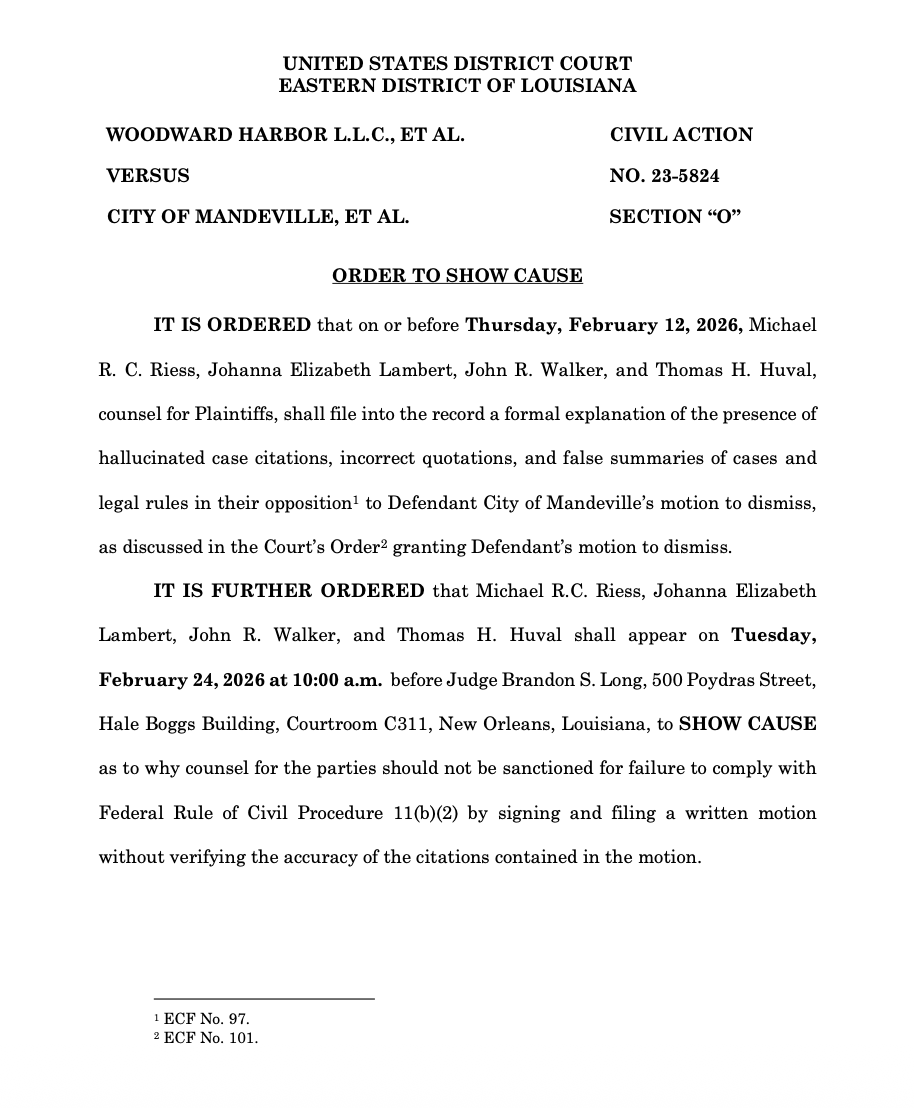
In the same order, Long sharply criticized the plaintiffs’ legal filings, finding that their opposition brief relied on non-existent court cases, false quotations, and inaccurate summaries of law, which he said violated attorneys’ obligations under Federal Rule of Civil Procedure 11.

The court ordered four attorneys for the plaintiffs to appear at a show-cause hearing Feb. 24 in New Orleans, where they must explain why they should not be sanctioned for submitting what the judge described as “hallucinated” legal authorities.


Lawsuit fully dismissed

The decision follows earlier rulings that had already eliminated most of the case.

In March, the court dismissed all claims against Zuckerman individually, holding that he was entitled to qualified immunity for actions taken in his role as an elected official. The court also previously dismissed federal and state takings claims, along with due-process claims against the city.

Wednesday’s ruling disposed of the remaining equal-protection and declaratory-judgment claims, concluding that the plaintiffs failed to identify similarly situated comparators and failed to overcome the city’s rational basis for denying the development.

The court found that concerns raised by council members — including traffic, scale, density, neighborhood compatibility, noise, and public safety — provided lawful and rational grounds under Mandeville’s zoning ordinance for rejecting the project.

Because the court determined the defects in the plaintiffs’ claims could not be cured, it dismissed them with prejudice and denied leave to amend.


Sanctions hearing ordered

In unusually direct language, Long said the plaintiffs’ filings undermined the integrity of the judicial process and wasted court resources.

The court ordered Michael R. C. Riess, Johanna Elizabeth Lambert, John R. Walker, and Thomas H. Huval, counsel for the plaintiffs, to file a written explanation addressing the presence of fabricated case citations and to appear in person on Feb. 24 before the U.S. District Court in New Orleans. The attorneys were ordered to show cause why they should not be sanctioned under Federal Rule of Civil Procedure 11 for submitting legal arguments supported by non-existent cases, incorrect quotations, and false summaries of law.

The judge noted that courts across the country have sanctioned attorneys for submitting fictitious, AI-generated case citations, and said the conduct alleged in this case warranted further scrutiny.

The upcoming hearing will determine whether sanctions are imposed and, if so, what form they may take. Potential sanctions under Rule 11 can include fines, payment of opposing counsel’s fees, or other disciplinary measures.

The court ordered Michael R. C. Riess, Johanna Elizabeth Lambert, John R. Walker, and Thomas H. Huval, counsel for the plaintiffs, to file a written explanation addressing the presence of fabricated case citations and to appear in person on Feb. 24 before the U.S. District Court in New Orleans. (Mandeville Daily graphic)

Background

The lawsuit stemmed from the Mandeville City Council’s unanimous 5-0 vote in September 2023 rejecting an ordinance that would have approved the Sucette Harbor project, a proposed mixed-use development along Lake Pontchartrain.

After the vote, the developers sued the city and Zuckerman in federal court, alleging constitutional violations related to zoning, land use, and equal protection.

With Wednesday’s judgment, all claims in the case have now been dismissed, bringing the litigation to a close unless appealed.

-30-
Mandeville Daily stories to appear in print in new ‘Southern Reveille’ edition

Partnership brings Mandeville-focused local reporting to weekly print readers

MANDEVILLE — Beginning with its January 16th issue, The Southern Reveille has launched a weekly Mandeville, Louisiana, print edition, and select Mandeville Daily news coverage will now appear in its pages.

The expansion brings Mandeville-focused reporting into print as part of the Reveille’s new Northshore edition, offering readers a traditional newspaper option alongside Mandeville Daily’s digital coverage. Select stories published by Mandeville Daily will be edited for print and distributed weekly to subscribers in Mandeville.

Founded in 1851, The Southern Reveille is based in Port Gibson, Mississippi, and serves Claiborne County as a community newspaper. The new Mandeville edition marks the paper’s first regular print presence in Louisiana and reflects a broader effort to support local journalism in communities that have seen a decline in traditional news outlets.

Kelly Sullivan, Publisher, Southern Reveille. (Mandeville Daily)

Publisher Kelly Sullivan said the new Mandeville edition is rooted in both tradition and forward-looking local journalism. “Born of a deep love for storytelling, truth-telling, and Southern voices, this paper is both a continuation and a fresh start,” Sullivan said. “My goal is to honor what came before while shining a smart, steady light on what’s next.”

William "Wild Bill" Kropog, Editor Emeritus and Publisher, Mandeville Daily. (Mandeville Daily)
William “Wild Bill” Kropog, Editor Emeritus and Publisher, Mandeville Daily. (Mandeville Daily)

Mandeville Daily will continue to operate independently as a digital-first local news outlet, covering City Council meetings, ordinances, public safety, development and community events. The print partnership allows that reporting to reach additional readers who prefer or rely on a physical newspaper.

The Mandeville edition of The Southern Reveille is published weekly. Subscription information is available through the newspaper’s website.

-30-
Council unanimously adopts sweeping parade, event overhaul

Queer Northshore warns new rules could force Pride parade out of Mandeville

Ordinance removes council, mayor authority to waive fees

Biggest changes mostly affect lakefront parades, not other events

MANDEVILLE — The Mandeville City Council on Thursday unanimously adopted a sweeping overhaul of the city’s parade and special-event rules, a move supporters said will modernize safety standards and create a more predictable system for recovering city costs tied to large events.

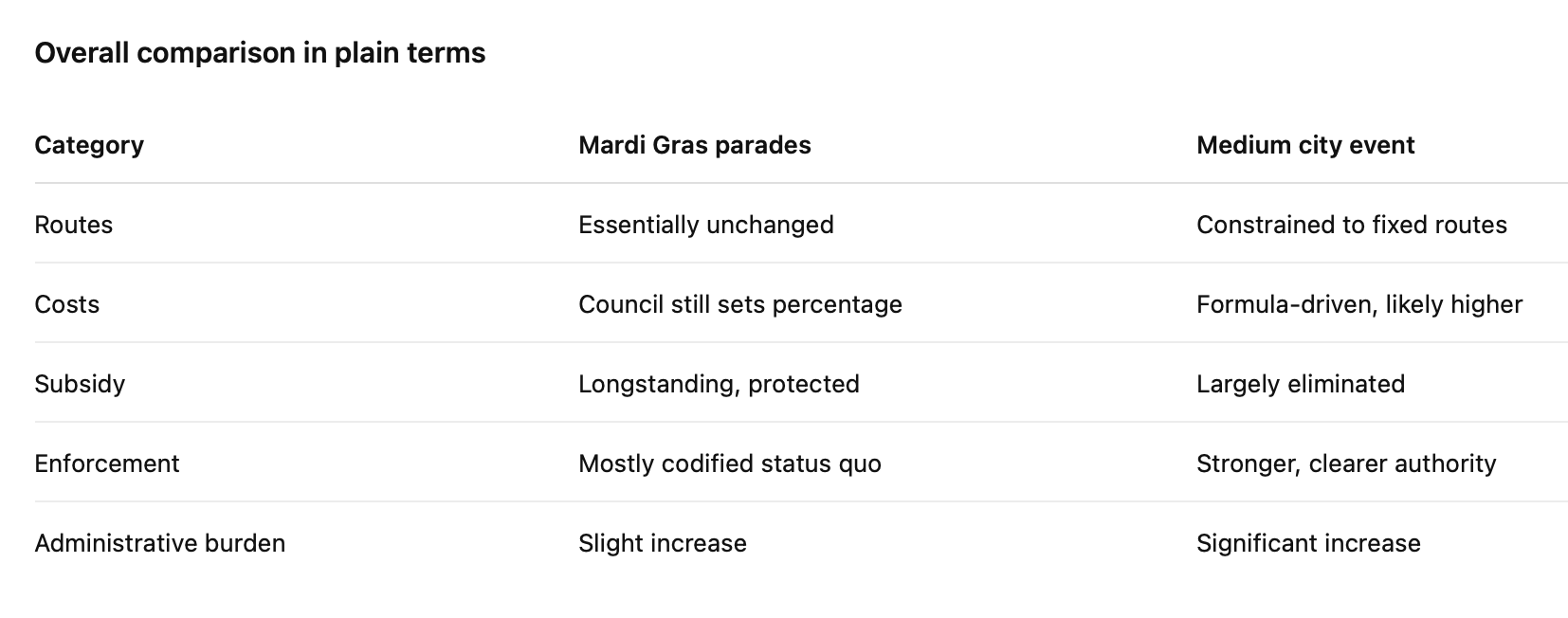
Ordinance 25-34 will fundamentally reshape how most non-Mardi Gras parades and special events are permitted, routed and paid for, shifting Mandeville to an attendance-based, formula-driven fee structure that could push the cost of large lakefront parades into the tens of thousands of dollars.

The ordinance also removes the ability of the City Council and mayor to waive fees, requiring equal treatment of all applicants.

The vote followed a relatively brief discussion where concerns about growing event sizes and neighborhood impacts were weighed against fears the new system could discourage community-based events.

Leyla Hekmatdoost, executive director of Queer Northshore, said the new fee structure could ultimately force the organization to move its Pride Parade — having rolled two years in a row — out of Mandeville due to the now-required fee structure. She argued that the event provides tangible economic benefits to the city, particularly for local businesses along the parade route. (City of Mandeville)

Leyla Hekmatdoost, executive director of Queer Northshore, said the new fee structure could ultimately force the organization to move its Pride Northshore parade — having rolled two years in a row — out of Mandeville due to the now-required fee structure. She argued that the event provides tangible economic benefits to the city, particularly for local businesses along the parade route.

“We feel like we bring value to the city with local businesses profiting as well as tax revenue, so if it became apparent that we would have to pay $20,000 for us to have a parade, we would have to look at a new location,” Hekmatdoost said. She added that relocating the event would come at a cost to Mandeville’s economy, noting that nearby businesses “would lose out on that new income they’ve had two years in a row.”

Mel Manuel (left) and Jeremy "JF" Thompson (right), former executive directors of Queer Northshore, echoed concerns that the new ordinance could effectively end the group’s ability to hold its Pride parade in Mandeville. Manuel said the potential cost of complying with the new fee structure could exceed what the organization can reasonably absorb. (City of Mandeville)
Mel Manuel (left) and Jeremy “JF” Thompson (right), former executive directors of Queer Northshore, echoed concerns that the new ordinance could effectively end the group’s ability to hold its Pride parade in Mandeville. Manuel said the potential cost of complying with the new fee structure could exceed what the organization can reasonably absorb. (City of Mandeville)

Mel Manuel and Jeremy “JF” Thompson, former executive directors of Queer Northshore, echoed concerns that the new ordinance could effectively end the group’s ability to hold its Pride parade in Mandeville. Manuel said the potential cost of complying with the new fee structure could exceed what the organization can reasonably absorb.

“If it’s true this is going to cost us $15,000 to $20,000 for this parade, that does represent fully half our annual revenue,” Manuel said. “I don’t know if we’d be able to do the parade here or not, just based solely on that.”

Under the ordinance, Mandeville will move away from its current discretionary approach to event permitting and instead require organizers to reimburse the city for public-safety and operational costs, including police, fire, EMS, sanitation and traffic control. Fees will be calculated in advance based on projected attendance and staffing needs, with the city retaining authority to bill additional costs if events exceed estimates.

The ordinance will also restrict most non-Mardi Gras parades to two predefined routes along Lakeshore Drive, tighten enforcement standards for participant behavior, and establish a new permit category for post-parade assemblies that significantly impact traffic or public spaces.

Although the ordinance does not assign specific dollar amounts, minimum-cost estimates based on the required staffing levels and typical municipal overtime rates indicate that a Lakeshore Drive parade turning up Girod Street with about 3,000 attendees could cost organizers approximately $15,000 to $20,000 or more, depending on final staffing and route conditions.

Post-parade gatherings will be limited to designated special-event areas such as the Mandeville Trailhead, Sunset Point Park or Lakeshore Park. Stationary activities extending beyond a typical parade disbandment — including events requiring police, EMS, sanitation or traffic control services, or involving amplified sound, vendors or alcohol — will require separate approval and, in most cases, a separate permit.

Traditional Mardi Gras parades will remain largely exempt, with existing routes, seasonal rules and City Council discretion over cost sharing left intact.

-30-
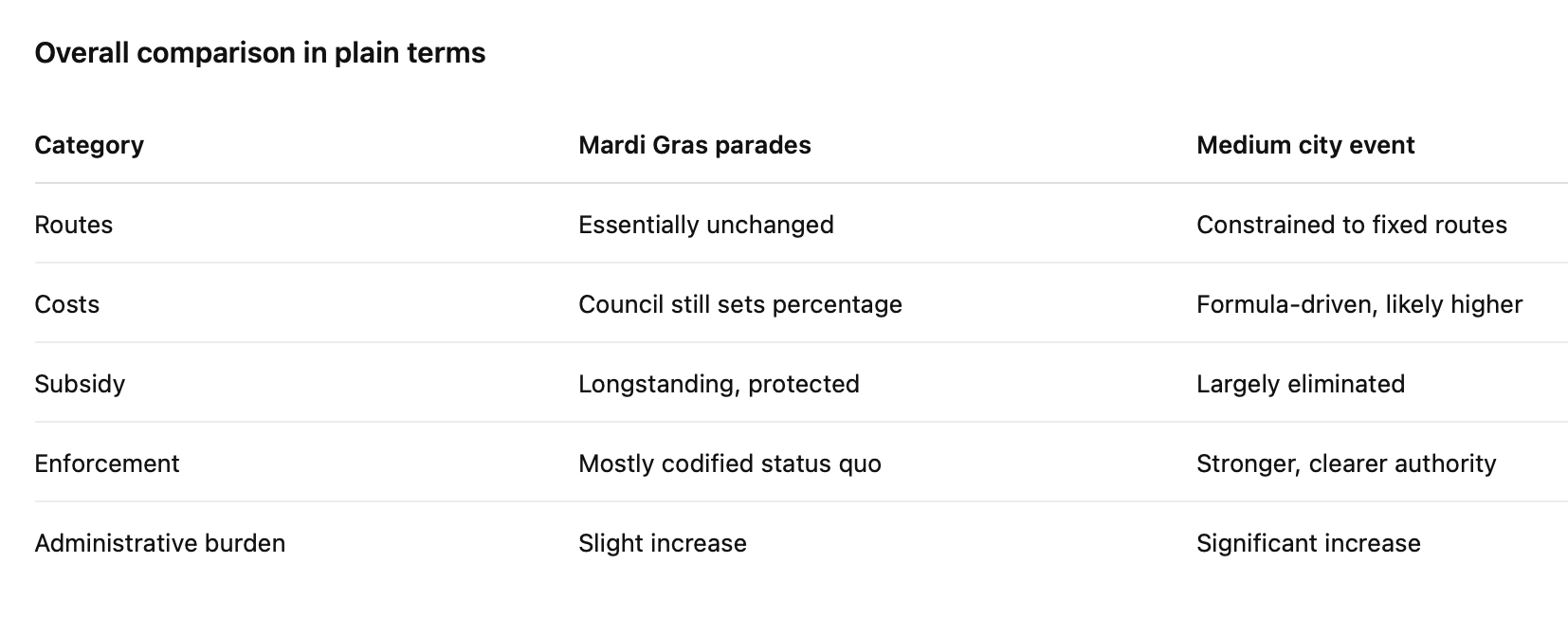
Mandeville’s ‘Wheelie Bandits’ strike again… and again… and again…

And again… and again… and again… and again… and again…

Teenagers on bikes weave in and out of traffic, events with impunity

Several near-accidents observed by locals, reporter

Similar activity reported in Slidell

Updated: See Community Note at bottom…

MANDEVILLE — A group of roughly five to 10 teenagers riding primarily electric bicycles — affectionately dubbed the “Wheelie Bandits” — has drawn growing concern in recent months for what residents describe as dangerous riding behavior through Old Mandeville, particularly along Girod Street and Lakeshore Drive.

Similar activity has been reported in other parts of the parish, particularly in Slidell, were Slidell Police Chief Daniel Seuzeneau is warning parents to intervene with their kids to prevent serious injury, and that he is going to start taking action by issuing tickets or charging the offenders.

A group has been frequently observed in Mandeville on weekends, and even almost daily during the recent holidays.

Affectionately dubbed the “Wheelie Bandits,” a group of teenagers ride electric bicycles and scooters through Old Mandeville, performing wheelies into oncoming traffic along Girod Street and Lakeshore Drive and near the Mandeville Trailhead. (Mandeville Daily)

Observers say the group rides a mix of e-bikes, regular bikes, with one or two riders occasionally using electric-powered scooters. The teenagers are frequently seen performing near-constant wheelies while traveling with — and often against — traffic on Girod Street, weaving in front of vehicles and forcing drivers to slow or stop out of fear that a rider could fall into the roadway and become seriously injured.

Locals have also expressed concern that the group’s constant presence and behavior is altering the character of the scenic old town area.

Mandeville Chief of Police Todd Schliem issued a statement to Mandeville Daily as follows: “I would like to echo [Slidell Police] Chief Seuzeneau’s statement regarding the reckless nature of some of our local kids when it comes to the operation of all types of bicycles. We have received several complaints regarding this issue and are taking it very seriously. Hopefully, we can get parents to talk to their kids about being more responsible. In the meantime, I would encourage anyone witnessing this type of behavior to immediately call the Mandeville Police Department.”

The activity appears to center around Girod Street, Lakeshore Drive and the Mandeville Trailhead, where the riders zip back and forth beneath the covered pavilion and across the grassy area in front of the stage, often maintaining wheelies for extended periods, especially down Girod Street or Lakeshore Drive, stopping traffic from time to time. The same gang was also photographed and filmed at a local gas station on Florida Street, displaying the same behavior.

Affectionately dubbed the “Wheelie Bandits,” a group of teenagers ride electric bicycles and scooters through Old Mandeville, performing wheelies into oncoming traffic along Girod Street and Lakeshore Drive and near the Mandeville Trailhead. (Mandeville Daily)

While on foot, this reporter witnessed an incident on Girod Street in which one of the teenagers riding in a wheelie position darted from a sidewalk into the path of an oncoming vehicle traveling on Girod Street, forcing the driver to slam on the brakes and sound the horn. The masked rider narrowly avoided impact, then turned and continued riding in a wheelie, showing no apparent reaction to the near collision.

Similar close calls have been reported to Mandeville Daily near Girod Street, an area that regularly sees heavy vehicle, pedestrian and bicycle traffic, particularly during evenings and weekends.

Residents say the behavior has continued for months with little apparent consequence, raising concerns about safety, enforcement and how these teenagers are behaving in shared public spaces. No injuries have been reported to Mandeville Daily, but residents worry the ongoing activity could result in a serious accident if it continues unchecked.

Affectionately dubbed the “Wheelie Bandits,” a group of teenagers ride electric bicycles and scooters through Old Mandeville, performing wheelies into oncoming traffic along Girod Street and Lakeshore Drive and near the Mandeville Trailhead. (Mandeville Daily)

Concerns were also raised by a local event coordinator who had reserved the trailhead facility for a pre-Christmas market featuring local artists and vendors. The coordinator said she attempted to ask the group to leave after observing the teenagers repeatedly riding their electric bicycles between vendor booths. According to the coordinator, her requests were ignored by the teens, and several of them plugged their e-bikes into electrical outlets in the middle of the vendor area to recharge during the event.

Many of the teenagers who have been observed were wearing helmets, often with face coverings, obscuring their identities and making it difficult for residents or event organizers to identify individual riders.

In Old Mandeville, residents say the repeated incidents underscore a familiar tension between preserving an open, family-friendly atmosphere and ensuring that visible disorder does not become an accepted part of the streetscape, as it apparently has with these “Wheelie Bandits.”


Community Note: We understand the concern expressed recently in social media comments concerning this coverage — on both sides of this issue. The images and videos used in the story were recorded in public spaces where there is no legal expectation of privacy. Additionally, we made every effort to distort identifiable faces or only to show imagery from a sufficient distance. The images and videos were submitted by multiple sources, primarily dash-cam footage.

In fact, certain up-close imagery of the wheelies into oncoming traffic provided by a confidential source was reviewed for verification purposes but was not published, both as a condition of access to the imagery and as an editorial decision to avoid singling out any one individual when the behavior involved multiple participants.

The behavior documented — including riding bicycles in so-called wheelie position into oncoming traffic — has resulted in documented near-collisions and poses a serious risk of injury to the riders and to motorists. We consulted Police Chief Todd Schliem before publication who confirmed certain details that had been passed on to us by other sources. He told us that his staff had already met and were planning a response to the behavior, irrespective of our intent to cover the issue. In other words, a police response was already in the works before our coverage.

With that said, we are disappointed in some of the comments on social media we are seeing in both directions. Name-calling and unfounded accusations and threats have no place in civil discord among neighbors. Thank you.


-30-
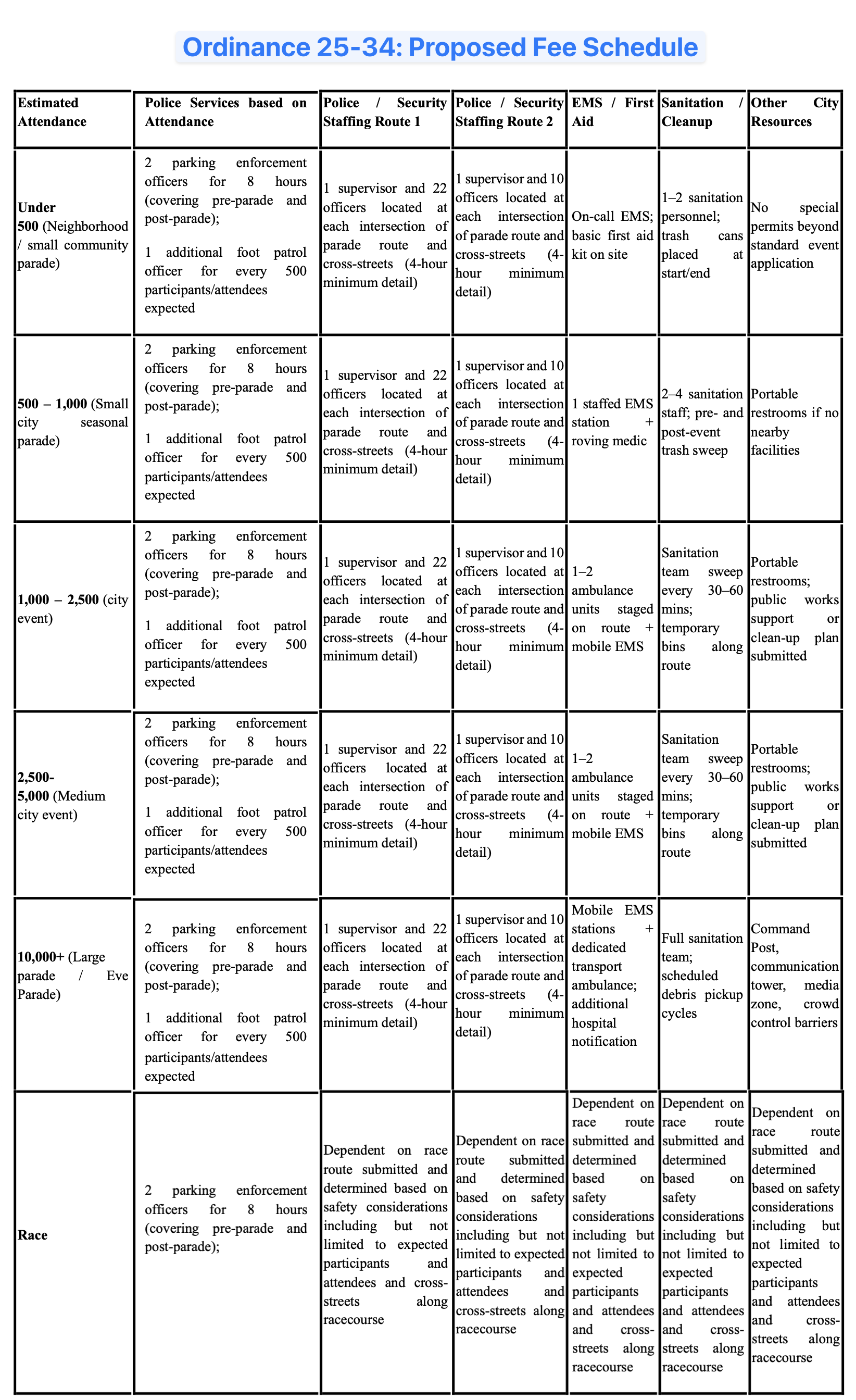
Big changes to lakefront parades, trailhead events up for vote

Would establish formula-based event fees but leave Mardi Gras parades largely unchanged

Heavy-turnout lakefront parades could face daunting financial obstacles

3K turnout could cost $20K

MANDEVILLE — A proposed rewrite of Mandeville’s parade and special-event rules — one that could push the price tag for large lakefront parades into the tens of thousands of dollars — is up for a vote at the January 8th City Council meeting.

Supporters say Ordinance 25-34 brings transparency, fairness and modern safety standards to a growing calendar of large events that often strain the Old Mandeville neighborhood. Critics contend the cost structure could discourage community-based parades and festivals by shifting major costs onto organizers.

The measure was formally introduced at the December 18th City Council meeting and would make sweeping changes to how most non-Mardi Gras parades and special events are permitted, routed and paid for.

As proposed, the ordinance would shift Mandeville away from its current discretionary approach to event permitting and toward an attendance-based, formula-driven system that requires organizers to reimburse the city for public-safety and operational costs such as police, fire, EMS, sanitation and traffic control. Fees would be calculated in advance, with the city retaining authority to bill additional costs if events exceed projected attendance.

The ordinance also would restrict most non-Mardi Gras parades to two predefined routes along Lakeshore Drive, tighten enforcement standards for participant behavior and create a new permit category for post-parade assemblies that significantly impact traffic or public spaces.

The two routes for non-Mardi Gras parades proposed by Ordinance 25-34. (Mandeville Daily)

While the ordinance does not assign dollar values, a minimum-cost estimate based on the required staffing levels and typical municipal overtime rates places the permit cost for a Lakeshore Drive parade turning up Girod Street with about 3,000 attendees at approximately $15,000 to $20,000 or more, depending on final staffing and route conditions as well as other factors that cannot be determined without more information.

Post-parade gatherings would be restricted to designated special event areas, such as the Mandeville Trailhead, Sunset Point Park, or Lakeshore Park. Additionally, any stationary activity that extends beyond the typical disbandment of the parade — requiring police, EMS, sanitation, or traffic control services, involving amplified sound, vendors, or alcohol — would require separate approval and, in most cases, a separate permitting process.

As an example, the Northshore Pride parade, organized by Queer Northshore, would likely be affected in this manner. Last year’s event followed a Lakeshore Drive route turning up Girod Street, with organizers publicly estimating attendance at more than 3,000 people, and concluded with a separate staged gathering at the Mandeville Trailhead. Under the proposed ordinance as written, that combination of attendance size, route configuration and post-parade activities would most likely trigger the higher cost and permitting requirements cited above, including separate approval for the trailhead event.

The Pride Northshore parade would likely be impacted by these changes, according to the group’s self-reported attendance from 2025, as found on the Queer Northshore website. (Mandeville Daily)

Traditional Mardi Gras parades would largely be exempt from the new framework, with existing routes, seasonal rules and council discretion over cost sharing left intact.

The impact of proposed Ordinance 25-34. (Mandeville Daily)

The January 8th City Council meeting will start at 6 p.m. in the Council Chambers at City Hall.

(Editor’s note: Mandeville Daily independently calculated the estimate in this piece using the staffing framework in the proposed ordinance, police overtime rates published in the city’s FY2026 adopted budget, and conservative assumptions for other services. The City of Mandeville has not issued an official cost estimate, and actual charges could differ materially.)

Ordinance 25-34: Proposed Fee Schedule. (City of Mandeville)

-30-

Proposed CLURO changes would reshape rezoning, conditional use, planned district reviews

Council seeks clearer, more transparent zoning framework after years of debate over large-scale proposals

Would alter path of future Sucette-like proposals if adopted

MANDEVILLE — Two interrelated zoning ordinances set for introduction by the City Council on January 8th would fundamentally change how major development proposals are brought before the public, requiring earlier council introduction, clearer limits on density calculations, and a single ordinance-driven review process from start to finish.

If enacted into law, the proposed ordinances would dramatically reshape how rezoning, conditional use permits, planned districts and mixed-use marina developments are evaluated, a shift that — had it been in place in 2023 — would likely have altered the timing, structure and public visibility of the Sucette Harbor application process.

The ordinances — 26-02 and 26-03 — are authored by Councilman-at-Large Jason Zuckerman and co-sponsored by District II Councilman Kevin Vogeltanz and are designed to work together. One focuses on how applications move through the city’s review process, while the other clarifies what land area may be counted when calculating density, units and parking in mixed-use developments.

Introduction is a procedural step required by law to notify the public that proposed ordinances are under consideration. No vote or discussion occurs at introduction; instead, the measures are published and will be scheduled for consideration and possible adoption at a later meeting.


Proposed Ordinance 26-02: Conditional use and planned district procedures

Ordinance 26-02 would amend the city’s Comprehensive Land Use Regulation Ordinance (CLURO) to restructure the procedural steps for rezoning, conditional use permits and planned district zoning. The changes are aimed at transparency and consistency rather than altering permitted uses.

Key elements include:

  • Council-first introduction of applications. Requests for rezoning, conditional use permits and planned district zoning would begin with the formal introduction of a proposed ordinance at the City Council, rather than originating solely as an application before the Planning Commission.
  • Applications framed as proposed ordinances. Each application reviewed by the Planning Commission would be required to include a draft ordinance detailing any rezoning requests, requested variances and development specifics, ensuring both bodies are reviewing the same document throughout the process.
  • Clarified public notice requirements. Public notice for conditional use permits and planned district developments would explicitly follow the same standards used for zoning amendments.
  • Limits on mid-process changes. Amendments or conditions proposed during Planning Commission review would not require restarting the process unless the original purpose of the proposed ordinance is fundamentally changed. Nothing in the proposal changes the fact that the Council may either agree or disagree with the Commission’s recommendations and may amend the ordinance as it sees fit without the need to restart the review process with the Planning Commission. The Council retains the authority to reject the proposed ordinance entirely, even if approval is recommended by the Planning Commission. Only if the actual purpose of the ordinance that was introduced, after amendments, no longer reflects the original intent of the ordinance that was advertised, would the process need to restart.
  • Clarified role of Planning Commission recommendations. The ordinance would require the Planning Commission to transmit clear recommendations to the City Council, including any conditions it supports, but would not require the commission to draft or propose specific ordinance amendments. The commission may suggest modified language if it chooses, but final ordinance drafting would remain the responsibility of the City Council.
  • Expanded application of supermajority voting rules. The ordinance would broaden existing four-fifths voting requirements to apply when proposed conditional uses or planned districts are adjacent to any residentially zoned property, rather than limiting the provision to single-family (R-1) neighborhoods, extending those protections to multifamily residential neighbors as well.

Proposed Ordinance 26-03: Mixed-use marina and planned district calculations

Ordinance 26-03 would amend definitions and development standards within marina and planned district zoning to clarify how site area, density and related calculations are performed for mixed-use projects.

Key elements include:

  • Revised definition of ‘lot area.’ For properties with more than one proposed or permitted use, only the portion of the site designated for each specific use could be used when calculating density, building area and parking.
  • Limits on density in marina districts. In both PM-1 (waterfront) and PM-2 (non-waterfront) Marina Districts, allowable units and building area would be calculated using only the land area assigned to each use, rather than the total acreage of a mixed-use site.
  • Exclusion of water and flood-prone areas. Areas extending into Lake Pontchartrain or other water bodies, wetlands and land subject to periodic inundation would be excluded from lot-area and density calculations.
  • Residential standards preserved. Residential portions of marina developments would continue to follow R-2 Two-Family Residential standards, preventing marina zoning from being used to increase residential density.
  • Clarified limits on planned district flexibility. While planned districts may still allow flexibility in design standards, each individual use would be required to obtain its own conditional use approval and comply with use-specific site-area calculations.
  • Uniform rules for combined-use developments. Parallel language would apply the same area-calculation rules across marina and planned district zoning to eliminate ambiguity.

How the ordinances work together

Taken together, the two measures align process and substance. Ordinance 26-02 restructures the review pathway so conditional use and planned district applications are introduced and tracked as ordinances from the outset. Ordinance 26-03 tightens how density and site area are calculated within that process, limiting the ability to use overall site size — including water or flood-prone areas — to increase development intensity.

Once introduced January 8th, both ordinances will be published and scheduled for future public hearings and council votes at a subsequent meeting or meetings.

-30-

Proposed ordinance would overhaul Mandeville parade rules, shift costs to organizers

Establishes formula-based event fees but leaves Mardi Gras parades largely unchanged

Non-traditional parades would see spike

MANDEVILLE — A proposed rewrite of Mandeville’s special events rules would significantly change how Old Mandeville’s parades and festivals are permitted, routed and paid for, while leaving traditional Mardi Gras parades largely unchanged.

Ordinance 25-34, scheduled to be introduced at the December 18th City Council meeting, amends Article V of the city code governing parades, festivals and other special events. The measure seeks to modernize public safety rules, clarify permitting standards and ensure large, non-city-sponsored events do not impose unreimbursed costs on taxpayers.

If adopted, the ordinance would replace the city’s largely discretionary system with a structured, attendance-based framework that requires event organizers to reimburse the city for police, fire, EMS, sanitation and traffic-control costs. The practical effect would be most pronounced for newer or nontraditional parades.

Shift toward structured, cost-based permitting

Under current law, nonprofit events may have most or all city costs waived at the discretion of the mayor or City Council. There is no standardized fee schedule, and staffing levels are determined administratively. The current system has made it difficult for the city to control special-event-related costs or budget for them accurately, especially as more groups seek permits for events that can strain city resources depending on attendance.

Ordinance 25-34 would replace that system with an attendance-based framework requiring organizers to reimburse the city for police, fire, EMS, sanitation and traffic-control services. Permit fees would be calculated upfront based on projected attendance, route length and safety needs, with the city retaining authority to bill additional costs if attendance exceeds estimates.

The proposed fee structure contemplates staffing that includes parking enforcement officers for extended pre- and post-event coverage, additional foot patrol officers tied to attendance, and traffic-control staffing at route intersections, along with staged EMS coverage and ongoing sanitation sweeps.
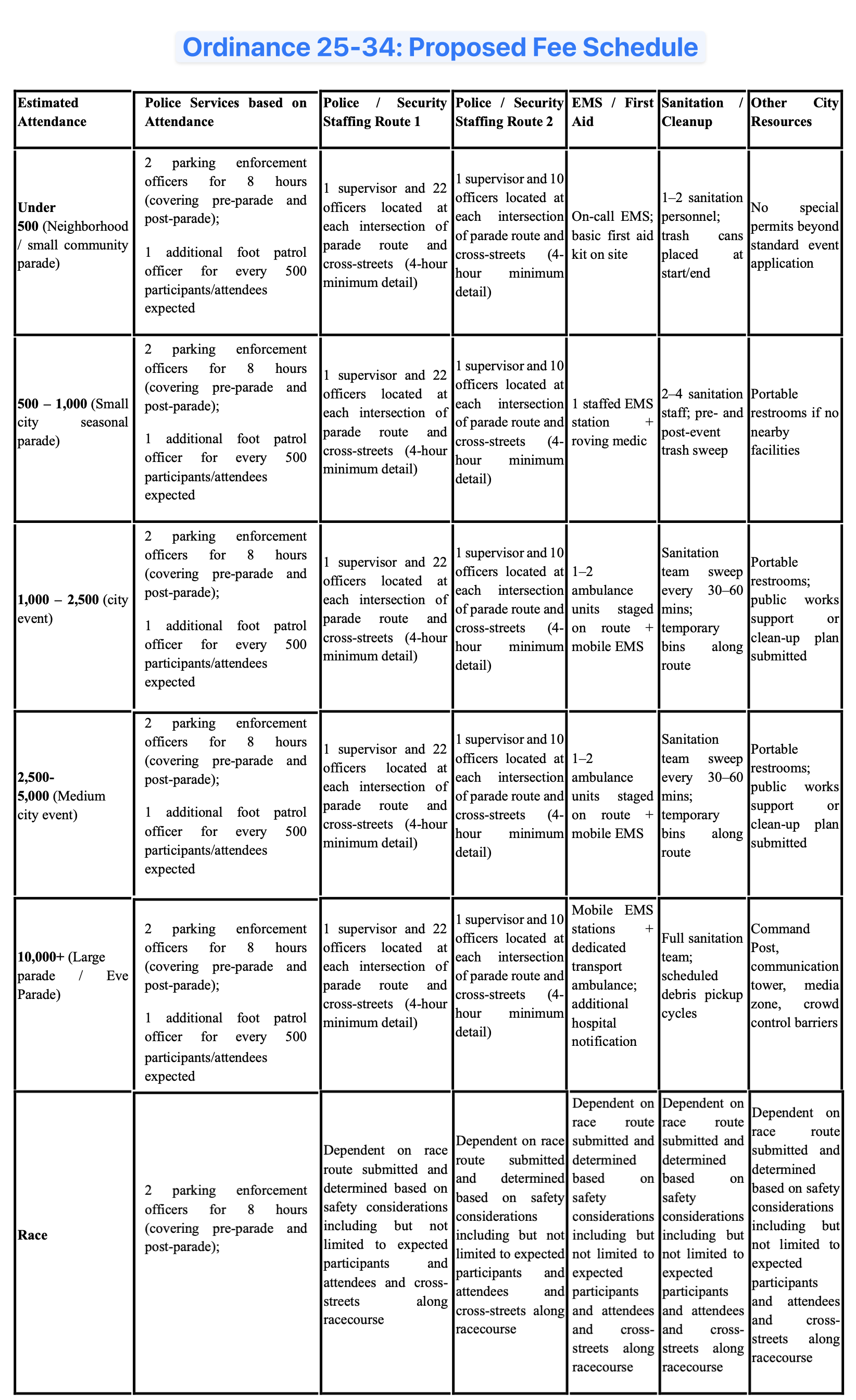
The ordinance also anticipates added costs for crowd-control barricades and vehicle-control measures, including temporary no-parking signage.

While the ordinance does not assign dollar values, a minimum-cost estimate based on the required staffing levels and typical municipal overtime rates places the permit cost for a Lakeshore Drive parade turning up Girod Street with about 3,000 attendees at approximately $15,000 to $20,000 or more, depending on final staffing and route conditions as well as other factors that cannot be determined without more information.

(Editor’s note: Mandeville Daily independently calculated this estimate using the staffing framework in the proposed ordinance, police overtime rates published in the city’s FY2026 adopted budget, and conservative assumptions for other services. The City of Mandeville has not issued an official cost estimate, and actual charges could differ materially.)

Ordinance 25-34: Proposed Fee Schedule. (City of Mandeville)

Route limits and enforcement

The ordinance would limit most non-Mardi Gras parades to two predefined public parade routes along Lakeshore Drive, with fixed staging and termination points.

While many conduct rules already exist in city code, the ordinance strengthens enforcement mechanisms by more clearly authorizing police and parade marshals to remove participants for indecent behavior, intoxication or safety violations. It also expands no-parking rules, clarifies sanitation minimums and codifies authority to cancel events due to weather or safety threats.

Post-parade assemblies permitted separately

The proposal creates a new category for “public assemblies,” requiring permits for organized gatherings expected to obstruct traffic or normal public use. Those permits would be tied to fixed locations, would require indemnification and cleanup commitments, and would be subject to cost recovery for public safety services.

Any post-parade gathering would be confined to designated special event areas such as the Mandeville Trailhead, Sunset Point Park or Lakeshore Park and would require separate approval — and in most cases a separate permit — if the activity is stationary, extends beyond normal parade disbandment, requires police, EMS, sanitation or traffic control services, or involves amplified sound, vendors or alcohol.

Mardi Gras parades largely unaffected

Traditional Mardi Gras parades would see comparatively little change. Established routes, seniority rules, float requirements and seasonal timing remain in place.

The City Council would continue to determine what percentage of city costs Mardi Gras organizations pay, preserving the city’s longstanding cost-sharing structure for those parades.

The impact of proposed Ordinance 25-34. (Mandeville Daily)

Debate ahead

Supporters argue the ordinance brings transparency, fairness and modern safety standards to a growing calendar of large events that often strain the Old Mandeville neighborhood. Critics contend the cost structure could discourage community-based parades and festivals by shifting major costs onto organizers.

Ordinance 25-34 is scheduled only for introduction at the City Council’s December 18th meeting. Ordinances are not debated or voted on at the meeting where they are introduced, but must be formally introduced in advance of a later meeting where they would debated and voted on.

-30-

Mandeville council agenda includes water and sewer rate discussion

Street changes, special event rules and capital budget amendments to be introduced

MANDEVILLE — Discussion of recently implemented water and sewer rate changes is included on the agenda for Thursday’s Mandeville City Council meeting, which also features several ordinance introductions and a full slate of routine city business.

The City Council unanimously adopted changes to its water and sewer billing system at the January 9th meeting earlier this year, a long-planned update that took effect this fall and resulted in higher initial bills for some customers, particularly high-volume users, during the rollout period.

The water and sewer rate discussion appears under new business, at the request of Councilman-at-Large Scott Discon. While no formal vote is scheduled, the agenda item gives council members an opportunity to publicly review and question rate adjustments that have already gone into effect.

In addition to the rate discussion, the council will introduce four ordinances. Ordinance 25-31 would revoke the public dedication of a portion of Harold Street between Albert and Colbert streets, declare the segment surplus and authorize its sale at private sale. 

Council members will also introduce Ordinance 25-32, which would establish one-way traffic on the 800 block of Penn Street. 

Ordinance 25-33 proposes an amendment to the city’s capital budget to address Jackson Avenue bulkhead repairs, while Ordinance 25-34 would amend the city code governing parades, festivals and other special events — a topic that has drawn increasing attention as the city reviews permitting and public-safety requirements. 

The agenda also includes proclamations recognizing January 2026 as Blood Donor Awareness Month and America’s upcoming 250th anniversary, followed by a finance report from Jessica Farno and a projects-in-progress update from Public Works Director Keith LaGrange covering more than a dozen ongoing infrastructure projects. 

Consent agenda items include special event permits, liquor license approvals, project completion certificates and contract-related resolutions. The council is also scheduled to consider a parks commission reappointment and a resolution authorizing a professional services agreement for comprehensive land use regulation ordinance revision services. 

The council is scheduled to meet at 6 p.m. Thursday, December 18th, at Mandeville City Hall, 3101 E. Causeway Approach, according to the posted agenda. 

-30-

OPINION | The fight over special districts: autonomous or above the law?

Mosquito district’s governance fight highlights broader dilemma: When do appointed commissions become immune to oversight?

Editorial

At the heart of the debate over appointed boards and special districts lies a fundamental question of representative government: how much authority can an elected legislative body delegate before it begins to surrender powers the constitution expects it to exercise? In Louisiana’s parish-president and council-mayor systems, councils hold the purse strings. They levy taxes, adopt budgets, and set spending priorities. Yet the state’s landscape is dotted with autonomous boards and districts — governing mosquito control, drainage, water, recreation and more — that operate with their own millages and policymaking authority, often beyond the direct reach of the officials voters elect.

The St. Tammany Parish Mosquito Abatement District highlights that tension. Its five-member volunteer board, appointed by the parish’s elected leadership, sets the district’s millage rate annually and manages a tax-funded operation with professional staff and millions in assets. That structure provides stability and shields technical work from day-to-day politics. But it also raises the question: when a board’s financial decisions stand apart from the council that levies taxes parish-wide, where does voter accountability ultimately reside?

This fight over special districts: Autonomous or above the law? (Mandeville Daily)

Mandeville grappled with issue in 2023

That concern is not new in St. Tammany Parish. Mandeville confronted a similar issue in 2023, when city officials debated reviving a now-defunct Financial Oversight Committee with an expanded mandate. Critics argued the proposal would have effectively transferred core budgetary powers from the elected City Council to an appointed advisory body, forcing the council to adopt spending recommendations it did not originate and could not amend, thereby usurping the budgetary authority placed in council members by the voters. Opponents warned that such a shift could violate the separation of powers required by the city charter and the state constitution. The council ultimately rejected the proposal.

Both cases underscore a structural dilemma. Appointed commissions can offer expertise and continuity, and voters often approve the millages that fund them. But when those bodies set tax rates, influence spending or initiate policy in ways that bind or bypass the elected legislative branch, the risk is not just operational drift — it is democratic drift. The more authority shifts to entities that voters cannot remove, the harder it becomes to ensure transparency, enforce oversight or determine who is accountable when disputes arise.

Mosquitos fighting back

The tension surfaced most visibly with the mosquito abatement district, when a recent push by some parish council members to rein in spending and consolidate budgets led to an unsuccessful effort to remove several of the district’s commissioners. The dispute escalated after District Attorney Collin Sims publicly criticized the district’s spending and conduct, following the district’s decision to file a complaint with the Louisiana Attorney Disciplinary Board over Sims’ role on St. Tammany’s DOGE-style transparency committee, which had been reviewing its finances.

The district even filed a lawsuit seeking an injunction to stop the parish from investigating the district’s finances, arguing the probe is politically motivated and intended to exert control over its dedicated tax dollars.

At the same time, a small but vocal group on social media — including some with ties to the district or who previously served on it — has been stoking public anger at elected officials for exercising their one remaining constitutional lever of control: the power to appoint and remove. The result is a narrative increasingly distorted and potentially dangerous.

Are we to accept, at face value, that once a committee, board or district is appointed and funded with its own long-term special tax, it is no longer answerable to the public or to the body that created it, or to any law enforcement official, not even a duly appointed financial review committee?

Autonomous or above the law?

It defies logic to argue that the parish’s chief law enforcement officer has a conflict of interest simply for reviewing the finances and operations of an appointed commission in the parish he serves. Likewise, it is untenable to claim that the appointing authority — the parish council — is somehow barred from examining the finances of a district funded with taxpayer dollars, the very taxpayers who elected them to provide said oversight in the first place.

The mosquito abatement district is a public body under Louisiana law, which holds that any board, committee, commission or entity created or appointed by an elected public body becomes a public body itself. As such, it is subject to the state’s Open Meetings Law (RS 42:11-28) and Public Records Act (RS 44:1-41), just as the parish council and every other public body is. Any resident has the right to request and obtain its financial records — a standard that applies all the more to the district attorney and the parish council.

Ultimately, voters should ask themselves a deeper question: when does the autonomy granted to a specialized district funded by dedicated tax dollars begin to resemble immunity from scrutiny? And if this publicly funded commission can reject oversight from both the parish council and the district attorney — even going to court to do so — has it not already crossed into a status no public body should ever hold: one that is, in practice, above the law?

-30-

Madden touts fall events, upcoming projects in holiday message

‘Madden Minute’

MANDEVILLE — Mayor Clay Madden took to his November 19th “Madden Minute” to express his gratitude to residents, city staff, and volunteers for their contributions during the busy fall season. He also unveiled Mandeville’s holiday lineup, aptly named “Merry Mandeville.” This festive event will commence on December 5th and extend through December 19th, featuring a variety of activities such as Sips of the Season, Winter on the Water, a holiday market, and the annual menorah lighting ceremony.

In addition to acknowledging the community’s efforts, Madden also highlighted several new or recently opened businesses in the city. These include Creative Cakes, Bub’s Burgers, the Gastro Group, and Endocenter, all located on St. Ann. He assured the public that more business announcements will be made in the future.

The mayor then provided an update on several significant infrastructure projects that are currently underway. The Highway 22 Drainage Project, which is largely funded through state capital outlay dollars with parish support, has commenced utility relocations. Furthermore, work is also underway in the Sunset Point area, involving the demolition of the hurricane-damaged fishing pier and the subsequent construction of a replacement.

Mayor Clay Madden announced that the Lakefront Wetlands Restoration Project, commonly known as 'the berm,' is nearing completion and is anticipated to be finished by Christmas. (Mandeville Daily)
Mayor Clay Madden announced that the Lakefront Wetlands Restoration Project, commonly known as ‘the berm,’ is nearing completion and is anticipated to be finished by Christmas. (Mandeville Daily)

Madden expressed optimism about the Lakefront Wetlands Restoration Project, commonly referred to as “the berm.” He mentioned that the project is nearing completion and is expected to be finished before Christmas. He emphasized the state’s strong interest in the project and its potential to secure future grants for the city.

In his closing remarks, Madden extended his heartfelt gratitude to Mandeville’s veterans. He acknowledged the recent ceremonies and the unwavering support provided by the community in honoring their sacrifices.

-30-

City Council to review event permits, infrastructure updates

Meeting agenda: November 20th, 2025

MANDEVILLE — The Mandeville City Council is set to tackle a full agenda Thursday, November 20th, with a slate of holiday event permits, infrastructure project updates and multiple contract approvals scheduled for consideration. The meeting begins at 6 p.m. at Mandeville City Hall.

Below is a breakdown of all items on the agenda.

Click here to download the agenda packet.


Minutes

Council members will be asked to adopt:

  • October 23rd, 2025, regular meeting minutes
  • November 4th, 2025, special meeting minutes

Introduction of ordinances

No new ordinances are listed for introduction.


Reports and announcements

The agenda lists time for general reports and a message from Mayor Clay Madden.


Presentations

No formal presentations are scheduled.


Finance report

Finance Director Jessica Farno will deliver the city’s monthly financial update.


Projects in progress

Public Works Director Keith LaGrange is scheduled to brief the council on the status of 13 active infrastructure projects:

  1. Lift Station A (Montgomery & Dupre) and Lift Station 27 (Mandeville High Blvd.)
  2. Seawall Repair – Segment 1
  3. Harbor Gazebo
  4. Lakefront Wetlands Restoration (“Berm”)
  5. Old Golden Shores Drainage
  6. Girod Street landscaping and lighting
  7. LA 22 drainage improvements
  8. Sunset Point fishing pier demolition
  9. Wastewater treatment plant disinfection system upgrades
  10. 2022/2025 roadway and drainage maintenance
  11. 2024 water and sewer maintenance
  12. 2022/2025 asphalt maintenance
  13. 2022/2025 striping maintenance

Consent agenda

The consent calendar is heavy with end-of-year and early-2026 event requests, largely requiring certificates of insurance, ATC approvals and coordination with MPD and Public Works.

  1. Mande Milkshakers — “Merry Mande Tea” (Dec. 7, 2025)

Location: Mandeville Trailhead
Includes special event and alcohol permit, plus approval to apply for an ATC permit.

  1. Mande Milkshakers — “Mande Kings Day Parade & Festival” (Jan. 10, 2026)

Parade at 2 p.m., festival at 3 p.m., running from the Lakefront to the Trailhead.
Requests include parade route approval, ATC authorization and coordination with MPD and Public Works.

  1. Old Mandeville Business Association — “Sips of the Season” (Dec. 5, 2025)

Location: Girod Street
Includes event and alcohol permit, event map approval and permission to leave Port-O-Lets in place for “Christmas Past.”

  1. OMBA — “Christmas Past Festival” (Dec. 13, 2025; rain date Dec. 14)

Location: Girod Street
Requests include map approval and departmental coordination.

  1. Junior League of Greater Covington — “Carnival Couture” (Jan. 16, 2026)

Location: Fleur De Lis Center (private event)
Alcohol permit request requiring ATC approval.

  1. Approval of 2026 council meeting dates

Sponsored by Councilman Zuckerman.

  1. Liquor license approval — Courtyard Bistro

Sponsored by Councilman Vogeltanz.

  1. Change Order No. 1 — Lakefront Wetlands Restoration (Berm)

Increases the contract by $2,612.50 and extends the project by 50 days due to modified grass mix and acceptance of a marsh-creation bid alternate.

  1. Resolution 25-56 — Amendment No. 1 to Tetra Tech debris-monitoring contract

Authorizes Mayor Madden to execute the amendment.

  1. Resolution 25-57 — Amendment No. 2 to High Tide Consultants contract

Covers Old Golden Shores drainage improvements.


Unfinished business

No unfinished business is listed.


New business

  1. Parks and Parkways Committee appointment

The council will deliberate and may appoint a new committee member.

  1. Resolution 25-58 — 2025 Asphalt Maintenance Contract

Would award the contract to Donahoe Construction, LLC, the apparent low bidder.

  1. Resolution 25-59 — Rehabilitation of Lift Stations 19 (Weldon Park) and 32 (Shadows)

Would award the contract to Subterranean Construction, LLC, the apparent low bidder.


Adjournment

The meeting notice was posted November 13th at City Hall. Residents needing ADA accommodations may contact the Council Clerk at (985) 624-3145.

-30-

Mandeville High placed on lockdown after shooting threat hoax

Police chief says response was ‘spot on’ and no danger was found

MANDEVILLE — Mandeville High School was placed on lockdown just before 1 p.m. Wednesday after an anonymous caller claimed someone was on their way to commit a shooting at the school, according to Mandeville Police Chief Todd Schliem.

Police and fire crews responded immediately, securing the campus alongside school officials under the city’s standard emergency procedures. The threat was later determined to be a hoax, Schliem said.

Mandeville High School campus (file photo)

“We were able to secure the facility and determined there was no active threat,” Schliem told Mandeville Daily on Friday. “We train for this all the time. Our response was absolutely spot on.”

Schliem praised school administrators and the St. Tammany Parish School Board for their coordination during the incident. Parents reported on social media that the school district’s emergency messaging system was used to alert parents about the lockdown.

“We could not have a better working relationship than we do with the school district,” Schliem said. “Our level of cooperation and working hand in hand with the school district is fantastic.”

Mandeville Police Chief Todd Schliem (City of Mandeville)

Students were released at their normal dismissal time, though officers maintained a presence around the campus for the remainder of the day as a precaution, he added.

“You can never plan for all scenarios,” Schliem said, “but I feel we were in a good spot yesterday.”

Similar hoax threats were reported around the same time at schools in Ponchatoula and Hammond. Schliem declined to discuss specific tactical procedures but emphasized that his department followed standard protocol throughout the response.

-30-

COMMENTARY | ‘When every outcome is a conspiracy…’

A four-panel cartoon published by Mandeville Daily satirizes a familiar pattern on social media, where a small but vocal group of disgruntled citizens denounce every institution that rules against them. The cartoon offers commentary on how online outrage often intensifies in inverse proportion to public support, especially when criticism stems not from evidence, but from dissatisfaction with an undesired outcome.

-30-