

1984 state act says City Council has final say after Civil Service Board signs off
Council first votes to approve raise then separate vote to fund it
Council ‘no’ vote does not mean ‘unfunded mandate’
Contradicts board member’s statements from July 18th meeting
Editorial
Updated 8/7/2023 at 6:41 a.m. to include a reference to the first COLA from one year ago.
Does the Municipal Police Employees Civil Service Board have the authority to set police pay and then leave the City Council obligated to fund it, a notion we have been led to believe for years?
The presumption of absolute authority
During the July 18th joint Civil Service Board and City Council meeting, longtime board member Jack B. McGuire reminded everyone: “So this board has the authority to set the salaries of the police officers who are covered by the police system and that is our sole authority subject to funding by the City Council.”
McGuire then dropped a not-so-subtle hint to the City Council members in attendance about what could happen if they didn’t fund the request. He recounted the events of four years earlier when the Civil Service Board was asking for a 15-percent across-the-board increase but the City Council at that time initially only wanted to grant 3.5 percent.
“But thanks to a large number of city employees and police officers who attended some meetings then, the council eventually adopted 14.2 percent, which probably is the highest annual raise that we’ve ever had and that was made the same for non-employees and municipal employees,” McGuire said.
The joint meeting came about because this City Council put into law that a cost-of-living adjustment (COLA) would be proposed in the Mayor’s annual budget. This was on the heels of what many saw as a generous yet much-needed pay scale overhaul in 2022, where most city employees saw 10- to 40-percent raises, followed by the first annual COLA of 5.9-percent last year.
The peculiar story behind Act 84-164
But does the Civil Service Board have the authority to unilaterally set police pay and then if the City Council doesn’t fund it, it becomes an unfunded mandate?
The answer may be unsettling to some, but the evidence supporting the case we are about to make has been right under our noses the entire time. Here is the real story:
Mandeville was granted a special carveout of sorts in 1984 by the Louisiana State Legislature when it passed Act 84-164, creating a separate municipal police civil service board for Mandeville. The legislation describes the board’s responsibilities and duties, how they are appointed, and so on. It was amended in 2009 and again in 2017, mostly to change who appoints the police chief, how the board members themselves are appointed, and how the personnel director is hired.
McGuire referred to this act as if it were sacrosanct legislation:
“One [civil service system] for police was enacted by municipal ordinance of the board of alderman [which preceded the City Council form of government Mandeville now has] and was then to ensure that a future board of alderman meeting could not by a majority of vote repeal it, enshrined it in a state legislative act. So the police system is actually regulated by a state act. The only change that can be made in that is if you change the state act,” he told the council members in attendance that night.
But according to a copy of Louisiana Revised Statutes Act 84-164 obtained from the Law Library of Louisiana — as amended by Acts 09-418 and 17-83 — the personnel director, who is indirectly appointed by the Civil Service Board itself, creates the compensation plan which must be approved by the Civil Service Board after a public hearing, and then — you guessed it — also approved by the Mandeville City Council.
The text in Section 3 which lists the duties of the personnel director reads: “To develop and to administer a compensation plan for all positions in the classified civil service. Such compensation plan shall be effective only upon approval by the (Civil Service) board after public hearing thereon and approval by the municipal governing authority [the City Council].”
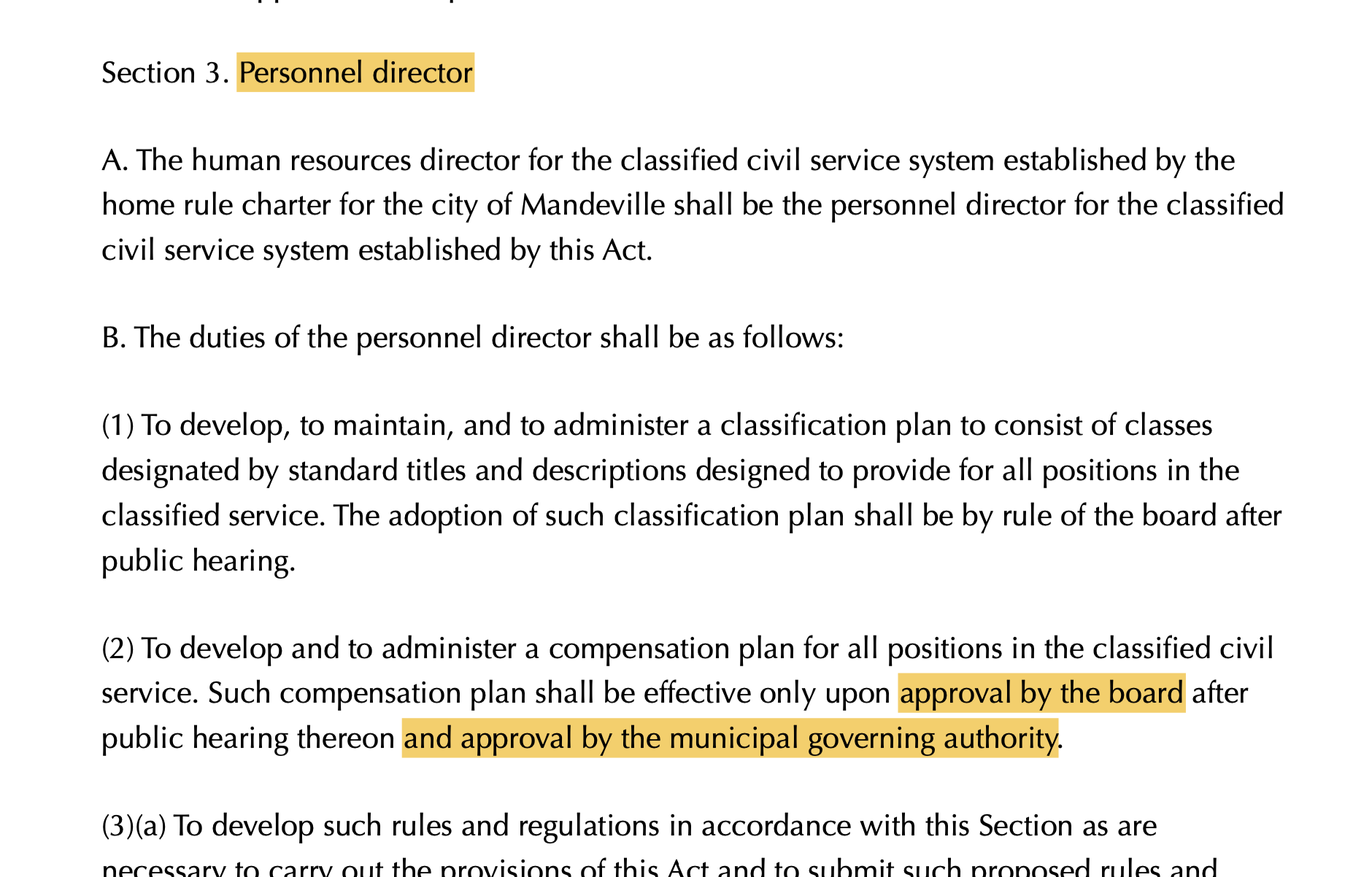

It is important to note that because Section 3 mentions that a duty of the Civil Service Board is to approve the compensation plan, that same duty is subsequently repeated under Section 4 which lists all the duties of the board. But this in no way means that only the Civil Service Board approves the compensation plan.
Talk of unfunded mandates
Perhaps this is what has led to a misunderstanding by some over the years. If one were to read or quote only Section 4, they might be inclined to misinterpret the entire act as saying the Civil Service board alone sets the pay scale. This is clearly not the case.
Up until this point, more than one city official has thrown around the term “unfunded mandate” as if the compensation plan for police would magically go into effect without an ordinance once the Civil Service Board approves it from the personnel director.
But as we can see now, this is clearly not what Act 84-164, Section 3 B(2) does. In fact, we only need to go as far back as February 2022 to prove it.
Council has always had right to just say ‘no’
The way city government works is, anytime they do something that requires spending money, not only do they have to pass an ordinance authorizing the thing they want to do, but then they have to adopt a second ordinance, called a budget adjustment, that gives them the money to do the thing they just approved. (Or they simply include the money in the next annual budget and wait until then to do the thing they want to do.)
This is exactly how the pay scale overhaul of February 2022 was done. The police raises were enacted by Ordinance 22-02. And then, at the very same council meeting, the money that funded those raises was approved in budget adjustment Ordinance 22-04.
But la pièce de résistance can be found in the wording of Ordinance 22-02:
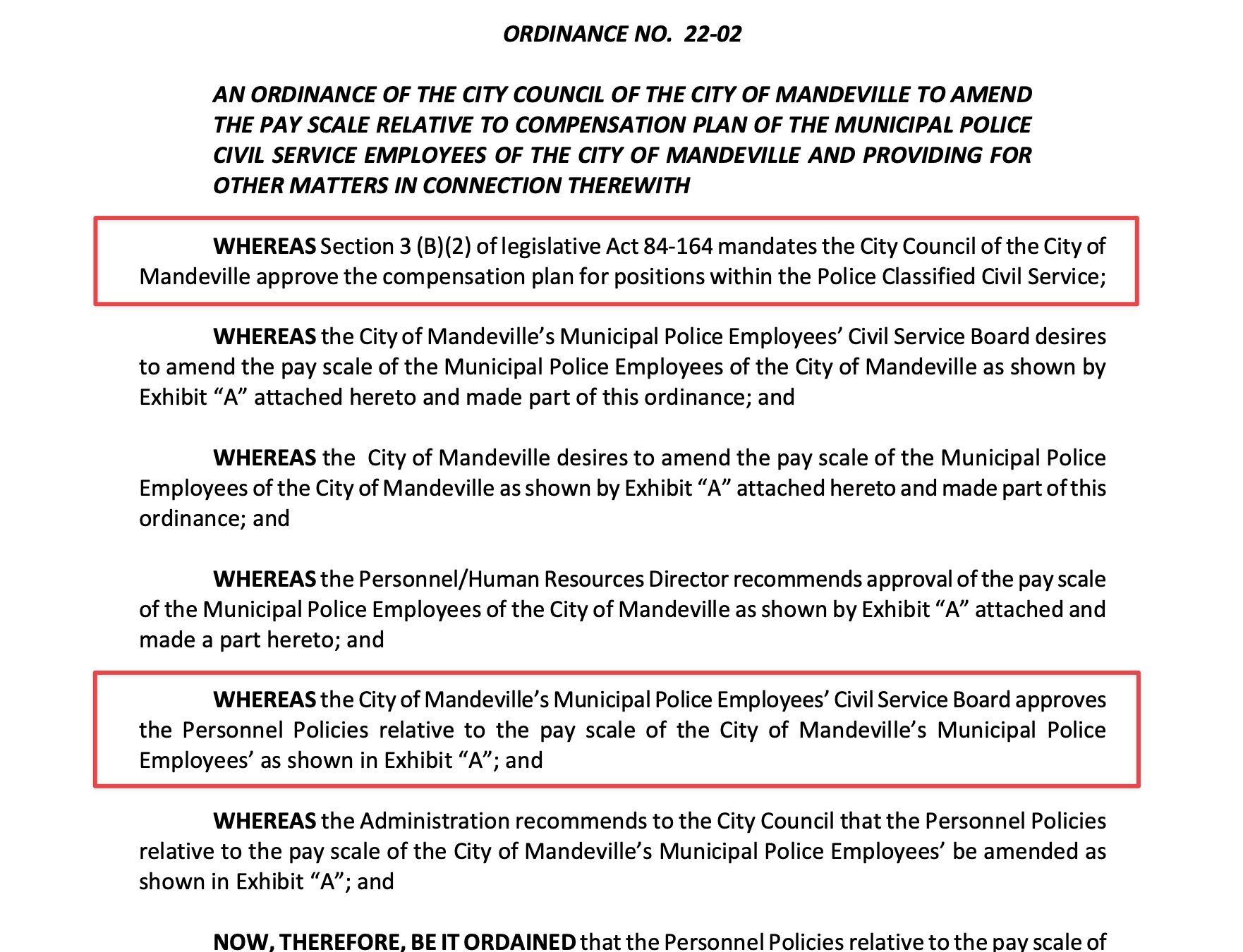
Notice the first and fifth “Whereas” clauses. These make our case.
Because Act 84-164 is specifically cited means the City is, and always has been, very aware of the role the Civil Service Board plays, and while that role is significant, it is still very limited. By the way, the exact same language was used in the first COLA adopted and funded roughly one year ago, Ordinance 22-24.
In other words, the City Council has to first approve the pay scale change in one piece of legislation, and then, in a completely separate act, they must approve to fund it. So it actually takes two different votes by the City Council to enact one pay scale change.
The only way it could ever become an unfunded mandate would be if the City Council were to vote for the pay scale change ordinance but then — for some weird reason — vote against the budget adjustment ordinance.
If what McGuire is saying were true, then the City Council wouldn’t have needed Ordinances 22-02 (pay scale overhaul) or 22-24 (first COLA); the raises would have simply become the law after the Civil Service Board approved them, leaving the City Council only a perfunctory duty in adopting budget adjustments for each.
But that’s not what the Act 84-164 says, and of course, that’s not what happened in 2022, or any other time a pay scale change has happened.
Act 84-164 gave Civil Service Board seat at the table
The only material thing Act 84-164 did when it comes to the police compensation plan was it ensured the Civil Service Board a role in negotiating police compensation plans.
Sure, it’s possible they could get a lone council member to introduce an ordinance without full council support, but it would simply fail, and there would be no raises, and there definitely would be no unfunded mandate.
This brings us back to the current situation and the debate over the proposed 5.8-percent COLA recommended by the Civil Service Board. Mayor Clay Madden had proposed a 2.7-percent COLA. What will happen August 7th when the two parties meet again?
Mandeville Daily has a strong suspicion they will come to an agreement on a new number. They’ll negotiate, just as Act 84-164 really intended they do.
The complete text of Louisiana Revised Statutes Act 84-164 — as amended by Acts 09-418 and 17-83 — can be downloaded here.
-30-
Related Stories:
Mandeville police, workers get historic raises in pay-scale overhaul (2/12/2022)
Mandeville’s lowest paid get less than market minimums (11/18/2021)
OPINION | Goodwill COLA gesture exposes delicate relationship with Civil Service Board

 Mandeville Daily