
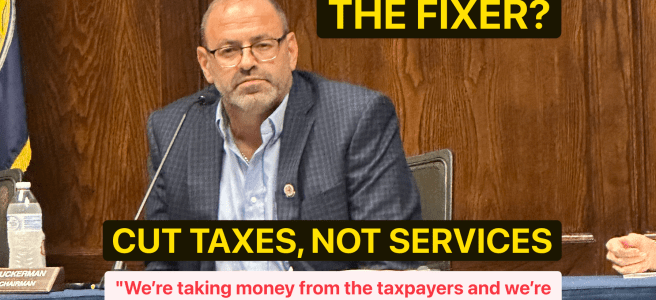
Says city collects $3.4M more per year than it spends
Excess money can’t be touched while general fund dwindles
2026 proposed budget 3% less than previous
City on track to be $2M under budget on operating expenses for 2025
MANDEVILLE — Councilman at Large Jason Zuckerman is proposing a sales tax reduction for Mandeville residents, arguing the city is collecting millions more than it spends and should return some of that money to taxpayers while still maintaining essential services.
At a budget hearing on July 23rd — the latest in a series before adoption of the city’s fiscal year 2025-2026 budget — Zuckerman laid out a plan to reduce the overall sales tax burden while shifting how the remaining tax revenue is divided among city funds. The goal, he says, is to stop overfilling restricted accounts while the general fund, which pays for most day-to-day operations, continues to shrink.
“The city is already collecting $3.4 million per year more than it spends,” Zuckerman said. “We can lower the tax rate and still fund core services — if we fix how that money is allocated.”
Zuckerman’s remarks came in stark contrast to Councilman at Large Scott Discon’s suggestion that the city shouldn’t rely on a ballot measure to reallocate sales taxes in favor of cutting spending and services and holding the millage rates steady.
Discon expressed concern that a city-wide ballot initiative would fail after a much larger, parish-wide rededication narrowly failed in the spring, leaving parish officials scrambling to make adjustments.
“And if, according to Mr. Zuckerman, he wants to give them a percentage cut on the sales tax, that’s fine. But I don’t think you can put it all on the residents right now. They don’t think the parish is spending all the money properly or wisely.”
Uneven growth among city funds
Mandeville’s budget is divided into a “general fund,” which pays for most recurring expenses and non-infrastructure capital projects; five restricted funds, which are limited primarily to streets and drainage; and an Enterprise Fund for water and sewer operations. By ordinance — and with voter approval — sales tax revenues are distributed among these funds according to fixed percentages, and cannot be changed without voter approval.
Zuckerman cited figures showing that since 2018:
- The general fund balance has dropped by $7 million (from $21 million to $14 million).
- The combined balances of all city funds grew by $18 million (from $49 million to $67 million).
- Most notably, the restricted funds grew by $23.4 million, or roughly $3.4 million per year.
“This isn’t an income problem,” Zuckerman said. “It’s an accounting restriction problem. We’re taxing citizens, then tying up their money in funds we legally can’t use for basic operations.”
Property taxes compared to sales taxes
Discon stressed the importance of holding Mandeville’s property tax millages steady, which the council voted unanimously at its last meeting to do.
“It would seem to me that if we showed the public: one, we’re not going to raise the millage — we’re going to hold off; and two, we make some cuts. Let’s just make some cuts and show them that we’re being responsible. The council’s job here is to authorize the spending, and it just appears that maybe we’re spending too much money,” he said.
But city property taxes only account for about 7.5 percent of a Mandeville homeowner’s property tax bill, with the rest going to the parish.
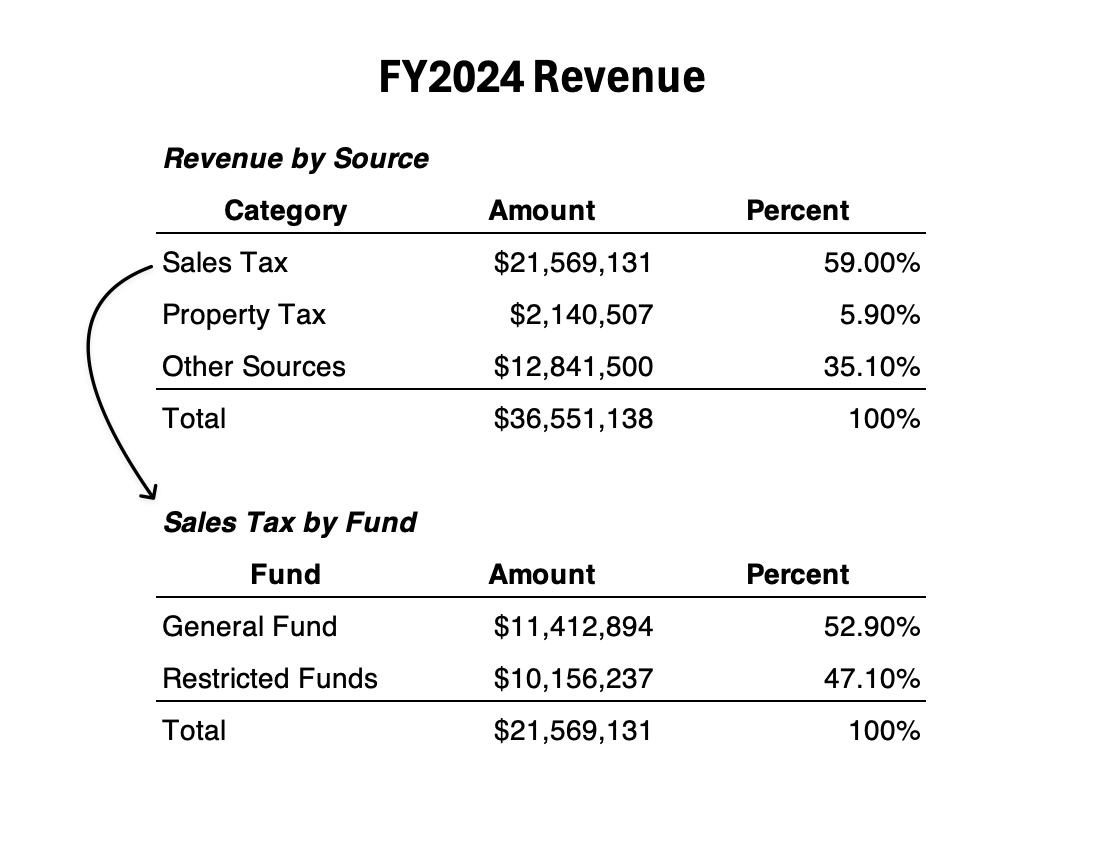
And according to the city’s fiscal year 2024 financial report, property taxes only account for 5.9 percent of total revenue. The city of Mandeville collected $21.6 million in sales tax revenue, accounting for a whopping 59 percent of its total income, but only $2.1 million from property taxes, or 5.9 percent. The city’s overall revenue for the year was $36.5 million, with the remaining funds coming from franchise fees, licenses, permits, intergovernmental transfers, fines and other sources.
The median home value in the City of Mandeville is approximately $385,000, significantly higher than St. Tammany Parish’s median of about $285,000, or excluding Mandeville, estimated between $250,000 and $270,000, according to the most recent available data from the U.S. Census Bureau and Realtor.com. (This will likely not reflect the 2024 increased property assessments.)
This means that in 2024, the typical Mandeville property owner paid just over $300 to the city in property taxes while sending nearly $4,000 to the parish.
Council members and property taxes
District I Councilwoman Cynthia Strong-Thompson pointed out at the July 24th council meeting that the median home value in her district was significantly higher than the rest of the city.
Strong-Thompson’s Sanctuary home was assessed by the parish at $787,483 total fair market value for 2024, higher than the city and parish’s median values combined, according to the St. Tammany Parish Assessor’s Office website. Her tax bill to the parish was $8,758.52 and $646.52 to the city. Her city taxes went up by $68.22 in 2024.
In Louisiana, an assessment ratio of 10 percent is applied to what the parish assessor determines to be the fair market value of a property, from which the homestead exemption — if applicable — is deducted, leaving the “taxable value.” For simplicity, we refer to the “assessment” as the assessed total fair market value. The resulting taxes mentioned herein for each property can be found at the St. Tammany Parish Assessor’s website.
Discon, on the other hand, whose home is about a block off Lakeshore Drive and was featured in a 2021 Times-Picayune article, came in at the bottom of the pack of council members being assessed at only $265,374, much lower than the Mandeville median value and right at the parish median. He only had to pay $2,340.22 to the parish and $217.87 to the city. His city taxes increased by $32.08 in 2024.
Zuckerman, who lives on the eastern end of Villere Street about seven-blocks distance from Lakeshore Drive, brought his last two property tax bills to the budget hearings to illustrate his argument about property taxes versus sales taxes. He was in the middle of the council pack at an assessment of $413,442, meaning he paid the parish $4,160.47 and the city, $339.43. Zuckerman’s city taxes saw the largest jump among council members at $77.28 due to his home seeing the largest assessment increase.
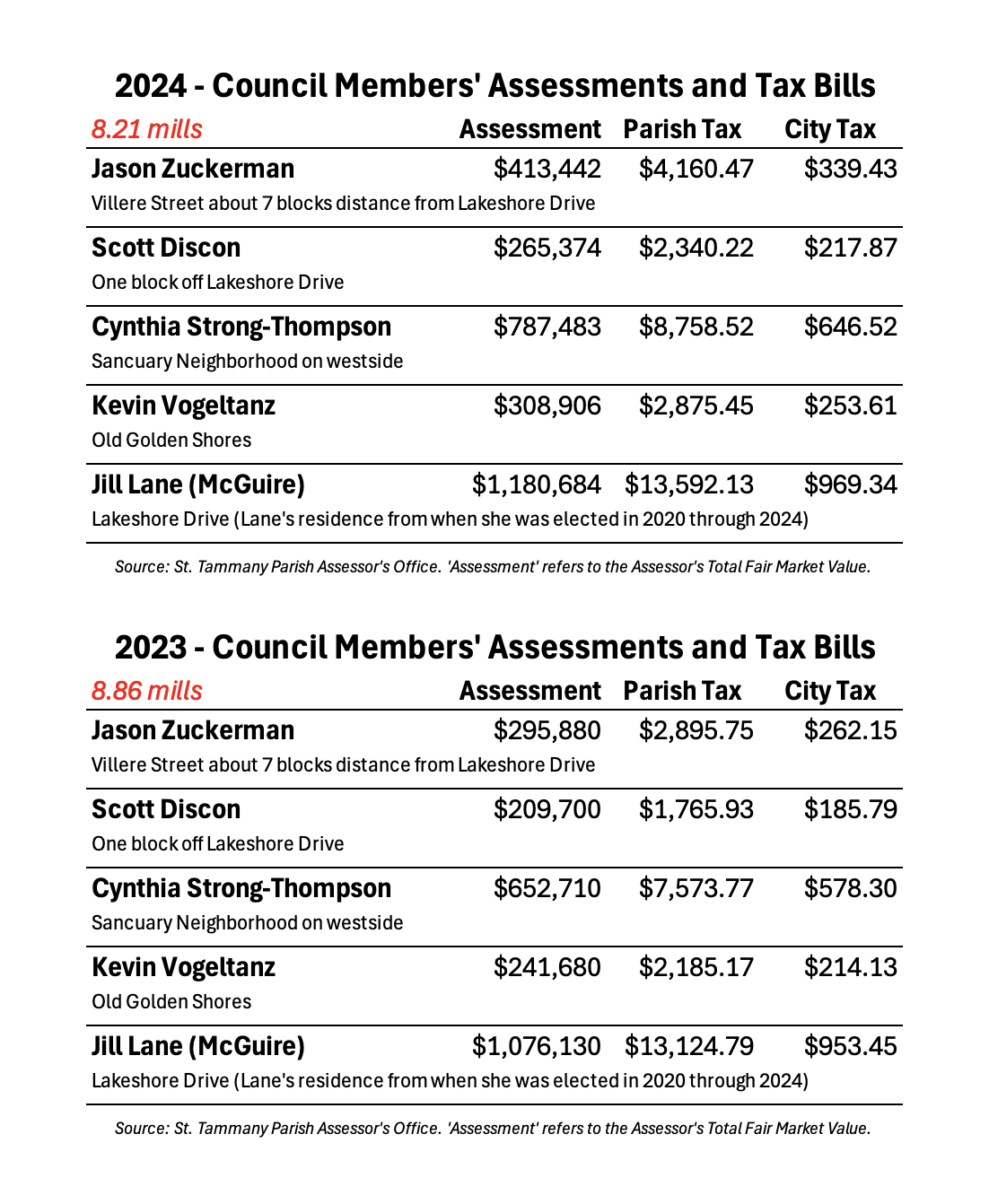
The city property tax cut championed by Discon last year, which cut the total city millage from 8.86 to 8.21, only provided a paltry savings of $25.08 annually for the typical Mandeville homeowner, barely $2 a month. The stated objective of the cut was to keep the city revenue neutral on ad valorem taxes in anticipation of inflationary assessments by the parish.
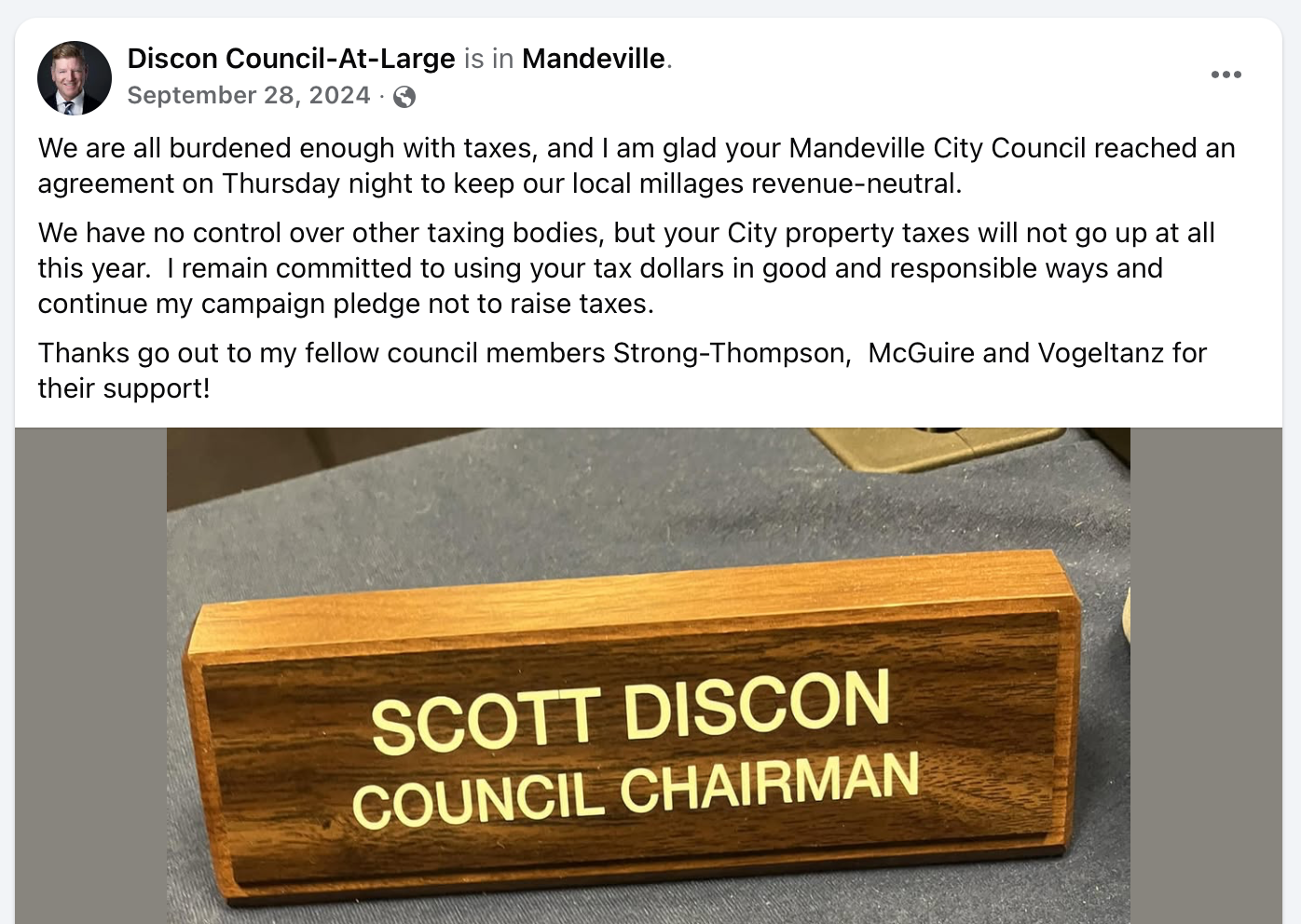
Despite Discon’s 2024 social media claim that “City property taxes will not go up at all this year,” most Mandeville homeowners still ended up paying more in city property taxes due to the parish assessments. While the City of Mandeville did cut its ad valorem tax rate, the sharp rise in assessed values led to higher tax bills despite the cut. The city’s year-to-date ad valorem collections confirm this, as the city is on track to collect nearly 3 percent more for fiscal year 2025 than in 2024.
But even if Mandeville were to completely abolish city property taxes, the typical property owner would barely save $25 per month while still sending over $300 a month to the parish, not to mention, the city’s restricted funds issue would still need to be addressed, according to Zuckerman.
No to cuts, yes to rebalancing
Zuckerman’s proposal would cut the sales tax rate to reflect the city’s recurring surpluses, while also pursuing a reallocation or redefinition to direct a greater share of revenue to the general fund expenses and less to the restricted accounts that have seen outsized growth. He said all this can easily be done while cutting the sales tax by at least $1 million.
He also pushed back against what he described as budget-cutting for appearances’ sake, taking aim at Discon’s remarks, who suggested good-faith budget cutting without addressing revenue distribution.
“We’re taking money from the taxpayers and we’re sticking it in the mattress — and it’s not right,” Zuckerman said. “I’m not in favor of just cutting for the sake of cutting, just to say we cut something. I’m not in favor of cutting or reducing services just to say we did.”
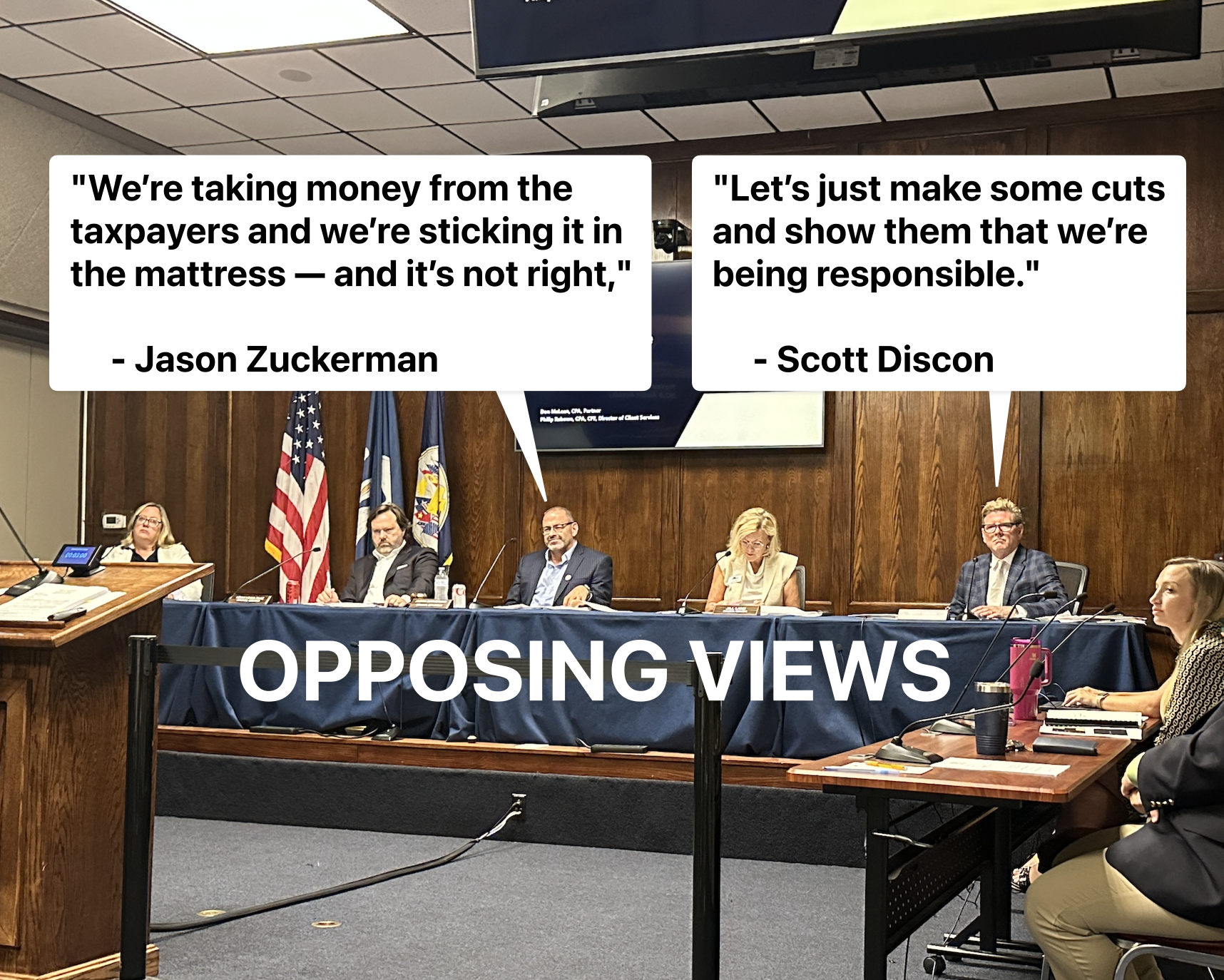
He emphasized that the city is not in a crisis — at least not financially — and warned against reducing services or benefits before correcting what he sees as a structural flaw in how tax revenue is managed.
“Before we raise property taxes, before we cut departments, before we reduce police or employee benefits — we need to fix how we’re using the money we already have,” he said.
Budget outlook stable
Zuckerman noted that the administration’s proposed operating budget for fiscal year 2025–2026 is 3 percent lower than last year’s adopted budget. Additionally, the city is currently on track to finish the current fiscal year $2 million under budget on operating expenses.
Despite those positive indicators, Zuckerman expressed frustration that the council has been unwilling to even consider adjusting how sales tax revenue is allocated into restricted vs. non-restricted accounts, while continuing to over-tax the citizens.
No formal ordinance has been introduced yet, but Zuckerman indicated he will continue to advocate for structural reforms — with the goal of cutting taxes without cutting services.
-30-

 Mandeville Daily
4 thoughts on “Zuckerman calls for sales tax cut to fix budget imbalance without cutting services”