
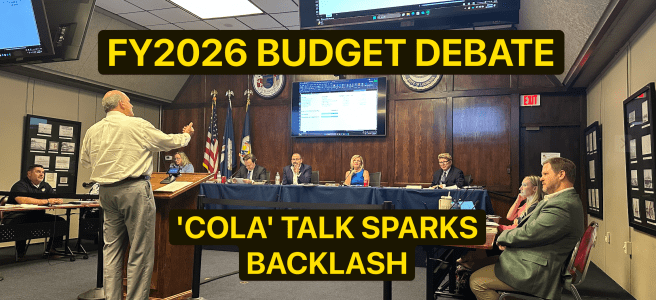
‘Secret meeting’ objective to rally public outrage at police, worker compensation
Finance director: budget is balanced, fiscally restrained
Officials: resources exceed spending
2024 political foes resuscitate rejected budget narrative
Updated 8/17/2025: Expands reporting on citizen meeting and positions.
MANDEVILLE — The City Council on Thursday adopted Mandeville’s fiscal 2026 operating and capital budgets, codified in Ordinances 25-25 and 25-26, after more than two hours of debate and a series of failed amendments aimed at reducing spending.
Background:
– Mandeville council heads into final FY26 budget vote with familiar divisions
– Zuckerman calls for sales tax cut to fix budget imbalance without cutting services
The operating budget (Ordinance 25-25) passed 4-1, with Councilman at Large Scott Discon casting the lone “no” vote. District I Councilwoman Cynthia Strong-Thompson, District II Councilman Kevin Vogeltanz, District III Councilwoman Jill Lane, and Councilman at Large Jason Zuckerman voted in favor.
Vogeltanz offered three amendments — to defund a city clerk position primarily handling public records requests, to cancel a planned Comprehensive Land Use Regulation Ordinance rewrite, and to reduce employee cost-of-living adjustments from 2.5% to 1% — but each failed by narrow margins.
Discon attempted to postpone the vote because he wanted the administration to propose cuts instead of the council being tied to voting on specific cuts. His motion died for lack of a second.
The capital budget (Ordinance 25-26) passed unanimously, 5-0. Vogeltanz proposed three amendments: to remove funding for three Mandeville Police Department vehicles, to eliminate replacement windows at the historic former town hall, and to cancel America Street Park’s environmental remediation and improvements. All failed, including one — the police vehicle cut — that was voted down unanimously.
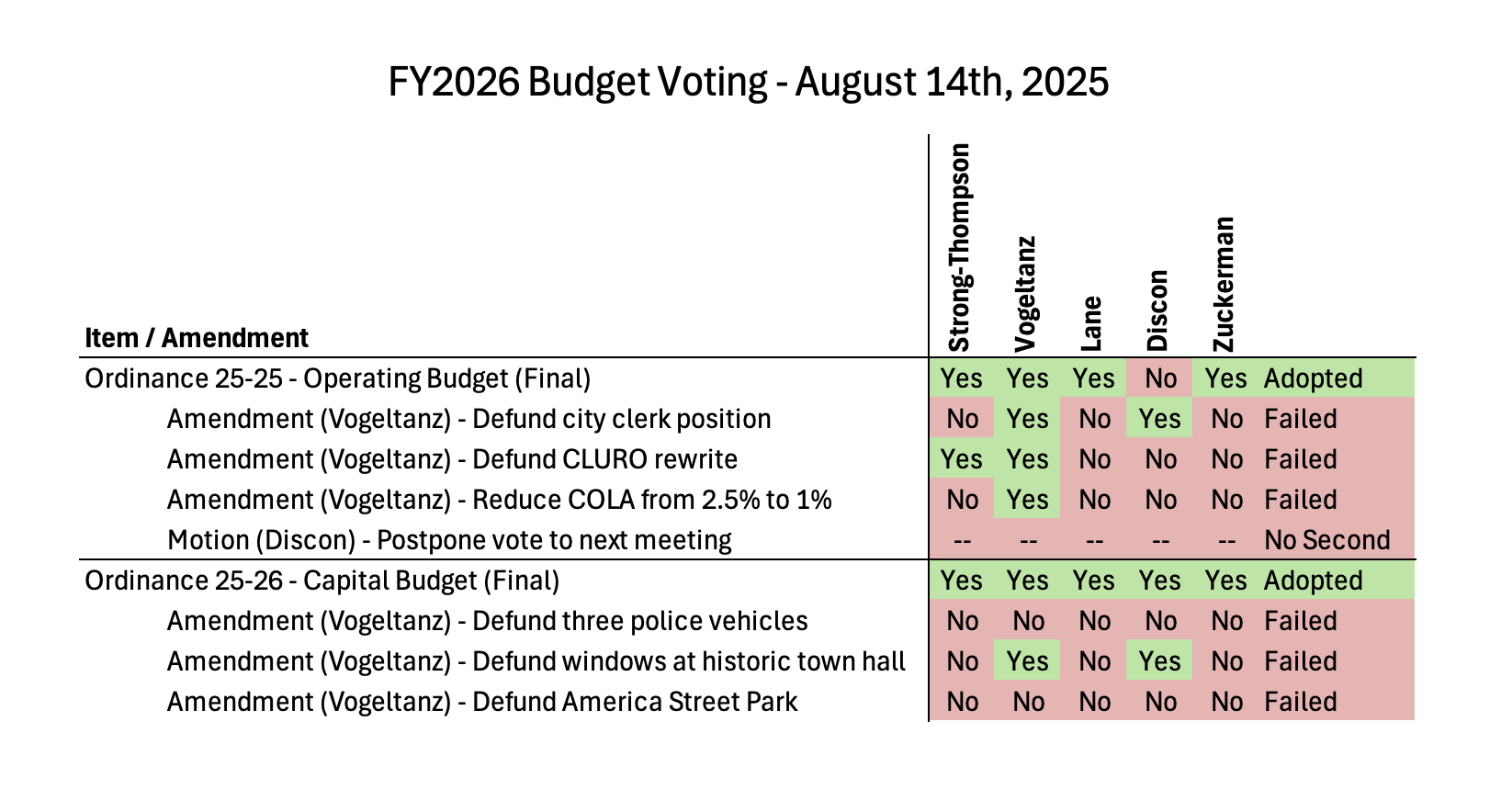
The adoptions cap a budget process marked by agreement on the city’s overall fiscal strength but continued disagreement over whether to make immediate cuts or focus on long-term fixes such as sales tax rededication.
Runyon renews 2024 budget crisis push ahead of FY2026 vote
According to sources, Glen Runyon — the former efficiency consultant for the City of Mandeville and now a frequent critic of Mayor Clay Madden — hosted a meeting in the Sanctuary neighborhood on Sunday, August 10th.
A text was sent out reading in part: “Glen Runyon, a bipartisan business/government consultant, is hosting a one hour informational meeting to factually explain the current city’s financial situation, how we got here, and options for a sustainable, long-term path forward.”
“The Mayor and council now are talking about reaching into voter decided “dedicated funds” for important infrastructure, such as streets, drainage, and flood protection. The city wants to ‘un dedicate’ these restricted infrastructure funds to transfer additional money to the general fund to offset existing and future deficits,” the invitation continued.
Attendees say Runyon pushed talking points he promoted in previous years, including during the run-up to the 2024 mayoral race. Madden went on to defeat Runyon and Discon’s ally Jeff Lyons in a 73–22% landslide, a result widely seen as a rejection of the budget crisis narrative.
Attendance at the first four budget hearings this time around was sparse, but the final session — held the day after the Sanctuary meeting and following Vogeltanz’s public hint at a possible COLA cut amendment — drew a near-capacity crowd.
According to sources, the Sanctuary meeting spurred the surge in attendance at the last two meetings. One attendee said the goal was to stage a visible challenge at the council meetings and “demand” answers about what organizers described as “outrageous” pay and benefits for police and city employees.
At Thursday’s meeting, Runyon took the podium repeatedly to challenge the administration’s characterization of the FY2026 budget as fiscally sound as well as criticisms of employee benefits.
A small group of Runyon’s allies echoed his concerns, each offering comments at multiple points before votes on Vogeltanz’s amendments, never fully supporting nor opposing any of them.
Runyon peppered council members and Finance Director Jessica Farno with questions and data points, echoing information he is known to email to the full council throughout the budget process, and again today, the day after the budget was approved.
On social media in recent weeks, Runyon had promoted:
- completely eliminating the annual cost-of-living adjustment (COLA) for police and non-police,
- forcing employees to pay a larger share of their health insurance cost, and
- steadily reducing the city’s contribution to the employee retirement fund while the employee would start to pay more and more.
If enacted, these would result in across-the-board pay cuts for all city employees, the likes of which Mandeville has never seen, according to publicly available information.
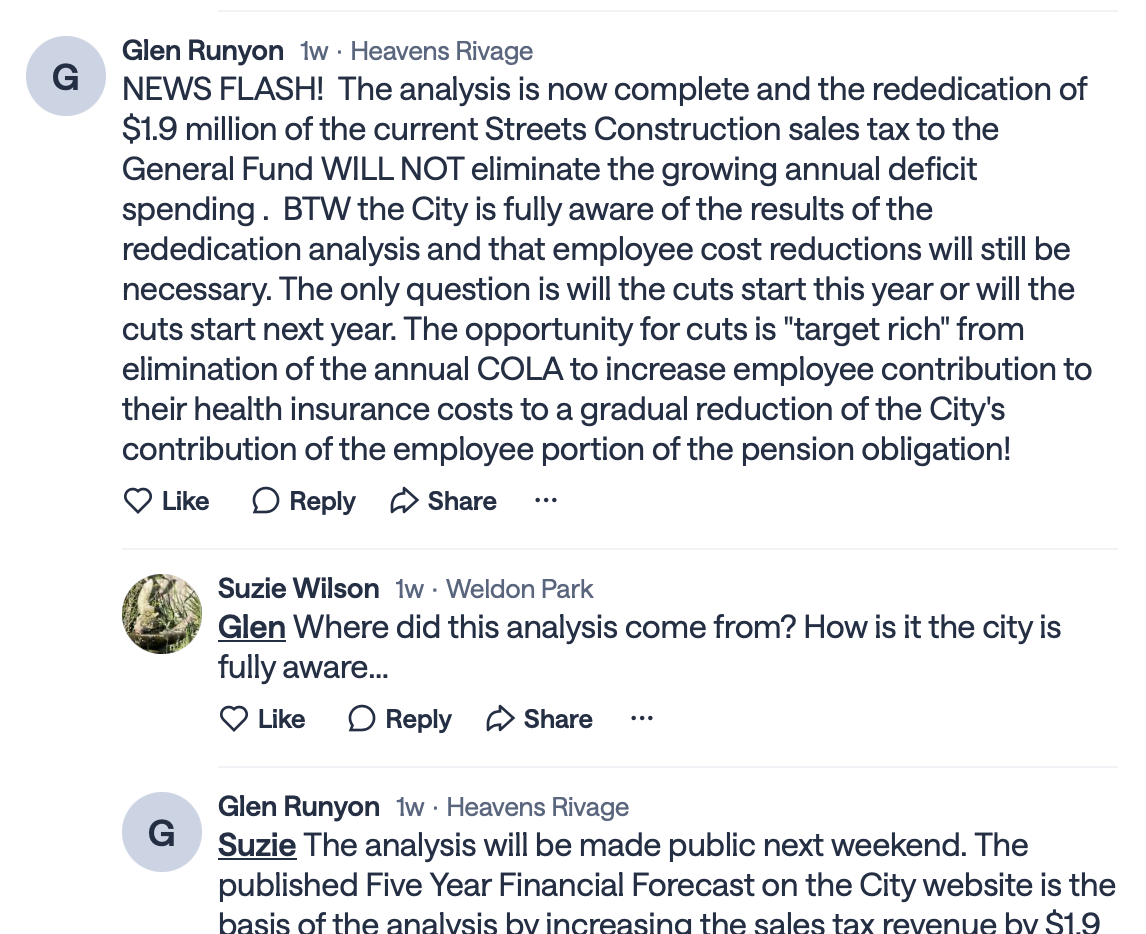
During Thursday’s meeting, Lane challenged the veracity of the information reportedly disseminated by Runyon Sunday, calling it misinformation.
Police show up in force
At the final two budget hearings, Vogeltanz presented a range of potential cuts that he later formed into amendments he offered Thursday night — as he claimed — to offer budget critics options if they were serious about cutting spending to fit within only recurring tax revenue.
One of these suggestions was to just lower the COLA from 2.5 percent to 1 percent only for FY2026. At the time, Vogeltanz told the audience that he didn’t necessarily plan to vote for any of his would-be amendments, but that he was responding to the budget critics who requested cuts.
The combined employee compensation talk from both Runyon and Vogeltanz drew a substantial turnout of police and city workers to the August 11th and 14th meetings, several of whom spoke against the amendment, including Municipal Police Employees’ Civil Service Board Chairman Brian Burke.
This put the Runyon boosters in a precarious position, as the significant turnout by police and city workers seemed to have a damping effect on planned criticisms of pay and benefits, which sources say was the reason for their presence in the first place.
Mayor sounds off
Mayor Clay Madden made his feelings known just before adjournment, recognizing and thanking the council for their work throughout the budget process.
He described the FY2026 budget hearings as the best he’s ever participated in.
“But I do have a problem with a group of people having a secret Sunday meeting (Sanctuary meeting), that none of us were invited to, at the last minute, after we had very productive budget meetings, trying to sabotage it at the end. Why not come to the meetings (budget hearings) that we had if you had some concerns?” Madden said.
He derided the budget crisis narrative, saying, “If it was true, none of us would have been elected.”
Summary of FY2026 Mandeville budget
The FY2026 operating and capital budgets total $28.8 million in general fund expenditures, including capital outlay. Farno says the budget reduces total general fund spending by more than 27 percent compared to the prior year’s revised budget, maintains more than six months’ worth of reserves — triple the Government Finance Officers Association’s recommended minimum — and ends FY2025 with a projected $14.8 million general fund balance.
The budget is balanced in the sense that total resources exceed planned spending, but recurring general fund revenue is about $1.2 million less than recurring expenditures. That gap will be covered with existing fund balances, a practice some council members criticized. The budget relies heavily on dedicated sales tax revenue, much of which is restricted to specific uses like streets, drainage, and District 3 improvements. This has left the general fund — which pays for police, public works, parks, and administration — under greater long-term pressure.
Major provisions in the budget include funding for police vehicle replacements, building maintenance such as new windows at the detective station, and other capital projects across the city. America Street Park remains funded from prior-year appropriations and a state matching grant, with no new FY2026 dollars allocated. Employee salaries and benefits reflect existing cost-of-living adjustments and merit opportunities.
Madden and Farno describe the budget as fiscally sound, prioritizing needed maintenance and community improvements while preserving healthy reserves.
Budget by the numbers – FY2026 budget
- $28.8 million — Total general fund expenditures, including capital outlay
- $14.8 million — Projected FY2025 year-end general fund balance
- 6+ months — Reserve coverage (triple GFOA’s recommended minimum)
- $1.8 million — Gap between recurring general fund revenue and recurring expenditures
- 27% — Reduction in total general fund spending compared to FY2025 revised budget (including capital outlay)
- 0 — New FY2026 funding for America Street Park (all from prior-year appropriations)
- $60+ million — Estimated total cash and investments across all city funds at start of FY2026 (includes restricted funds)
Restricted vs. Unrestricted Funds – FY2026 context
Unrestricted (General Fund)
- Pays for: Police, public works, administration, parks, day-to-day operations
- FY2025 projected year-end balance: $14.8 million
- Share of total city funds: Minority (most city cash is restricted)
- Source of strain: Budgeted recurring expenditures exceed budgeted recurring revenue by $1.2 million
Restricted Funds
- Examples: Street Fund, Drainage Fund, District 3 Fund, Sales Tax Fund, Capital Projects Fund
- Pays for: Specific uses only, as set by voter-approved dedications or grants
- FY2025 projected combined balances: Tens of millions (cannot be used for general operations without voter approval)
- Main issue: Balances keep growing because revenue exceeds spending capacity in these categories
Why it matters
While the city appears “cash-rich” with over $60 million in total cash and investments, much of that money is locked into restricted purposes and cannot legally be redirected to the general fund without a voter-approved sales tax rededication.
-30-

 Mandeville Daily
One thought on “Council adopts FY2026 budget, rejects crisis narrative from 2024 foes”