
Officials promise billing review, late-fee pause through year’s end
MANDEVILLE — Locals confronted city leaders this week over dramatic spikes in their water and sewer bills — with one reporting charges of $2,200 and others seeing jumps from about $100 to $800 — after Mandeville implemented a new rate structure this summer.
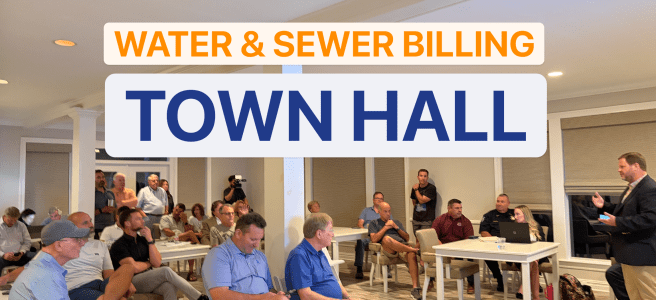
At a town hall in the Sanctuary neighborhood clubhouse Monday (October 6th) hosted by District I Councilwoman Cynthia Strong-Thompson and District II Councilman Kevin Vogeltanz, residents questioned whether “smart” meters are misreading usage and criticized the city for charging sewer fees on all water consumed — including irrigation and pool filling that never enters the sewer system. Mayor Clay Madden, Finance Director Jessica Farno and Public Works Director Keith LaGrange attended and fielded questions from roughly two dozen residents.
The meeting grew tense at moments, with residents and officials occasionally talking over one another as frustrations about high bills spilled out. Yet the discussion remained largely constructive, as officials allowed every attendee who wished to speak a chance to do so and worked to address each concern in turn.
(Click here to download the raw transcript of the meeting.)
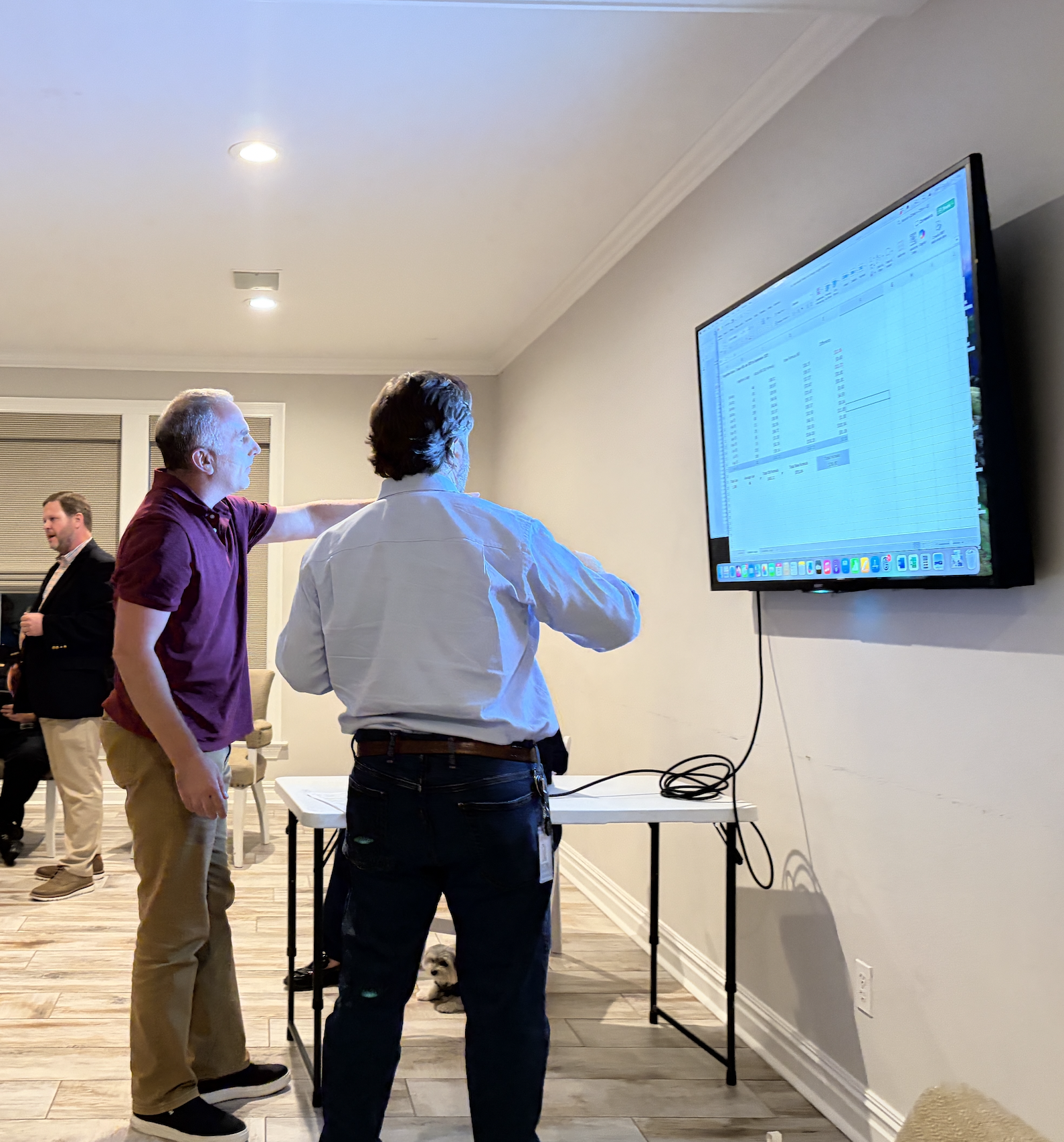
Vogeltanz, who presented a computer spreadsheet with the rates calculations programmed to demonstrate before and after comparisons, said the largest driver of the increases is a change to how sewer is billed. Under the old system, most households paid a flat sewer fee of about $20 a month regardless of usage. Under the new formula, customers pay $3.25 per 1,000 gallons after the first 3,000 gallons, on top of tiered water rates that escalate with consumption. At the highest tier, the combined effective charge can reach about $8.38 per 1,000 gallons, he said.
“You couldn’t have picked a worse moment to roll this out — peak summer irrigation and an extended six-week billing cycle,” Vogeltanz told the crowd. “That combination supercharged the bills, and I apologize for the way this landed.”
Residents reported usage spikes they said defy logic — for example, monthly totals exceeding 120,000 or even 274,000 gallons. Several insisted they irrigate modestly or were out of town. LaGrange urged anyone disputing a bill to submit a work order through the city website so crews can perform on-site checks and pull historic reads. He said public works will prioritize those calls and can conduct simple verification tests at the meter.
The city recently switched to a new metered rates system for water and sewer billing, which had been in the works for years, dating back to the early days of Mayor Clay Madden’s administration.
The higher charges stem from the city’s 2023 state-funded rate study, which found that Mandeville’s water and sewer enterprise fund had been operating at a loss for decades, extending back into former Mayor Donald Villere’s administration, which implemented a council-adopted rate hike that failed to fix the issue.
Mandeville has in effect been partially subsidizing residents’ water and sewer services, and it is not alone in facing pressure to align utility rates with actual costs. In 2020, Covington ended a decade of subsidies by raising rates, with its City Council redirecting the savings toward priorities such as higher police pay.
As of August 31, 2024, the enterprise fund owed more than $5.6 million to the general fund. Without rate adjustments, Finance Director Jessica Farno said, the city risked losing about $2.2 million in state Water Sector Program funding.
The Louisiana Water Sector Program, created in 2021, was designed to repair and modernize the state’s aging water and sewer infrastructure. Funded primarily through the American Rescue Plan Act and supplemented with state dollars, the program awards grants to municipalities, parishes, and local water and sewer providers to fix or consolidate systems that often date back decades. Recipients are required to contribute matching funds, typically ranging from 25 to 50 percent of the total project cost, depending on the size and financial capacity of the applicant.
Mandeville received a grant under the program to help fund improvements to its water and sewer systems. According to program records, St. Tammany Parish as well as other municipalities or water companies received grants through the program.
The funding was part of more than $450 million distributed statewide beginning in 2022 to address critical infrastructure needs. Additional rounds of state-funded grants under Phase 2 have continued through 2025, with the overall goal of improving water quality, reducing service interruptions, and easing the financial strain on smaller communities and rural systems unable to fund major upgrades on their own.
Several residents urged the city to adopt “winter averaging,” a method used elsewhere that bases sewer charges on indoor-use months when irrigation is minimal. Vogeltanz signaled openness to revisiting the structure after several months of data, saying the council must first see whether collections match actual operating costs. He also said state law limits the city’s ability to issue discretionary bill credits, except for proven meter or city errors.
Officials outlined near-term steps:
- The city will re-average the six-week billing cycle and adjust accounts that were pushed into higher tiers by the extended period.
- Late fees are suspended through the end of the year, officials said.
- Residents may request meter inspections via the public works “Report a Problem” portal; photo uploads and geolocation help staff track issues.
- Customers with heavy irrigation can install a separate irrigation meter to avoid sewer charges on outdoor use, though that requires a deposit and plumbing work.
Vogeltanz said he would press for a broader analysis of meter accuracy and rate fairness. “If the data show we’re over-collecting, I’ll be the first to demand we adjust the rates down,” he said.
How to seek help: City leaders urged residents to file a public works work order online if they suspect a meter error or drainage issue, and to email their council members if they do not receive a response.
Do we have a quorum here?
Conflicting reports suggest that both at-large councilmen Jason Zuckerman and Scott Discon had agreed or were asked not to attend the Sanctuary town hall so the two district members, Cynthia Strong-Thompson and Kevin Vogeltanz, could lead the discussion. However, as the meeting began, Discon arrived and was seen walking through the crowd, greeting residents and shaking hands. Strong-Thompson reportedly asked Discon to step outside, reminding him of their agreement that only the two district members would conduct the session.
Zuckerman said as the meeting started, he received text messages from supporters alerting him that Discon was present despite his prior understanding, so he decided to go to the meeting to stand quietly in the back and observe but not participate.
Zuckerman told Mandeville Daily that upon arriving he encountered Discon and former councilwoman and past mayoral candidate Trilby Lenfant — who emerged as a prominent advocate for the ill-fated Sucette Harbor development — outside and confronted Discon about the apparent contradiction. According to Zuckerman, Discon denied he agreed to skip the meeting. Zuckerman said he had honored what he understood to be a mutual decision until learning that Discon had chosen to attend.
However, Discon told Mandeville Daily there was never any agreement with anyone not to attend the Sanctuary town hall. He said he had told Strong-Thompson weeks earlier that he planned to attend only as a member of the audience, and that he and Zuckerman had never discussed the matter. Discon said that upon arriving at the clubhouse, Strong-Thompson advised him he could not attend because it might violate the Open Meetings Law, so he left the room and waited outside for the duration of the meeting. He said he later encountered Zuckerman in the parking lot, where they briefly discussed the confusion. “Evidently, someone did not want me attending the meeting,” Discon wrote.
Strong-Thompson, on the other hand, said she had asked both Discon and Zuckerman not to attend because she had invited Vogeltanz to co-host the meeting and wanted to avoid creating the appearance of a quorum. She added that she was trying to keep the meeting “low key” and to ensure there was no question of violating the Open Meetings Law.
The situation drew questions on social media about whether the appearance of a quorum of council members constituted a violation of Louisiana’s Open Meetings Law. However, legal experts and prior state attorneys-general opinions have noted that the law does not prohibit a quorum of a public body from attending another event as long as they do not deliberate or participate in official discussion. City Council members have been known to attend Planning & Zoning Commission meetings in the audience, at times forming a quorum, without an Open Meetings Law violation. Similarly, elected officials attend debates or forums during campaigns, where technically a quorum is created.
-30-

 Mandeville Daily
One thought on “Sanctuary residents press city over spiking water, sewer bills”