
Council approves Discon’s proposal after procedural uncertainty, confusion
Unhappy with adopted version, Zuckerman plans follow-up fixes
MANDEVILLE — The City Council voted unanimously Thursday night to adopt Ordinance 25-11, a sweeping expansion of the city’s tree-protection rules, but only after a tense stretch of confusion over a new document shown on the council-chamber screens in the lead-up to the vote.
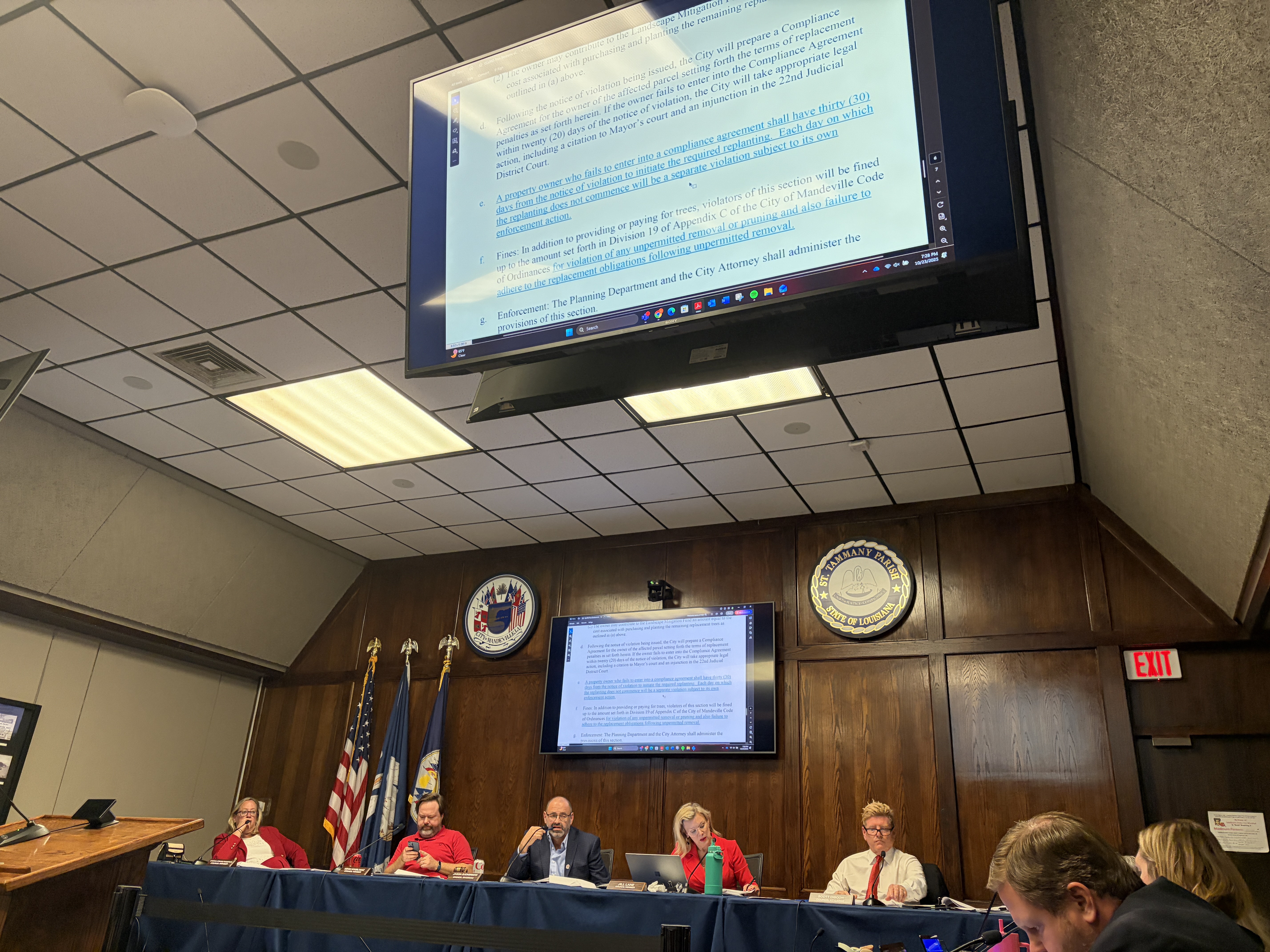
Councilman-at-Large Scott Discon, who authored the ordinance, directed Planning Director Cara Bartholomew to display what appeared to be an enhanced version of the proposal. The document, however, had not been made available to the public beforehand, and even several council members said they had not received a printed copy.
The mix-up prompted uncertainty over exactly what text the council was voting on. Discon and other officials didn’t clearly explain that the on-screen version merely illustrated how the adopted Comprehensive Land Use Regulations Ordinance (CLURO) would look once the changes were incorporated. To members of the audience — and to some on the dais — it seemed like a revised ordinance from what had been officially published into the record.
Councilman-at-Large Jason Zuckerman, along with council members Kevin Vogeltanz and Jill Lane, expressed concerns that adopting the measure without clarifying its differences would be unfair to property owners and confusing for the public. Vogeltanz proposed postponing the vote to the next meeting. However, after a debate, the motion failed with a vote of 2-3. In a reversal, Vogeltanz voted against postponement after Bartholomew advised that any significant amendments could necessitate revisiting the measure through the Planning and Zoning Commission, potentially delaying its implementation for months instead of weeks.
Discon, clearly frustrated by the talk of postponement, urged colleagues to move forward. “We worked extensively with legal, extensively with the planning department,” he said. “It always seems like there’s someone else that’s got something they want to add to it. And it’s just very frustrating.”
After extended public comment, the council adopted the ordinance 5-0.
After the meeting, Zuckerman wrote that he had voted for the ordinance “reluctantly,” saying it should have been postponed “to allow council members that had issues … to craft some meaningful amendments.” He added that he plans to propose follow-up legislation to fix what he views as problematic provisions that could affect property owners and builders.
In comments to Mandeville Daily on Friday, Zuckerman said he does not agree that further amendments would have required another Planning and Zoning review. He said the commission’s role is only to make a recommendation, and that “there is nothing in the charter that says it must go back after amendments.”
“The council, as always, can accept, alter, or reject a P&Z recommendation. It’s just that — a recommendation,” he said.
The ordinance itself amends eight sections of the CLURO, expanding protection to bald cypress and southern magnolia trees alongside the live oak and adding new permit requirements, fencing standards, and replacement rules for removed trees. Violations now trigger automatic suspension of permits or certificates of occupancy until fines or replanting obligations are met.
Confusion triggered by Discon presentation
When the ordinance was brought to the floor for consideration Thursday night, a document was shown on the video screens in council chambers, which at first appeared to be the proposed ordinance itself.
In essence, the visual presentation on-screen combined ordinance 25-11’s directives with the existing CLURO framework, producing a longer and more detailed document than the eight-page ordinance that had been publicly posted. For those unfamiliar, the document resembled an “expanded version” of the ordinance itself rather than a contextual markup — contributing to the confusion that would unfold in the room.
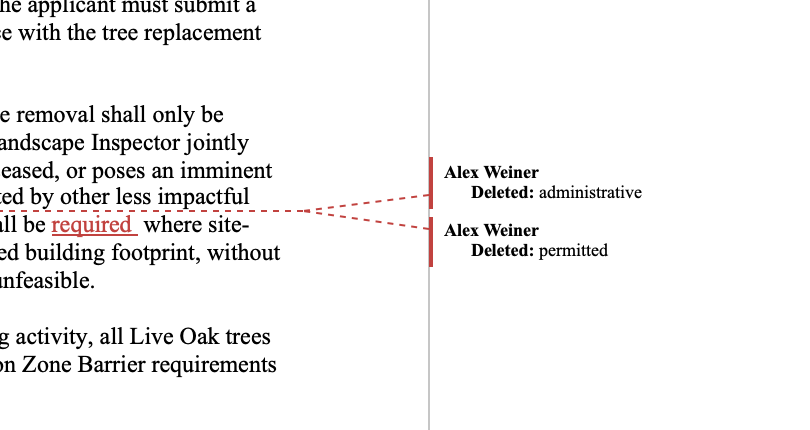
Zuckerman, Lane, and Vogeltanz expressed frustration over what was being shown on-screen. Zuckerman also pointed out unexplained annotations in the printed versions they held in their hands, which had several one-line annotations with no explanation. Those annotations had previously been exposed in a Microsoft Word Document version online as having been made by a planning department staffer named “Alex Weiner.” What was being shown on-screen seemed drastically different, said Zuckerman and Lane.
The confusion among council members and those in attendance began to grow because neither the council members (other than Discon) nor the those in attendance received a printed copy of what was being shown on-screen, and while it appeared to be the ordinance itself, it contained new blue and red markings in the text.
Because passages and headers from the CLURO would appear identical to the wording of the last published version of the ordinance, it created the false impression that a new, as-yet-unpublished version of the ordinance was being shown on-screen, when in fact, the on-screen document was merely a presentation to show what the CLURO would look like with and without the proposed ordinance’s changes.
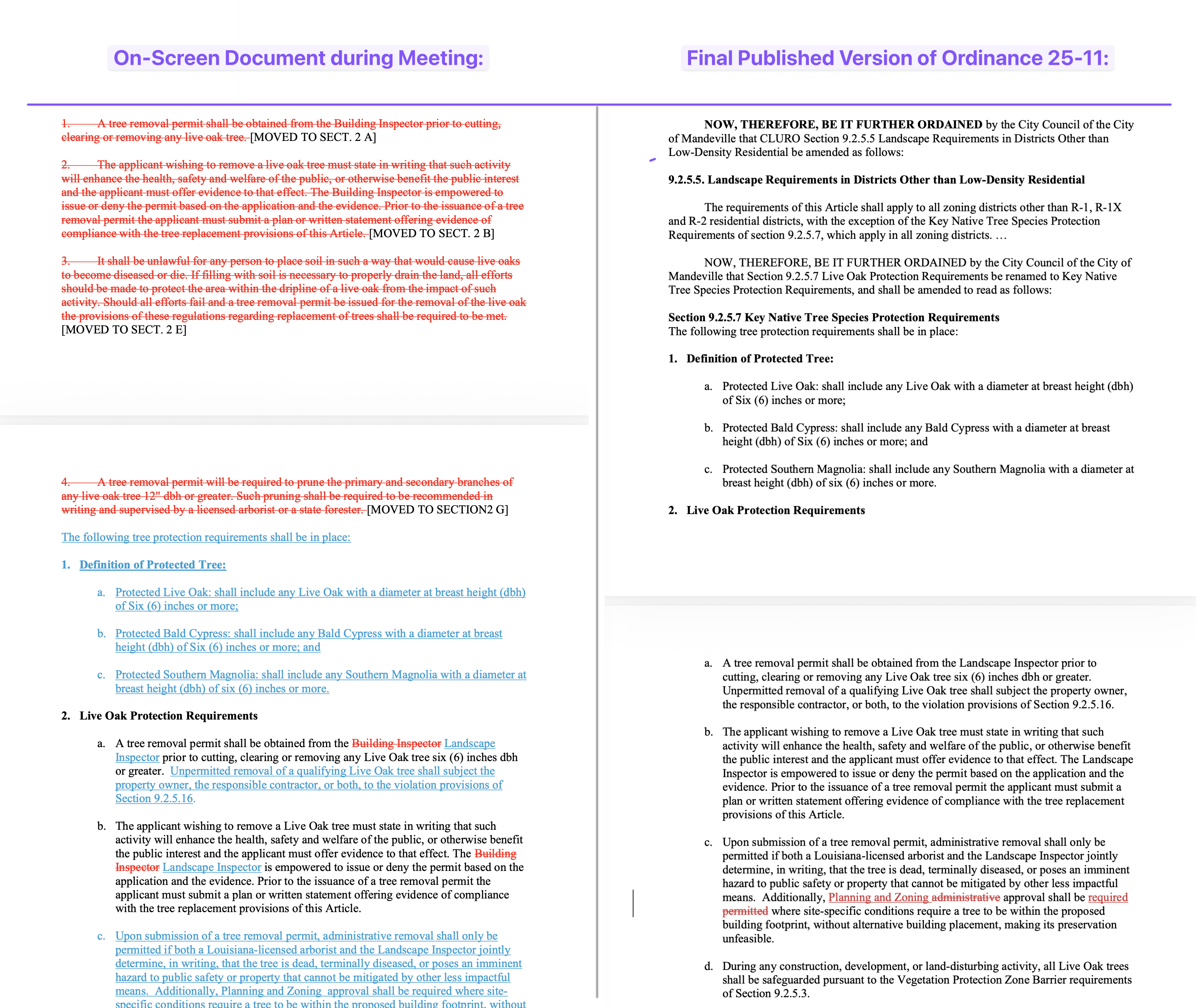
(Click here to download the CLURO-changes presentation document shown at the meeting.)
Exchanges like the following only exacerbated the problem, when Discon said, “Cara, [Bartholomew, Planning Director] would you like to go through the amendment, uh, the ordinance?” This reference to “ordinance” proved crucial.
Bartholomew, who was controlling the on-screen document from her notebook computer, replied, “All right. So what I have on my screen is going to be the red-line version of the actual, or of the actual language in the CLURO, so it’s not the ordinance as advertised — it’s the red-line version.”
Her wording unintentionally created the impression that she was showing a “red-line version” of the proposed ordinance, not the CLURO. Those who spoke with Mandeville Daily — all of whom said they were in favor of the ordinance — said they too thought that what was on-screen was in-fact an updated version of the proposed ordinance that had not been published or advertised. According to the state’s Open Meetings Law, that could have put a vote by the council in legal jeopardy, if it had been true.
Next, Discon unwittingly continued the confusion when he said the following:
“I’m gonna explain to you the ordinance that you have in your hand. Uh, councilman, that’s the ordinance. … So what we did to make it easier [gesturing with hand to the screen above] is when you look at the screen, anything in blue is added. That’s the new stuff. And you’ll see that there’s only so much blue that’s, that’s been added. Red is being crossed out. We taking…”
By this time, Zuckerman, Lane and Vogeltanz were beginning to express their concerns over how the matter was being handled by Discon and staff. Zuckerman interrupted to ask: “But that’s not in the [meeting] packet though, right?” Discon replied, “No, it’s not. We, we just had this done this morning because we wanted to make it easier for everyone to understand.”
Those who spoke to Mandeville Daily said they believe the controversy could have been avoided if officials had made printed copies available to the public, or had they better explained what was going on.
Mandeville Daily tried to obtain a copy of the on-screen document immediately following the meeting but officials did not make it available. Mandeville Daily submitted a public records request the next day and as a result received a copy.
Ordinance previously postponed twice
Ordinance 25-11 was first introduced last spring to strengthen Mandeville’s environmental safeguards by expanding the list of protected trees and tightening enforcement during construction.
Discon said the intent was to modernize and clarify the city’s existing rules under the CLURO. The original version proposed adding bald cypress and southern magnolia trees to the list of protected species, which currently includes only the live oak.
At the June 12th meeting, Zuckerman urged caution, saying the proposal could impose costly and confusing requirements on residents and trigger a surge in variance requests before the Planning and Zoning Commission.
The proposal was postponed twice — first to July 10th and then to August 14th. Following those delays, Discon and city staff spent months revising the proposal.
What changed in the CLURO text
The document shown on the chamber screens — which included blue underlined additions and red strike-through deletions — appeared to be a “tracked” version of the city’s Comprehensive Land Use Regulations Ordinance (CLURO), reflecting how Ordinance 25-11’s proposed edits would integrate into the full code.
While the official ordinance published before the meeting contained only the new text to be adopted, the on-screen version showed the same CLURO sections with detailed markups that revealed the extent of the changes — and a few differences that were not obvious to those reading the posted version.
Among the most significant additions was a complete rewrite of Section 9.2.5.7, formerly titled Live Oak Protection Requirements, renamed Key Native Tree Species Protection Requirements. This section established three categories of protected trees — live oak, bald cypress, and southern magnolia — each requiring a removal permit for trees six inches in diameter or larger. The section also introduced explicit rules for pruning, site disturbance, and tree replacement ratios, along with penalties for unpermitted removal.
The on-screen markup also showed that the ordinance:
- Shifted enforcement authority from the Building Inspector to the Landscape Inspector in most sections, including permit issuance and violation review.
- Inserted a new “FEMA elevation exception” in Section 9.2.5.2, allowing administrative approval for tree work inside Vegetation Protection Zones on elevation projects funded by FEMA.
- Replaced flexible barrier standards with a requirement for rigid four-foot, 12-gauge metal fencing around protected trees during construction.
- Added new penalty provisions in Section 9.2.5.16, allowing for automatic suspension of building or occupancy permits until fines are paid or replanting requirements are met.
- Created the Landscape Mitigation Fund, enabling property owners who cannot replant enough trees on-site to pay an equivalent fee to the city instead.
Some text in the markup clarified or restructured old CLURO sections to integrate the new key native species terminology, while other deletions removed references that applied only to live oaks. The display also visually indicated where sections from different parts of the CLURO — such as sign landscaping and site-map requirements — were being retitled or lightly amended to reflect the inclusion of new protected species.
-30-

 Mandeville Daily