
Judge finds Sucette lawyers cited non-existent court cases in opposition brief
Federal court orders attorneys to explain ‘hallucinated’ legal citations at rare sanctions hearing
City Council had lawful, ‘rational’ grounds to reject Sucette Harbor
Updated 2/6/2026: Expands coverage of sanctions hearing, corrects date or orders.
MANDEVILLE — A federal judge on Thursday dismissed all remaining claims in the Sucette Harbor lawsuits against the City of Mandeville and City Councilman Jason Zuckerman, issuing final judgment in favor of the defendants and ordering a separate hearing to determine whether the plaintiffs’ attorneys should be sanctioned for citing fabricated court cases.
(Download dismissal order here.)
U.S. District Judge Brandon S. Long dismissed the last surviving federal claims with prejudice, meaning they cannot be refiled. The ruling fully resolves the lawsuits brought by Woodward Harbor LLC and LSU Health Foundation New Orleans over the rejected Sucette Harbor development.
In the same order, Long sharply criticized the plaintiffs’ legal filings, finding that their opposition brief relied on non-existent court cases, false quotations, and inaccurate summaries of law, which he said violated attorneys’ obligations under Federal Rule of Civil Procedure 11.
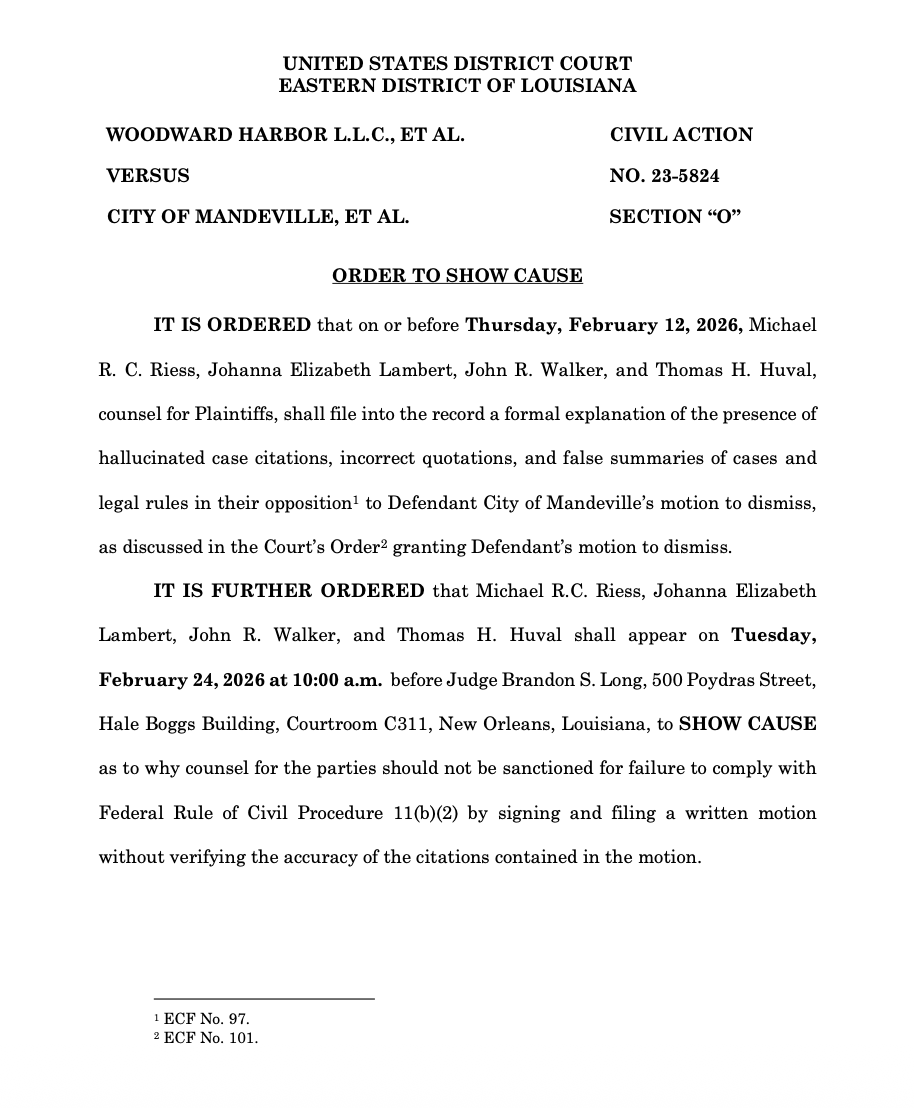
The court ordered four attorneys for the plaintiffs to appear at a show-cause hearing Feb. 24 in New Orleans, where they must explain why they should not be sanctioned for submitting what the judge described as “hallucinated” legal authorities.
Lawsuit fully dismissed
The decision follows earlier rulings that had already eliminated most of the case.
In March, the court dismissed all claims against Zuckerman individually, holding that he was entitled to qualified immunity for actions taken in his role as an elected official. The court also previously dismissed federal and state takings claims, along with due-process claims against the city.
Wednesday’s ruling disposed of the remaining equal-protection and declaratory-judgment claims, concluding that the plaintiffs failed to identify similarly situated comparators and failed to overcome the city’s rational basis for denying the development.
The court found that concerns raised by council members — including traffic, scale, density, neighborhood compatibility, noise, and public safety — provided lawful and rational grounds under Mandeville’s zoning ordinance for rejecting the project.
Because the court determined the defects in the plaintiffs’ claims could not be cured, it dismissed them with prejudice and denied leave to amend.
Sanctions hearing ordered
In unusually direct language, Long said the plaintiffs’ filings undermined the integrity of the judicial process and wasted court resources.
The court ordered Michael R. C. Riess, Johanna Elizabeth Lambert, John R. Walker, and Thomas H. Huval, counsel for the plaintiffs, to file a written explanation addressing the presence of fabricated case citations and to appear in person on Feb. 24 before the U.S. District Court in New Orleans. The attorneys were ordered to show cause why they should not be sanctioned under Federal Rule of Civil Procedure 11 for submitting legal arguments supported by non-existent cases, incorrect quotations, and false summaries of law.
The judge noted that courts across the country have sanctioned attorneys for submitting fictitious, AI-generated case citations, and said the conduct alleged in this case warranted further scrutiny.
The upcoming hearing will determine whether sanctions are imposed and, if so, what form they may take. Potential sanctions under Rule 11 can include fines, payment of opposing counsel’s fees, or other disciplinary measures.
Background
The lawsuit stemmed from the Mandeville City Council’s unanimous 5-0 vote in September 2023 rejecting an ordinance that would have approved the Sucette Harbor project, a proposed mixed-use development along Lake Pontchartrain.
After the vote, the developers sued the city and Zuckerman in federal court, alleging constitutional violations related to zoning, land use, and equal protection.
With Wednesday’s judgment, all claims in the case have now been dismissed, bringing the litigation to a close unless appealed.
-30-

 Mandeville Daily
4 thoughts on “Judge dismisses all Sucette Harbor lawsuits, orders sanctions hearing over fake case citations”