
Ordinance 26-08 would apply broad online speech rules to mayor, council members
Concerns policy could disadvantage incumbents against challengers
Proposal stands in contrast to national guidance
MANDEVILLE — The Mandeville City Council will consider a proposal Thursday that would add a detailed social media policy to the city’s existing Code of Conduct — a move that could significantly affect how elected officials communicate with voters online and conduct reelection campaigns, according to some who have read the proposal.
Ordinance 26-08 would amend the city’s 2010 Code of Conduct by adding an entirely new section titled “Social Media Conduct.” The new language applies to elected officials, unclassified employees and persons appointed to boards, committees and commissions, placing them under the same set of online speech standards.
Some say the policy would have a chilling effect during election cycles. A political opponent seeking to unseat a council member or mayor could file a Code of Conduct complaint over campaign-related social media posts.
That possibility, critics argue, would discourage robust policy debate during an active campaign, undermine public confidence in an incumbent or, at minimum, complicate an official’s ability to respond forcefully to political attacks and defend their record.
Broad prohibitions would extend to personal accounts
Under the proposed language, elected officials, appointed members of boards and committees, and unclassified employees are prohibited from:
- Posting “rumors or information” they know or “should reasonably know” to be false about the city or others;
- Posting photographs of fellow employees without permission;
- Posting material that is “disruptive to the work environment” or “damaging to the City’s reputation”;
- Disclosing confidential information.
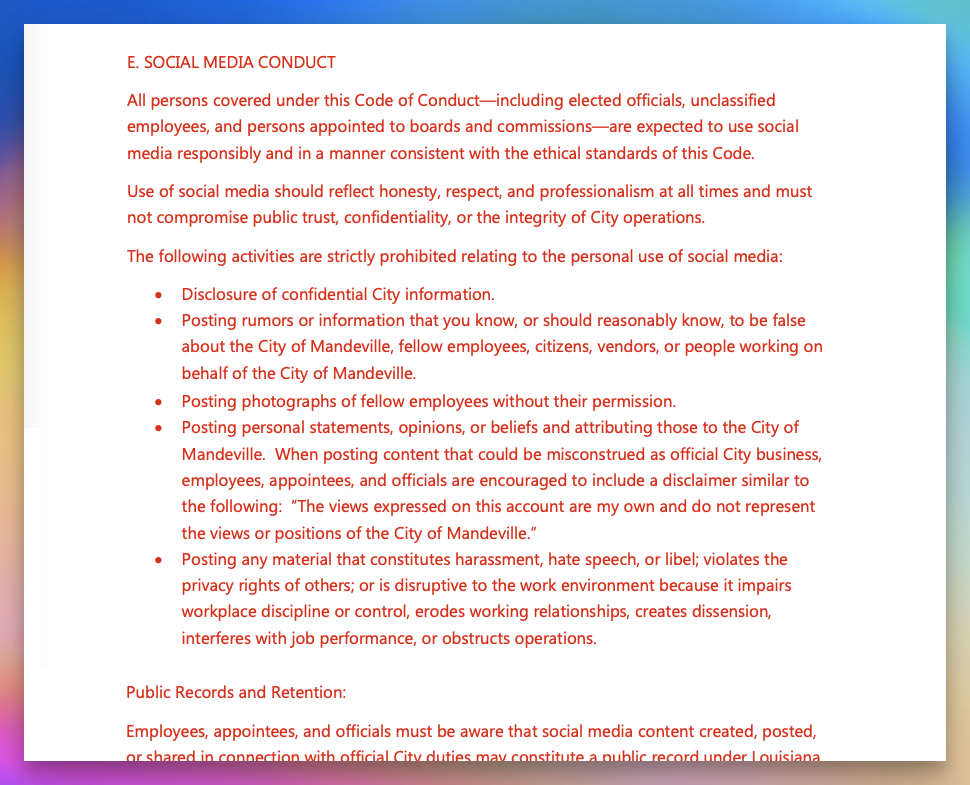
The ordinance also warns that violations could result in disciplinary action for employees, removal from appointed office or referral to the Louisiana Board of Ethics when it pertains to council members. 
Because several of the prohibitions rely on subjective standards, critics argue this creates a mechanism for “lawfare” during reelection bids. Because the policy allows anyone to file a complaint regarding “rumors” or “disruptive” material, opponents can use the formal process to create a public record of “ethical violations” that may not be resolved until after an election.
While the section does include a statement that nothing in the policy is intended to infringe upon First Amendment rights, that sentence, however, is immediately followed by language stating that “the City retains the right to address conduct that disrupts City operations, undermines public trust, or violates applicable law or policy.”
Critics say that pairing a constitutional disclaimer with broad, subjective enforcement standards is contradictory to the stated protection of speech considering the city says it retains authority to discipline conduct deemed disruptive or damaging.
Comparison to national guidance
Guidance from the National League of Cities, a Washington-based organization that provides policy resources to municipalities nationwide, outlines recommended best practices for local government social media policies.
In its guidance materials, the NLC addresses elected officials separately from employees, recognizing that elected leaders use social media as a primary means of communicating with constituents on matters of public concern.
Rather than recommending broad speech prohibitions for elected and appointed officials, the NLC’s materials generally emphasize transparency, clarity about when an official is speaking in a personal capacity and compliance with existing legal requirements.
By contrast, Ordinance 26-08 makes no such distinction and would apply the same set of online speech standards — including restrictions on posting information one “should reasonably know” to be false or damaging to the city’s reputation — not only to employees but also to elected officials and appointed board and commission members. 
That structural difference has prompted questions about whether employee-oriented policy language is being extended to officials whose roles are constitutionally different and protected.
While municipalities routinely regulate employee conduct on social media, it is less common for identical standards to be imposed on elected officials, who are directly accountable to voters rather than subject to traditional employment discipline.
Supreme Court draws line between official and private accounts
A recent U.S. Supreme Court decision further underscores the legal contrast between an elected official’s personal social media activity and official government communications.
In Lindke v. Freed (2024), the Court addressed when a public official’s social media account constitutes “state action” subject to First Amendment limits. The Court unanimously held that an official’s social media activity is not automatically considered government action simply because the individual holds public office.
Instead, the Court adopted a two-step test. First, the official must have actual authority to speak on behalf of the government. Second, the official must have purported to exercise that authority in the specific social media activity at issue.
Legal observers note that this test may be relevant when municipalities craft social media policies, particularly when policies seek to regulate the personal speech of elected officials rather than the administration of official city accounts.
Ordinance 26-08 would apply “to the personal use of social media,” making no distinction between personal or official accounts.
Hypothetical scenarios applied to proposal
Several provisions in the proposal use subjective standards such as “rumors,” “should reasonably know,” and “disruptive to the work environment.” Applied to elected officials, those terms could create uncertainty about what political speech might trigger a complaint.
For example, during debate over a proposed large-scale development, a council member might post on social media that certain zoning provisions are being misinterpreted or that a city official’s determination is legally incorrect. Under the proposed policy’s prohibition on posting information one “should reasonably know” to be false or damaging to the city’s reputation, such commentary could become the subject of a complaint. Even if the dispute reflects a legitimate disagreement over the interpretation of city zoning regulations, a complaint alleging misinformation would trigger review under the Code of Conduct, possibly hampering or disrupting the Council’s deliberations on the aforementioned development.
Another scenario could involve a mayor seeking reelection who posts videos highlighting what he or she describes as their policy successes while in office. If those characterizations are later disputed — for example, by critics or challengers in the upcoming election who interpret those outcomes differently — the posts could potentially prompt a complaint alleging misinformation under Ordinance 26-08. Even if the disagreement centers on competing interpretations of public data, the complaint process itself would be triggered, and hence the potential for reputational harm that likely would not be adjudicated until after the election.
Yet another scenario could involve an appointed member of a volunteer board or committee who oversees one area of city operations but comments on a controversy involving a different department. If that appointee posts criticism outside the scope of his or her assigned committee duties, someone who disagrees with the characterization could allege that the post violates the social media policy. Even though the appointee is speaking as a private citizen on a matter of public concern completely unrelated to the office they serve, the complaint process outlined in the Code of Conduct would be triggered and could result in removal.
Such disputes are common in political debate, particularly in small municipalities where officials frequently use personal social media accounts to communicate directly with constituents, often in blunt or sarcastic language.
Enforcement structure raises ‘separation’ concerns
Under the existing Code of Conduct framework, all complaints must be submitted in writing to the City Attorney’s Office, where a log is to be maintained. If a complaint alleges ethical violations, the city attorney recommends to the mayor whether the matter should be forwarded to the Louisiana Board of Ethics.
Because the proposed social media policy would be incorporated into that same Code of Conduct, enforcement would appear to follow the same process.
That structure has prompted concerns that an appointed executive-branch official — the city attorney — would be the arbiter of whether an elected council member’s speech (or their appointees’) violates the policy, which in the wrong hands could be used to punish or silence political adversaries.
While referral to the state ethics board does not itself constitute punishment, the process can carry reputational and political consequences. Some observers argue that placing interpretive authority over elected and appointed officials’ speech within the executive branch risks creating separation-of-powers issues between the executive and the legislative, which would be the city council in this case.
Photography and public meetings
The proposal also prohibits posting photographs of fellow employees without their permission. The language does not distinguish between private settings and public meetings.
Council members often document city events, workshops and council meetings on social media. Without clarification, the provision could limit how elected officials visually report on city operations.
Because officials often repost images from public meetings or city events, the policy could create ambiguity about whether separate permission is required for each posting. That ambiguity, critics say, could open the door to complaints based not on the content of the photo itself, but on disputes over consent, or literally who shared it as opposed to what was shared.
Policy expansion beyond 2010 code
The city’s original Code of Conduct, adopted in 2010, focused largely on ethics training, conflicts of interest and compliance with the Louisiana Code of Governmental Ethics. 
Ordinance 26-08 represents a substantial expansion by adding explicit online speech restrictions that did not previously exist.
The ordinance was introduced at the council’s February 12th meeting. Under Louisiana law, introduction is the required first step in the adoption process and triggers public notice requirements before a final vote.
The measure now appears on the February 26th meeting agenda. If approved at that time, the ordinance would take effect upon the mayor’s signature.
-30-

 Mandeville Daily