You are being fooled: ERNEST BURGUIÈRES

By Ernest A. Burguières

July 11, 2023


Ernest A. Burguières is a Mandeville attorney who formerly served as District III Councilman. Mandeville Daily is honored to publish Mr. Burguières’ column with permission which is a combined reporting of the goings on in Mandeville government with his personal commentary.


This whole discussion about planned development is a red herring. A red herring is a misleading statement, question, or argument meant to redirect a conversation away from its original topic.

Over the past few months the discussion has been sometimes heated and always exhausting.

How big will the hotel be? How many parking spaces? What is included in a marina? How big is the restaurant? All questions that involve a commercial zoned area.

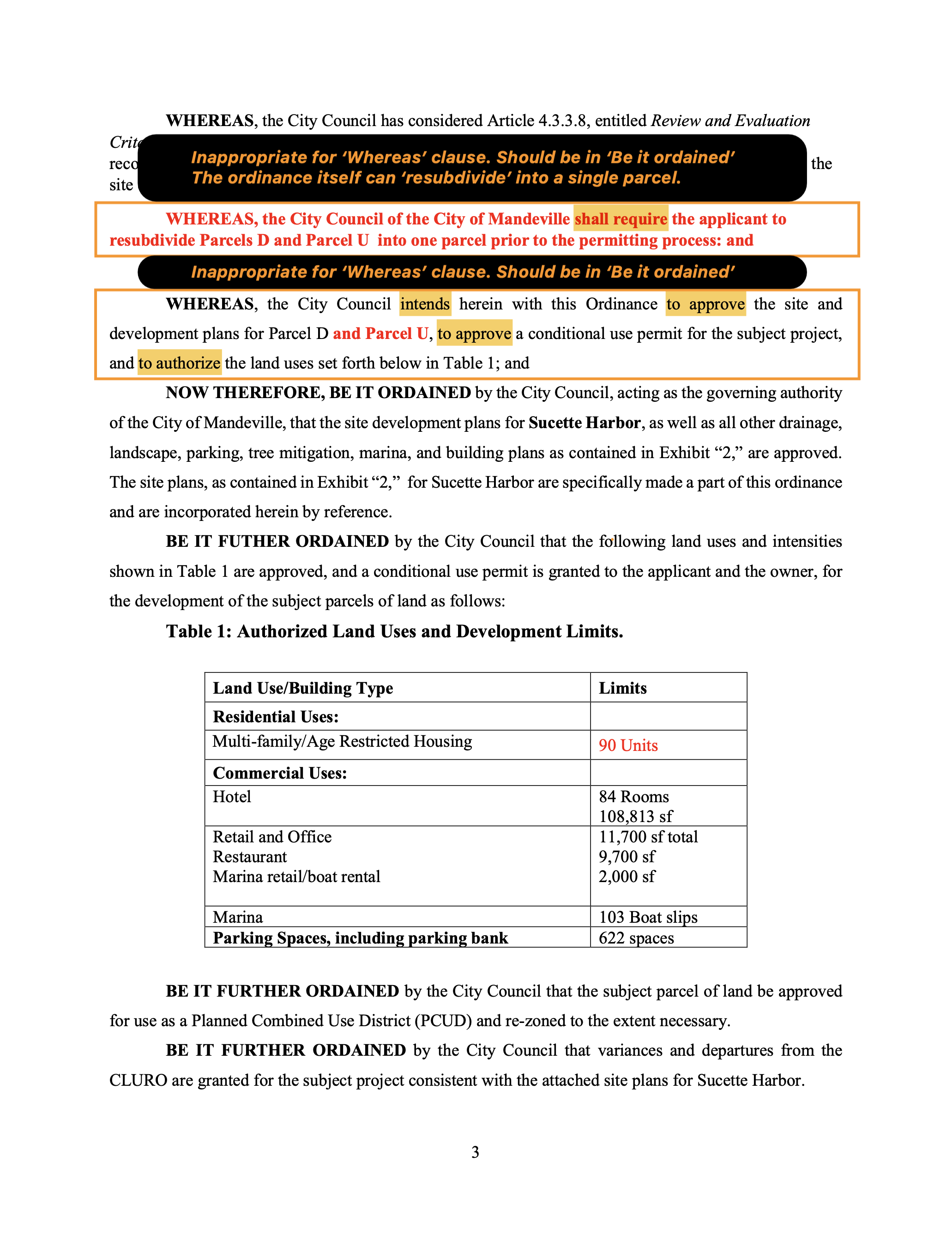
The problem with all of these discussions is that they assume the property is already zoned commercial. It is not. It is zoned residential. It has to be zoned commercial first before you can discuss the details of a conditional use permit for a commercial operation. That is why Ord. 23-16 contains a provision to re-zone this property to commercial.

The terms planned development residential and planned development multi use still boil down to zoned residential and zoned commercial. Planned development is merely a term that provides different rules for executing, but the zoning is either residential or commercial.

So, somebody combined two issues; zoning and conditional use. The Mandeville rules may ALLOW these two items to be combined into one ordinance, but the rules do not REQUIRE them to be combined.

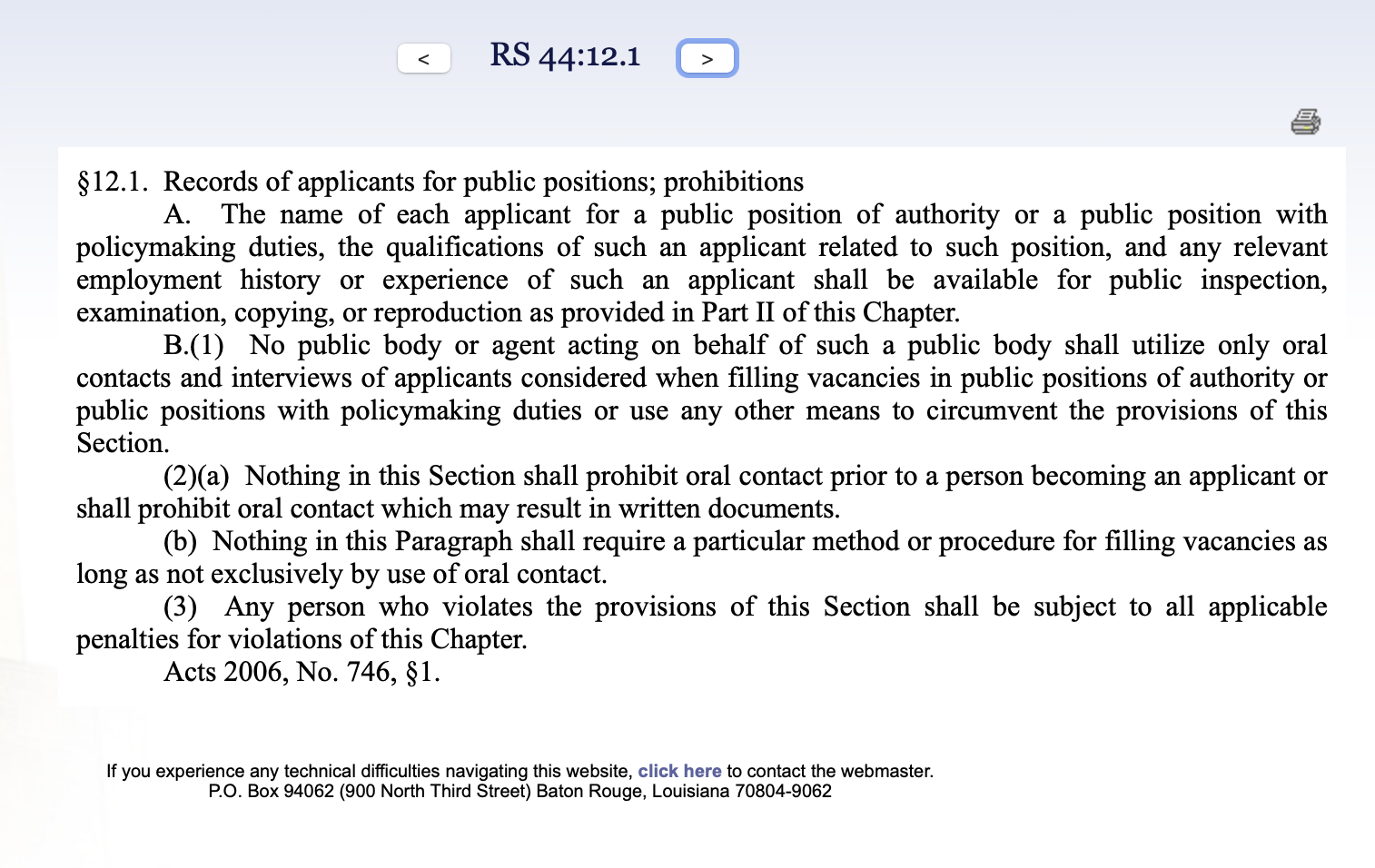
CLURO rule 4.3.3.3. Concurrent Applications:

Application for a Conditional Use Permit and for Rezoning or Planned District zoning for the same property may be made concurrently, subject to the fees applicable to a rezoning or Planned District zoning only. The Planning Commission and Zoning Commission may hold the public hearing on the Rezoning and the Conditional Use Permit at the same meeting and may combine the two hearings. The City Council likewise may hold the two public hearings in combination and may approve both the Conditional Use and rezoning or Planned District zoning by one ordinance.

Clearly, 4.3.3.3. contemplates that a Conditional Use Permit and a Rezoning are two different matters, except it states that they can be made concurrently. In fact, it further states that the City Council likewise may hold the two public hearings in combination and may approve both the Conditional Use and re-zoning or Planned District zoning by one ordinance. No where does it say that you MUST combine these two issues. It is just for the convenience of the person seeking approval, e.g. Sucette.

Combining the two confuses a big issue. Our discussions have focused on the ramifications of the different conditional use issues. What has not been discussed is how re-zoning this property from residential to commercial benefits the health, safety and welfare of this community. Whenever someone applies for a zoning change there is increased scrutiny and a reluctance to change the zoning, especially if it appears to result in spot zoning (a different zoning designation than the surrounding area which is what is occurring in Sucette).

In this instance there has been virtually no discussion of the desirability of changing the zoning from residential to commercial. There has been a great deal of citizen angst and criticism about the various commercial uses, but we have lost sight of the fact that the reason for this angst is it does not fit in a residential area.

Additionally, once you zone this property commercial, it will always be commercial for any project that comes along after this one fails. I do not believe this has ever been discussed. Why not? Plus, it certainly sets a precedent for surrounding properties to request a zoning change to commercial. Are we not allowed to look at the potential consequences of each aspect of a decision? This is certainly foreseeable.

Our brains are geared to a “truth bias:” We automatically tag incoming information as true and must exert extra effort to remain uncertain or to re-label it as false. This bias is not a bug, but a feature. Truth bias turns seeing into believing, so it is a prerequisite for any act of deception. To overcome this tendency we need to curb our enthusiasm and ask ourselves, “what’s missing?’

Our tendency to focus on the information we already have can be amplified further by our preference for consistency. Smoothness and simplicity appeal to us because perfect patterns sometimes do reflect insight.

We are given all sorts of reasons why the specifics of the conditional use are beyond discussion, but that is because it presumes that the property is already zoned commercial. It is not. Implicit in our discussions is that the property is zoned commercial and we do not question this. Why is that? This is the first question that we decide whether we realize it or not. By hiding the decision process with the focus on conditional use with its controversial aspects we do not make the case for why it does, or does not, benefit the community to re-zone to commercial.

Was it sneaky to quietly incorporate the zoning issue into Ordinance 23-16? Possibly. We can certainly see the problem once we start to dissect the decision making process.

Abraham v. City of Mandeville shares similarities with Sucette debate: ERNEST BURGUIÈRES

By Ernest A. Burguières

July 9, 2023


Ernest A. Burguières is a Mandeville attorney who formerly served as District III Councilman. Mandeville Daily is honored to publish Mr. Burguières’ column with permission which is a combined reporting of the goings on in Mandeville government with his personal commentary.


This is an interesting case that was litigated in Federal District Court in New Orleans in 1986. Anthony P. Abraham sued the city, the city councilmen individually and the Planning and Zoning commissioners individually. The case shares similarities with the present debate regarding Sucette.

The basis of the suit was a zoning controversy triggered by Abraham’s proposal to construct a condominium project and hotel on Lake Pontchartrain in Old Golden Shores, which is on the west side of The Causeway. The site was the location of the old Golden Shores clubhouse area and it was zoned B-2 (Highway Business District) when Abraham’s building applications were submitted to the city in 1983. Shortly thereafter, the Mandeville City Council met and introduced an ordinance to re-zone the property to R-1 (Single Family Residence District).

The record reflected that the building inspector denied the application because of a failure to comply with several building requirements.

Abraham tried to cure the defects in the original building permit and re-submitted his application and requested that a permit be issued.

The chairman of the Planning and Zoning Commission recommended that the permit be denied because of questions as to whether multi family housing was permitted on property zoned B-2 which was surrounded by single family residences.

Abraham then revised his plans and submitted an application to construct a hotel complex on the site.

During this time there is a strong suggestion that the area residents were very much opposed to this development.

A new temporary building inspector, who had not been confirmed the City Council, approved the application to build a hotel along with several other permits which were pending in November of 1983.

In December, 1983 the Council ratified the appointment of the temporary building inspector, but revoked all of the permits issued by him because he had not been confirmed at the time he issued all of the permits.

At the same December meeting the Council passed a resolution declaring a moratorium on the issuance of any building permits regarding Abraham’s property until a pending ordinance to re-zone that property from B-2 to R-1 had been considered.

At a February, 1984 the Planning and Zoning Commission held a public hearing on the proposed re-zoning ordinance to Abraham’s property. The Planning and Zoning Commission recommended that the property be re-zoned from B-2 to R-1. Abraham was present at the Commission hearing. Many residents appeared and voiced support for the zoning change. Residents and city officials expressed concern about preserving and maintaining the residential character of the area.

In March, 1984 the City Council acted on the Planning and Zoning Commission’s recommendation and unanimously voted in favor of the ordinance to re-zone the property to R-1. This action killed Abraham’s project.

Uncontroverted affidavits submitted by officials of the Planning and Zoning Commission and the City Council reflected that the decision to re-zone the property was based on overwhelming support by the residents of the City of Mandeville, the general welfare of the community, the adverse impact that Abraham’s proposed hotel development would have on the residential character of the neighborhood surrounding the subject property, and the adverse impact of such commercial projects on the density, sewerage, water and roadway systems of the surrounding neighborhood.

Abraham had not sought a zoning variance or any other relief. He did file suit in Federal Court claiming constitutional violations and sought that the R-1 zoning ordinance be stricken plus damages.

The City of Mandeville and the other defendants sought a summary judgment against Abraham seeking to dismiss his lawsuit on the basis of a U.S. Court of Appeals for the Fifth Circuit decision in the case of Shelton v. City of College Station, 780 F.2d 475 (5th Cir 1986) which included a rehearing en banc. (Normally a Fifth Circuit hearing is comprised of a panel of three judges. An en banc hearing is where all of the judges of the Fifth Circuit participate.) The Shelton case involved alleged substantive and procedural due process and equal protection violations just like in Abraham. The en banc ruling was that there was a rational basis for the decision of the local College Station zoning board.

Writing for the majority, Judge Higginbottom stated that:

“[I]n the absence of invidious discrimination, suspect classifying criteria, or infringement of fundamental interests”, all of which are absent in this case, judicial review of municipal zoning decisions “is confined to whether the decisions were ‘arbitrary and capricious’ “.

“[t]his requirement of substantive due process under the Fourteenth Amendment … is met if there was any conceivable rational basis for the zoning decision”.

“federal judicial interference with a state zoning board’s quasi-legislative decisions … is proper only if the governmental body could have had no legitimate reason for its decision”.

The key inquiry”, the Court states, “is whether the question ‘is at least debatable’ … If it is, there is no denial of substantive due process as a matter of federal constitutional law.” Id. That is the test we must apply here.

The Shelton Court summarized the appropriate manner of review of a municipal zoning decision as follows:

“Entailed in the [prior] panel’s conclusion that there are in this case issues of fact for a jury, is the further conclusion that a jury might properly find that there was a rational basis for the zoning decisions. Under the legislative model, which asks whether the factual question was at least debatable, the district court’s grant of defendant’s motion for summary judgment was a fortiori proper. Detailing the record evidence is therefore an unnecessary exercise.”

As a result, the Abraham Court found no evidence to support Abraham’s contention that the denial of a permit for this project was arbitrary and capricious.

The uncontroverted testimony was that the application was rejected for failure to comply with several local building requirements. This provided a conceivable rational basis for the City’s decision. Concern over unresolved questions regarding interpretation of the local zoning ordinance articulated a recognition of the general welfare of the community and provided a rational basis for their decision.

The Abraham Court also found that:

“the Council’s decision to declare a moratorium on the issuance of any building permits regarding plaintiffs’ site until the pending ordinance to re-zone the property had been resolved one way or the other was also a fair exercise of its police power, and was indisputably related to the general welfare. Passage of an ordinance which in effect invalidates a pending building permit is an ordinary and necessary power of local zoning bodies”.

The Fifth Circuit commented that it had previously recognized that:

“[t]he power to channel growth through zoning is ‘one of the firmest and most basic of the rights of local control’ … and where a community expresses that power as part of ‘a rational and understandable effort to deal with a perceived evil’, … a federal challenge cannot be sustained in the district court”.

Local zoning officials and bodies are most familiar with the public needs and with evaluating the peculiar suitability of particular land area uses. This Court has no mandate to supplant or alter the legislative judgment. Further, interim “[i]nterim development controls such as … moratorium have been found to play an important role in municipal planning” because “[t]hey aid in ‘bridging the gap between planning and its implementation into legal measures.’”

The City of Mandeville won.

What is interesting here is that the Mandeville City administration and the Mandeville City Council united around the significant local opposition to this project. Is the state of the law the same today as it was in 1986? I don’t know, but given the detail in this decision it is certainly worth a look. I think the City’s actions in Abraham were much more egregious than any acts taken in Sucette. Some may look to the Port Marigny case, but there are a host of issues that are very different in the way that case was litigated, and its result, that make it a poor precedent for reference.

-30-

ERNEST BURGUIÈRES: The Sucette Spectacle of Fear goes into extra innings

July 5, 2023: Coverage of the City Council’s special meeting to discuss the Sucette Harbor project

By Ernest A. Burguières


Ernest A. Burguières is a Mandeville attorney who formerly served as District III Councilman. Mandeville Daily is honored to publish Mr. Burguières’ column with permission which is a combined reporting of the goings on in Mandeville government with his personal commentary.


The Sucette Spectacle of Fear continued its plod toward a resolution of some sort. The Sucette people made what they consider to be substantial changes to their plan. They reduced the number of apartments by about 10% by converting some three bedroom units to two bedroom units. (Last week they said they could not reduce the number of apartments, what changed?) They increased parking by cutting out buildings or moving footprints. It is difficult to say because there were no real final renderings of what they want or where exactly they want it. Overlays of different colors would have been helpful. But no change on the height. It kind of looks like they are dialing back on the buildings or services associated with the marina.

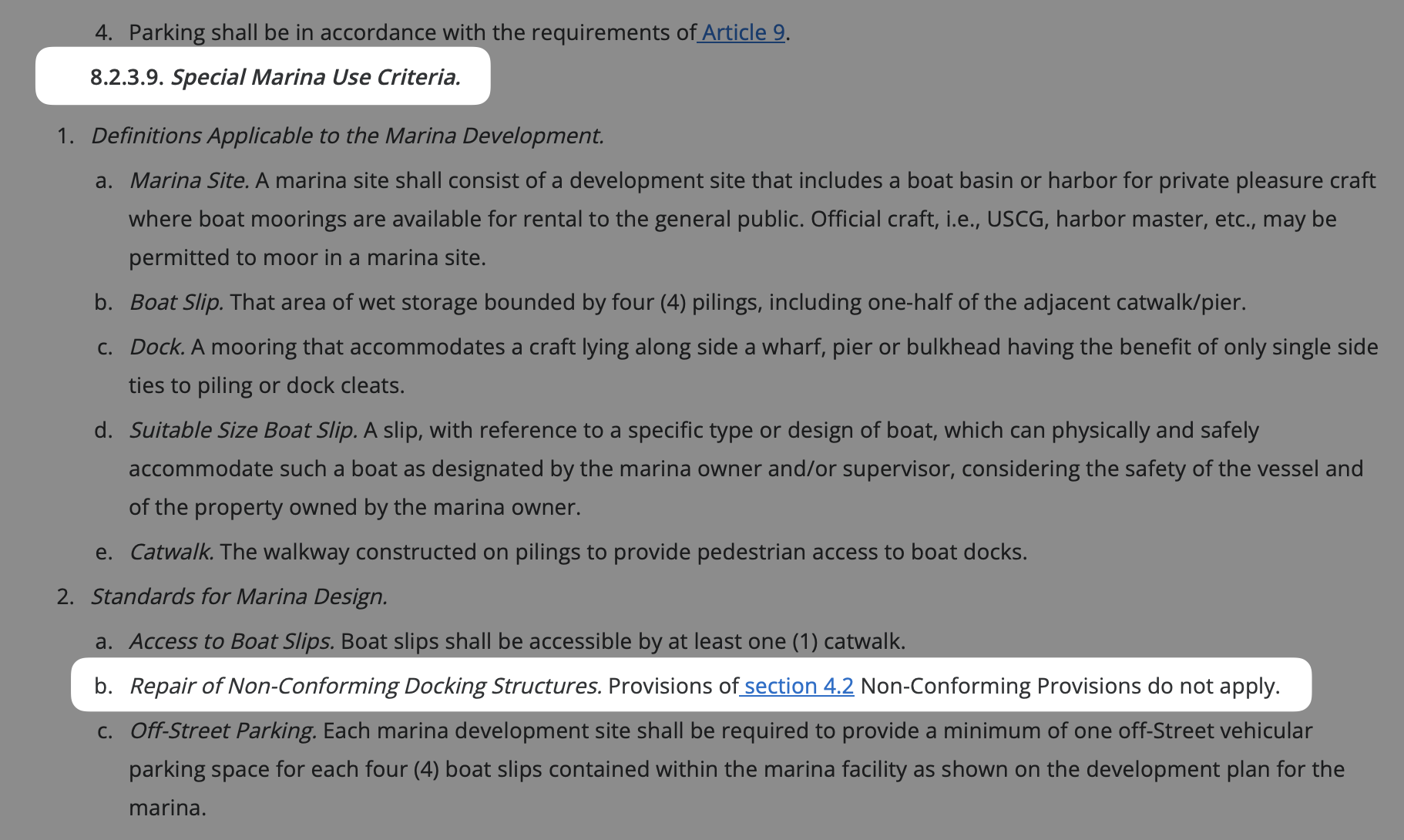
The discussion then slipped into the marina that was not being considered but was nonetheless part of the project. (How do you consider and discuss a marina that is on a different piece of property that is not being considered in this application? This may be one of those mysteries of life.) Terri Hamilton commented on the fact that it was merely a body of water at this time and had no clues that it was a marina. Then came the legal gymnastics. The City Attorney proclaimed that it used to be a marina and therefore basically, it will always be a marina under the CLURO. To this a question and comment by Bill Kropog: CLURO Section 8.2.3.9, 2b states that you can maintain a marina by Repair of Non-Conforming Docking Structures. The problem is that there are no docking structures, they were all removed around 2018. The City Attorney disagreed and maintained that potential repair of imaginary docking structures was sufficient to maintain marina status. This is the kind of stuff that gives the law a bad name. Only special shamans can tell us lowly peasants that the true meaning Repair of Non-Conforming Docking Structures obviously refers to docking structures that only shamans can see.

Then another invaluable shaman interpretation occurred when Van Mayhal asked about CLURO 4.3.3.8, this is the section that states:

4.3.3.8. Review and Evaluation Criteria.

The Planning Director, the Planning Commission and the City Council shall review and evaluate and make the following findings before granting a Conditional Use Permit or Planned District zoning using the following criteria:

There are 12 criteria that are listed which are below, but Mr. Mayhal, an attorney but apparently not a shaman, stated that in the law when the word “shall’ is used in a statute you must do whatever follows. (A shaman is a member of certain traditional societies, who acts as a medium between the visible world and an invisible spirit world and who practices magic or sorcery for purposes of healing, divination, and control over natural events.) The simple conclusion to be drawn from the introductory statement above is that all three entities; The Planning Director, the Planning Commission and the City Council must review and evaluate Sucette by answering the following:

  1. Comparison with applicable regulations and standards established by the Comprehensive Land Use Regulations applicable to the proposed use and site.
  2. Compatibility with existing or permitted uses on abutting sites, in terms of building height, bulk and scale, setbacks and open spaces, landscaping and site development, and access and circulation features.
  3. Potentially unfavorable effects or impacts on other existing conforming or permitted uses on abutting sites, to the extent such impacts exceed these which reasonably may result from use of the site by a permitted use.
  4. Modifications to the site plan which would result in increased compatibility, or would mitigate potentially unfavorable impacts, or would be necessary to conform to applicable regulations and standards and to protect the public health, safety, morals, and general welfare.
  5. Safety and convenience of vehicular and pedestrian circulation in the vicinity, including traffic reasonably expected to be generated by the proposed use and other uses reasonable and anticipated in the area considering existing zoning and land uses in the area.
  6. Protection of persons and property from erosion, flood or water damage, fire, noise, glare, and similar hazards or impacts.
  7. Location, lighting, and type of signs; and relation of signs to traffic control and adverse effect on adjacent properties.
  8. Adequacy and convenience of off-street parking and loading facilities and protection of adjacent property from glare of site lighting.
  9. Conformity with the objectives of these regulations and the purposes of the zone in which the site is located.
  10. Compatibility of the proposed use and site development, together with any modifications applicable thereto, with existing or permitted uses in the vicinity.
  11. That any conditions applicable to approval are the minimum necessary to minimize potentially unfavorable impacts on nearby uses and to ensure compatibility of the proposed use with existing or permitted uses in the same district and the surrounding area.
  12. That the proposed use, together with the conditions applicable thereto, will not be detrimental to the public health, safety, or welfare, or community aesthetics, or materially injurious to properties or improvements in the vicinity.

There are meaty subjects in these 12 items. We don’t know what the Planning Director did except that she did not deviate from the Sucette plan. However, there is no evidence that Planning and Zoning reviewed, evaluated or made any findings involving these individual 12 items so we don’t know specifically what they decided, or why. All that we can infer is that because they voted (4-3) to move this on to council that they must have considered these criteria. What? Can an inference be a finding? Is that what is contemplated by 4.3.3.8? If this matter goes before a judge, what can he determine about the review and evaluation process and why a certain decision was made. You really can’t without more information hence the need for a finding on each issue. Maybe nobody thinks this will ever get to court and therefore the City of Mandeville does not need to worry about it? Why wouldn’t you want to be clear about what you did, and why? Maybe I have answered my own question.

Larry Grundman, a persistent critic, lamented the fact that all of the questions mostly raised by citizens in the Planning and Zoning hearings and to some extent, the council hearings, appeared to have fallen off into the ether. Were the questions ever answered? How can anyone tell? If you cannot find the questions or the answers what have you learned? Nothing. Does that mean that the protestations of the unwashed masses (e.g. the citizens) is merely an irritation to those in charge who are on a mission?

I can really understand how citizen questions can be repetitive, tedious and off the mark. But the citizens in a democracy have always been the theoretical owners, the client. Now when you throw in an educated populace, one that is motivated, the questions become more pointed and considered. Especially when their lifestyle is jeopardized.

At this point I made a comment suggesting that some of the responses, or lack of responses by some council people suggested that they may have had a hard time actually visualizing the basis for all of this citizen angst. I implored them to do a field trip to the site and bring the City Attorney and Director of Planning so that the questions and comments of citizens would be less abstract. How will that Sysco tractor trailer truck make that right turn from Monroe on to W. Antibes? The Mariners Island is only 100′ from the event center? How will several hundred more cars and trucks shuffle in and out of this small peninsula of land every day?

The conversation then drifted off with a pronouncement by the Director of Planning that the City of Mandeville of Mandeville could prohibit the sale of Parcel U in order to maintain its tie to the Parcel D development. What?

Then the question of how or why this could be done landed in the City Attorney’s lap who asked Councilman Jason Zuckerman if he wanted to waive attorney client privilege since he was the client. Now attorney client privilege is in place so your adversaries don’t discover your attorney’s confidential communication. Oh, and in this case, in case you didn’t know, you and I are the adversaries.

Local attorney Kevin Vogeltanz tried to remind the council that this property is currently zoned residential, albeit planned development residential which is why in 1998 it was approved for 10 single family homes, which was specifically supported by that council at that time because it maintained the residential atmosphere of the Old Town. No more. We apparently cannot afford to maintain that residential quality. It disappeared not in a specific change in the law or Comprehensive Plan but rather through a lawyer’s interpretation of what should be.

Does anyone get the feeling that all of this planning stuff, and the legal interpretations that support it, might as well be a foreign language that somehow loses sight of the fact that it is supposed to represent the will of the people?

Moving on. Larry Grundman, Brian Rhinehart and Kevin Vogeltanz got up and again asked why nobody was even considering going item by item through the 12 criteria in 4.3.3.8. Crickets.

Then the discussion moved to height. We all might think this is a cut and dried issue. How tall is it? Well, no. Do you measure from the ground, the first floor of a garage, the first floor where people live and walk? Now Councilman Jason Zuckerman is an architect and he works for a big contractor. He has done a few buildings. Mr. Hoffman and Mr. Zuckerman got into a discussion about whether the buildings are 60′, 70′ or 80′. Hoffman talked about “architectural features” at the top. Zuckerman called that a roof. Part of the problem is that the ground is not flat. The elevation may change by many feet in a very small area. If you have to have the first floor above a certain elevation for flood purposes then that can add to the total height of the structure. And so it went.

Then Terri Hamilton got up and shared a photo an engineer friend did that imagined Sucette in place surrounded by Mariners Island and Tops’l, the immediate adjacent condos that are I believe around 35′ high. Well, the depiction envisioned a 60′ Sucette (instead of 70′ or 80″) which literally made it twice as high. It dwarfed its neighbors. Will there be a finding that this is compatible?

The evening finished up with Councilwoman Jill McGuire expressing frustration that she was either getting no advice or conflicting advice from the City Attorney or the Director of Planning. Are we at a point where the Council should hire its own attorney? We may be past that time.

Councilman Jason Zuckerman finished by questioning the vague and over inclusive language of the ordinance. The ordinance purports to “re-zone to the extent necessary”. What does that mean? “All variances are granted”. What variances? They said they weren’t required to get any variances, why are they asking for a blank check on variances?

The next episode will be Wednesday, July 12th Spitzfaden Center at 6:00pm.

-30-

OPINION: City Attorney’s position on Parcel U is flawed

The case for a conditional use permit for the ‘marina’

Editorial

During the last few City Council meetings where the Sucette Harbor project was debated, the City Attorney repeatedly insisted that the parcel of land where the marina will lie, does not need the City Council to approve a conditional use permit as is required for the rest of the property.

But some on the council – specifically Councilman at Large Jason Zuckerman and District III Councilwoman Jill McGuire – seem to disagree with this interpretation based on their lines of questioning.

The crux of the matter is the working interpretation by City Attorney Elizabeth Sconzert of a section of Mandeville’s Comprehensive Land Use Regulation Ordinance, or CLURO.

Steel Man Argument: Sconzert’s case

Sconzert, along with Director of Planning and Development Cara Bartholomew, have maintained since the very beginning that a conditional use permit is not required for the marina parcel, but only for the parcel of land where the hotel, events center and apartment structures will lie.

Sucette Harbor proposed site plan, June 28, 2023, revision (Mandeville Daily)

The current ordinance only contains a conditional use permit for Parcel D, not Parcel U where the marina lies. The CLURO has a table of designated uses and procedures that apply to each according to their respective zoning districts.

CLURO Section 7.7 — Table Of Permitted Uses By Zoning District — is a big deal, and anyone who plans to build something in Mandeville is well aware of its implications.

According to the table, each designated use might require a procedure or special approval based on its zoning district in order to have something built.


See also:
Sucette Harbor plans revised to reduce scale, density, plus fix property line issues


For example, Parcel U is currently zoned “Planned District” or “PD” in the table, and the designated use “Marine Service *Marinas” (line 6.4.53) with that zoning requires a conditional use permit, so says Section 7.7.

However — and this is Sconzert’s contention — there is an asterisk after that designated use, which she says means a conditional use permit is not in fact required because there’s an exception for the designated use of marina.

According to the legend for the table (Section 7.7.2 – Use of Symbols in Table of Permitted Uses), the asterisk (*) means “Special Development Criteria” which directs the reader to Article 8 of the CLURO to see if there is a matching criterion.

Sconzert says there is indeed a matching condition at Section 8.2.3.9 “Special Marina Use Criteria” and she even quoted it verbatim at the last meeting on June 20th. In full, it reads:

“8.2.3.9(2b) – Repair of Non-Conforming Docking Structures. Provisions of section 4.2 Non-Conforming Provisions do not apply.”

There we have it. Section 4.2 does not apply. But what is 4.2?

Section 4.2 defines what legally non-conforming is. Basically, it lists a whole slew of conditions that allow a legally non-conforming parcel to be brought up to compliance and in such cases, they lose their permit to operate and generally need to reapply.

This is made clear in 4.2.3(9): “Abandonment or Discontinuance. When the use of a non-conforming development site has been abandoned for a period of six (6) months, regardless of any reservation of intent not to abandon use of the site, such site shall not thereafter be used, developed or improved until it is brought into conformance with the provisions of this Ordinance…”

And “provisions of this Ordinance” would simply mean they have to start over and apply for their use permit, according to the aforementioned Table of Permitted Uses at 7.7.3.

But remember, Sconzert is saying nothing in 4.2 matters. She is asserting that the “Special Development Criteria” of Article 8, as specified by the Table of Permitted Uses at Section 7.7.3, line item 6.4.53 “Marine Service *Marinas” renders 4.2 moot, because the developer is merely repairing existing docking structures.

Everything we’ve laid out here in this piece is Sconzert’s “steel man” argument, as if she were here making the case herself. No trickery.

But it is the opinion of Mandeville Daily that she is just plain wrong, and here’s why:

What does it mean to be a non-conforming marina?

Section 8.2.3.9(2b) — the linchpin of Sconzert’s argument — is only a valid condition for marinas whose “docking structures” have fallen into disrepair, not marinas that had their slips and docks removed before being transferred from one party to another as Al Copeland Jr. did with Parcel U in 2018, giving it to the LSU Health Foundation.

Copeland willfully and voluntarily took Parcel U out of commerce in 2018, when he demolished and removed the slips, hence making it subject to 4.2 “Non-Conforming Provisions,” or more specifically 4.2.3(9): “Abandonment or Discontinuance.”

Section 8.2.3.9(2b) very specifically refers to “docking structures” and not a marina as a whole. And besides, “marina” in the eyes of the CLURO is just a designated use and not an actual thing.

“Repair of Non-Conforming Docking Structures. Provisions of section 4.2 Non-Conforming Provisions do not apply.”

But this section or the CLURO was only intended to allow the owner/operator of an otherwise working marina repair his docking structures without having to get a new conditional use permit.

On which planet can you take what is effectively an empty body of water and build a new marina infrastructure — including docks, slips, bulkheads, fueling stations, etc. — and call it “Repair of Non-Conforming Docking Structures” and get away with it?

Words have meaning.

Parcel U is non-conforming and the Table of Permitted Uses at Section 7.7.3 says a conditional use permit is required to build a new marina infrastructure. Unfortunately, we have a City Attorney who seems to be ignoring the obvious.

Bonus: Parcel U never again has to come before the Council… ever

Sconzert and Bartholomew keep saying that Parcel U has always been a “marina” since before the CLURO was enacted, and its designated use is not changing, therefore there is no need for a conditional use permit.

The only problem with that is, the property changed hands or ownership when Al Copeland Jr. donated it to the LSU Health Foundation. What’s more, as emphasized earlier, the slip and docking structures were removed.

According to Sconzert, it doesn’t matter that the property changed owners, as long as it remains a “marina” by designated use, it does not have to come before the City Council.

Based on this interpretation, if the LSU Health Foundation and Woodward Interests decided next month that they have changed their plans and no longer need Parcel U, they could immediately sell it to someone else, who could then build however many boat slips, docks or whatever they wanted, without a conditional use permit, without an ordinance, without even telling anyone what they were doing.

From here to eternity, it would never have to come before the City Council again… as long as it keeps the designated use of “marina.”

To that, we’ll just agree with McGuire: “That’s crazy talk.”

Past the point of no return

Mandeville Daily believes that Sconzert and Bartholomew feel they are past the point of no return to admit there might be an issue anywhere that could throw a wrench into the works.

Maybe it’s just as simple as this: They honestly and wholeheartedly believe the project is good for Mandeville and it must be adopted at all costs, despite all of us dummies out here who don’t know any better.

If they were to change their position at this late stage of the game, then surely we could expect a lawsuit from the developer.

Until this thing is hopefully voted down by the City Council or perhaps vetoed by Mayor Clay Madden, Sconzert and Bartholomew will continue to make awkward faces, weird contortions, and seemingly impossible leaps in logic during council meetings when confronted with even the most basic observations of fact or contradiction.

-30-

Related Links:

OPINION: Conflicting statements by city official revealing, troubling

Sparks fly over property lines, conditional use permit details as council members tangle with city officials at special meeting

Sucette Harbor special meeting rescheduled after delay in updated plans

ERNEST BURGUIÈRES: The circus does not fail to amuse


Sucette Harbor plans revised to reduce scale, density, plus fix property line issues

Apartments reduced from 201 to 178, 11% reduction

Coucilwoman Bush had asked for reduction at June 20 meeting

Developer had insisted such reduction not possible to keep project economically viable

Resturant and seating removed from Parcel U

Doesn’t address Parcel U conditional use permit controversy

MANDEVILLE — The Sucette Harbor developer has submitted a drastically revised site plan just 13 days before an expected vote, reducing the apartments from 201 down to 178 and redesigning the restaurant and parking layout to avoid encroachment into an adjacent parcel for which a conditional use permit was not submitted.


We have looked at the size of it from the very beginning… If we reduce the number of apartments then it starts impacting the overall economics of the whole development, which includes the site plan and the marina and everything else that goes into it. So it’s not a simple question of do you take out 10 apartments and everything still stays OK.

— Bill Hoffman, President, Woodward Interests
— June 20th Special Meeting


By removing the south wing of the active adult complex we eliminate a net 23 apartments.

— Bill Hoffman, President, Woodward Interests
— June 28th letter to City Council announcing site plan changes


The new site plan seems to show that a significant portion of the restaurant and outdoor seating has been removed from Parcel U and is now completely contained within Parcel D.

Ordinance 23-16 contains a conditional use permit for Parcel D, but not Parcel U. The revised site plan still has a marina planned for Parcel U, which some on the council and in the community contend requires a conditional use permit for the project to move forward. Those concerns were not addressed with these latest changes.

During questioning at the June 20th special meeting, District I Councilwoman Rebecca Bush expressed to Woodward Interests President Bill Hoffman that her issue with the proposal was one of scale.

“Is there no way we can reduce the number of apartments? … Are y’all willing to budge on that at all?” Bush asked.

Hoffman replied, “We have looked at the size of it from the very beginning… If we reduce the number of apartments then it starts impacting the overall economics of the whole development, which includes the site plan and the marina and everything else that goes into it. So it’s not a simple question of do you take out 10 apartments and everything still stays OK.”

The update to the site plan yesterday (June 28th) shows a reduction of 23 apartments.


See also:
Sparks fly over property lines, conditional use permit details as council members tangle with city officials at special meeting
Sucette Harbor special meeting rescheduled after delay in updated plans
OPINION: City Attorney’s position on Parcel U is flawed
OPINION: Conflicting statements by city official revealing, troubling


The City was notified of these changes via an email from Hoffman yesterday (June 28th).

Here is the revised proposed site plan dated June 28, 2023:

.
Here is the original proposed site plan:

.

Hoffman’s email reads:

Councilmembers,

For nine (9) months, we have listened and worked with the community to develop plans for Sucette Harbor. Based on feedback, we have significantly modified the plans to address parking, restaurant location, and retail space related to the marina. At present, the project complies with CLURO provisions on density. Nonetheless, the Council and the public have commented on the scale of the project for the subject site. As a result, we are prepared to make major alterations in the plans for Sucette Harbor to further reduce the density, to allow for even more parking, and to substantially reduce the scale of the project. This is being done in the interests of cooperation and in anticipation of full Council support for the project.

Based on this feedback we are proposing to amend the Sucette Harbor plans to include the following changes.

Scale of Active Adult – To address the scale of the active adult complex, we propose to remove the south wing of the complex. This will eliminate approximately 55,000 square feet of building from the active adult complex, 12% of the space.

Density – By removing the south wing of the active adult complex we eliminate a net 23 apartments. The density allowed by the CLURO for Parcel D is 218 apartments. The plans submitted included 201 apartments. With this proposed amendment to the plans, Sucette Harbor will have 178 apartments, or 1 per 3,673 square feet of land, 11.86 units per acre.

Parking – By removing the south wing of the active adult complex the number of parking spaces required is reduced and we are able to add additional parking spaces on site. With a total of 622 parking spaces, Sucette Harbor will have 43 more spaces on the site than required assuming a multi-family complex and 132 more spaces than needed for an active adult complex. See attached parking summary.

Attached is a site plan with the south wing removed and the additional parking spaces added. (Note the restaurant building has also been pulled back off the property line.)

If you are in agreement with the above changes, we will have our attorney work with the City’s attorney to amend the ordinance. We will also include revisions requested on parcel D based on the discussions surrounding the marina services.

I will be happy to discuss the above changes at the next public meeting on Sucette Harbor.

Regards, Bill
William D. “Bill” Hoffman
President, Woodward Interests, LLC

The next scheduled special meeting is July 5th at 6 p.m. This is a developing story.

-30-

OPINION: Conflicting statements by city officials revealing, troubling

City Attorney admission that building, structures on Parcel U means amendment required to avoid conditional use permit

Planning director contradicts City Attorney with denial that buildings on Parcel U

Site plan shows restaurant building, outdoor seating on Parcel U

Editorial

The Sucette Harbor ordinance as written, including its latest exhibits, would require amendment in order to pass legal muster, so says City Attorney Elizabeth Sconzert.

Yes. She said that.

Not in so many words, but she said it all the same. It was the kind of revelation whose significance might have slipped by the casual observer. Mandeville Daily didn’t catch it until after watching the video from the June 20th special meeting for the third time.

What’s more astonishing is that minutes later, Director of Planning and Development Cara Bartholomew would state the exact opposite — on the record. And she and Sconzert sit right next to each other.

Sconzert and Bartholomew have maintained throughout this process of public meetings that Parcel U is “off the table” when it comes to requiring a conditional use permit, even though some council members and others have been jumping up and down in frustration because the latest site plans clearly show buildings on Parcel U. (Critics also allege that Parcel U was taken out of commerce years ago, having its boat slips and bulkheads demolished, hence requiring a conditional use permit for that reason as well. Sconzert has a different legal argument to combat that complaint.)

Until June 20th, anyone who questioned the proposal was told that Parcel U is just a marina, and doesn’t require a conditional use permit. As if they were willfully ignoring the property line between Parcels D and U as well as the developer’s drawings clearly showing buildings on Parcel U.

Nothing to see here, we were told.

But with what Sconzert said on June 20th, everything has changed. So much so that mysteriously, Woodward Interests, the Sucette Harbor developer, abruptly asked for more time to revise something which triggered a previously scheduled meeting for June 29th to be canceled, er, rescheduled, that is.

Sconzert didn’t come right out and say that there is a legal issue with Ordinance 23-16, mind you. She is an attorney after all.

What she actually said was, there are two “issues” at present.

Sconzert said the first issue was that there are indeed structures planned for Parcel U (which would require a conditional use permit) but that this is a minor glitch because it can easily be remedied by the City Council, presumably with an amendment specifying that all building structures must be contained within Parcel D and not on Parcel U. (Parcel D has a conditional use permit as part of the ordinance.)

Really? Then why didn’t they draw it that way from the beginning? These facts admitted to by Sconzert were just as true five months ago as they are now.

This means that the ordinance as written with its current exhibits and site plan, would indeed require a conditional use permit for Parcel U.

And if you take that to its logical conclusion, the ordinance needs to be amended one way or the other: either to specify that no buildings can be on Parcel U, or to add a conditional use permit for Parcel U.

The latter would in effect throw the whole thing back to the Planning and Zoning Commission. Rest assured, they don’t want that to happen.

Here are Sconzert’s exact words:

“There’s a little tiny parcel of land that goes along the wedding garden, and there’s a little tiny diagonal corner where the restaurant is set to be. The question is, is because the restaurant is sitting on — as in the conceptual site plan — because that restaurant is sitting on possibly Parcel U and Parcel D, should Parcel U be here (and require a conditional use permit)? And I think that’s just kind of a, that’s a situation where you guys can ask that. Like are you… does it intend to stay on Parcel D and it’s probably, because it’s conceptual, it could be moved and limited to Parcel D (via amendment).”

She’s clearly saying Ordinance 23-16 has a problem, and it must be fixed, one way or the other, if it is to be adopted. There is no other way to parse her statements.

Sconzert even reiterated this assertion in an exchange with Councilman at Large Jason Zuckerman moments later when he cross-examined her, probably because he too was astonished at what he had just heard:

Sconzert: “There is a little part of Parcel D and Parcel U, that there’s a restaurant sitting on it.”

Zuckerman: “In the site plan we are being asked to approve, there is a restaurant shown that is over the property line in another parcel (Parcel U), that’s correct, along with outdoor seating?”

Sconzert: “Yes.”

Wow. And if that wasn’t enough, about five minutes later Bartholomew threw out a real head-scratcher.

Zuckerman asked Bartholomew if the city would require a conditional use permit for Parcel U (because previous statements by Sconzert implied such an action is at the discretion of the planning department head).

Bartholomew responded: “So at this point, all the plans that we have seen are only showing the docks on Parcel U. I haven’t seen a plan or anything that shows anything else other than the slips on parcel U and the bulkheads.”

Is she kidding? Did she not hear Sconzert moments earlier say the exact opposite and admit to buildings being in Parcel U on the current site plan? Had Bartholomew not seen the site plan by now?

And why would the developer — if they were working with Sconzert and Bartholomew from the get-go — submit an ordinance and site plan that has such significant problems baked into it, that they are now quite literally having to go back to the drawing board to fix it with only weeks to go before a vote?

In baseball this is called the unforced error. The only question is, whose error?

-30-


Related Links:

Sparks fly over property lines, conditional use permit details as council members tangle with city officials at special meeting

Sucette Harbor special meeting rescheduled after delay in updated plans

ERNEST BURGUIÈRES: The circus does not fail to amuse


Sucette Harbor special meeting rescheduled after delay in updated plans

Developer asks for more time to make changes to proposal

Planning director denied that any buildings or structures were planned for Parcel U despite site plan showing otherwise

Update: Corrects rescheduled meeting date to ‘June 29th.’

MANDEVILLE — The City Council has rescheduled the June 29th Sucette Harbor special meeting after confusion over the site plan at the last meeting when it was announced that changes to that site plan had been made but were not yet available.

The meeting has been rescheduled to July 5th at 5:00 p.m. The announcement was made by Council Chairman Councilman at Large Rick Danielson at the beginning of tonight’s (June 22nd) regular City Council meeting.

The council was notified today (June 22nd) that the project developer asked for more time for revisions they had promised to deliver to council members by today.

At the previous meeting on June 20th, City of Mandeville Planning and Development Director Cara Bartholomew made a bombshell announcement at the beginning of the meeting that significant changes had been made to the site plan and other exhibits in response to original conditions or requests made by the Planning and Zoning Commission but those changes would not be available to the council at that meeting.

Councilman at Large Jason Zuckerman asked Bartholomew if the city would require a conditional use permit for Parcel U, which is the marina parcel of property.

She responded, “So at this point, all the plans that we have seen are only showing the docks on Parcel U. I haven’t seen a plan or anything that shows anything else other than the slips on parcel U and the bulkheads.”

So at this point, all the plans that we have seen are only showing the docks on Parcel U. I haven’t seen a plan or anything that shows anything else other than the slips on parcel U and the bulkheads.

— Planning and Development Director Cara Bartholomew

This statement appears to be in contradiction to the most-current available site plan drawings. (See this previous report in for a detailed examination of those plans.)

Those drawings clearly show the restaurant building and outdoor patio seating well into Parcel U (see below):

Planning and Development Director Cara Bartholomew told Councilman at Large Jason Zuckerman that no buildings or outdoors patio seating is planned for Parcel U. (Mandeville Daily)

Sucette Harbor attorney Paul Harrison had promised during questioning by Zuckerman to provide an updated site plan “tomorrow or the next day” after it was revealed that significant changes had been made that were not yet available to the council or public.

Now it appears, those updated plans and exhibits will not be delivered as promised.

It remains unclear if the coming changes from the developer will remove the above pictured buildings from Parcel U. Bartholomew described the coming changes as:

“There was [sic] two buildings located on the west side of the property along the marina, one of those buildings were [sic] removed. … The square footage of that southern building was added on about 2,000 square feet to accommodate just the marina service operations.”

The delay in updates drew harsh reactions from some on the council who during the meeting questioned Bartholomew and City Attorney Elizabeth Sconzert concerning conflicts with a servitude of passage and buildings planned for a parcel that Bartholomew and Sconzert had previously asserted had no such plans.

A vote on Ordinance 23-16 is tentatively planned for July 12th. It is unknown if this vote will be postponed in light of the canceled June 29th special meeting.

This is a developing story.

-30-

ERNEST BURGUIÈRES: The circus does not fail to amuse

June 20, 2023: Coverage of the City Council’s special meeting to discuss the Sucette Harbor project

By Ernest A. Burguières


Ernest A. Burguières is a Mandeville attorney who formerly served as District III Councilman. Mandeville Daily is honored to publish Mr. Burguières’ column with permission which is a combined reporting of the goings on in Mandeville government with his personal commentary.


I think these events are getting more interesting. People are starting to reveal themselves in ways that I don’t think they imagined.

The evening started with Cara Bartholomew, Director of Planning for the City of Mandeville reiterating something that her later comments show that she does not believe; the Council can accept, reject or modify Sucette.

First problem, which ought to be a big problem that only Jason Zuckerman and Jill McGuire seem to be aware of; the exhibits, plans and drawings they have are not current. How can you possibly consider a proposal in which the variables are constantly changing? This should have been finalized at the Planning and Zoning stage where Council would be reviewing a finished product. There was no finished product to review. Whose fault is that? This project went through the Planning Dept. and then to Planning and Zoning for months. What was accomplished? What questions were answered? What questions weren’t answered? Does anyone even realize how bush league this is?

Then Chairman Rick Danielson outlined the Succette topics for the evening: outlined the Sucette topics for the evening:

  1. Marina use
  2. Location of hotel
  3. Density
  4. Height
  5. Parking
  6. Traffic

The Marina

The Marina property is not under consideration but the design, build and operation of the marina on a separate parcel is part of the current proposal. Huh?

In response to Jason Zuckerman’s question about lapsed use (of the marina) Liz Sconzert, the City Attorney, unequivocally stated that once it was a marina it will always be a marina. Period. What about lapse of use? Sconzert maintains it was used as a marina last in 2018. My recollection is that it had not been used as a marina since Hurricane Katrina almost 20 years ago. Just a because a boat may have been parked in the water in Parcel U does not mean it was operating as a marina. Did it have any occupational licenses? Did it pay any sales tax? Did it have a utilities? Did it sell any fuel? Did it remove and effluence? Did it have any paying tenants? Most everyone knows that this harbor had a silting problem before Katrina and lack of maintenance made it virtually unusable.

The bottom line is that even though Parcel D and Parcel U are owned by the same entity only Parcel D (the land) was before the Council. This despite the fact that pretty much all of the drawings and plans submitted to the city are so imprecise that each parcel overflows into the other. Some of Parcel U is on land and contains pieces of Sucette and vice versa. How can the city make decisions on one parcel that have an effect on another parcel that is not under consideration? How can the Council make a decision with such imprecise drawings? Why didn’t Planning and Zoning take this up? Should it be referred back to Planning and Zoning?

Then, a bit of a bombshell. Jason Zuckerman was asking why Parcel U just wasn’t included? He also asked why the marina aspects of Parcel U would not require the review of a conditional use permit? Parcel D includes a lot of features and functions for a marina that is not part of the project and doesn’t really exist anymore. Apparently Cara Bartholomew, Director of Planning has the discretion to require that it go through a conditional use review instead of just applying for an administrative permit with no public hearing. So, Jason asked her if she would require them to go through a conditional use review. Silence. Why? Are you not aware of how controversial this project is and the City’s track record with managing marinas in the east part of town?

There is no information in the conceptual plans about what business the marina office will and will not do. There was vagueness about boat sales and boat repairs. We were initially told that there would be no fuel dock and no effluence removal facilities. Now, there might be both, especially since the CLURO kind of requires it. We also now learn Sucette expect only maybe eight (8) slips to be rented by Sucette residents, the rest (close to 100) would be rented to Mandeville area residents. Wouldn’t this add to the parking pressure? Kind of makes you question what Sucette is trying to do, and why.

The Hotel

The 80+ room, 108,000 square foot hotel that would be bigger than anything between Mandeville and Covington.

Jill McGuire opened the questioning regarding the event center. I, like many people, believed that the event center was a separate building from the hotel that would also entertain weddings with a capacity of over 200-plus people. Confusion reigned. It turns out, or maybe it doesn’t, that the hotel would have a ballroom in its primary building. Or maybe it was a separate structure near the hotel. I do not recall that the question was ever answered. Well in all fairness to Sucette it was not fair for the Council to try and rely on their current drawings.

Then Jason Zuckerman brought up the issue of compatibility. Mariner’s Island, the single family condos across from the 100′ marina entrance was maybe 150′ from the event center. How is this compatible, or fair, to the Mariner’s Island residents, many who are older, who sought out the location because it was peaceful? And, how is it compatible funneling all of this through the narrow Antibes streets?

The Right of Passage/Servitude

This is a feature that is tied to the land that pre dates Copeland’s ownership. When the manmade marina was dug out one of the conditions was that there had to be unfettered access by the public from Mariners Blvd. to the Lake. This is a strip of land that was surveyed and recorded with the Clerk of Court in Covington so that everyone would be on notice of its existence and location. Up until the prior council meeting no one, including Planning and Zoning in their hearings mentioned it. In fact, Planning and Zoning member Nixon Adams, its longest serving member, must have thought he was being generous and enlightened by persuading Planning and Zoning to include a public right of way to the Lake on the eastern border of the property. Nixon, it already existed on the western side. In any event, it was such a significant feature back in the 1998 case study and permit for Al Copeland, sr. that the Planning Department at the time objected to part of Copeland’s plans that showed encroachment on the right of way by some parking spots. Back then their plans were more complete or definite. The Planning Department was not so diligent today.

Density

The elephant in the room. We are told to just whistle past the graveyard.

In a surprise move Councilwoman Rebecca Bush asked Sucette if they could pull back just a little on the number of apartments. NO. According to Sucette, there economic model was so tightly would that it could not tolerate any reduction or change in the plans. Well, there you go. Sucette just admitted that their economic model could not tolerate a 10 unit reduction in apartments which means that it is not compatible with the area.

And then another bombshell. Jason Zuckerman read from an email that local architect, Vaughan Sollberger sent to the council with images showing that the Sucette density was exponentially greater than anything in the City of Mandeville. Then the bombshell. Cara Bartholomew, Director of Planning stated that the only use that is factored into her density calculation is the 200 unit apartment. The hotel is ignored. The event center is ignored. The marina is ignored. The restaurant is ignored. The Byzantine Mandeville CLURO ignores a majority of the people and uses to make you believe that this is a “low density” project that Sucette claimed in their mailer. How stupid are you? We shall see.

Citizen Terri Hamilton asked why a moratorium could not be issued on this project until all of these inconsistencies are resolved involving current dilemmas with marinas. Not going to happen. The train has left the station.

Local attorney Kevin Vogeltanz asked why the Sucette matter was not broken up in to two matters; the re-zoning and the conditional use permit. Cara Bartholomew, Director of Planning and Liz Sconzert, the City Attorney both agreed that the property was already properly zoned and therefore did not need to be re-zoned, despite the fact that the Ordinance 23-16 specifically requests that the property be re-zoned. Who you gonna believe, me or your lyin’ eyes?

Conclusion

This brings us to our conclusion. I can remember when I started highschool there was an extracurricular called debate. In debate you would take one side of an argument one day, and then be expected to take the opposite side the next day. Law school was similar. You learned that there are virtually no cases that are so black And white that the opposition doesn’t have some merit. With Sucette I am afraid that Cara Bartholomew, Director of Planning and Liz Sconzert, the City Attorney have talked themselves into believing, beyond any reasonable doubt, there is only one answer to this Sucette issue. This despite the fact that almost everyone is aware of numerous inconsistencies in the Mandeville CLURO. Last night more of the public started voicing their sentiment about Bartholomew and Sconzert by openly criticizing, mocking and deriding them for their comments that would have been expected from the Sucette attorney, Paul Harrison. In a way I feel bad for Bartholomew and Sconzert. They are so absolutely convinced that their position is the ONLY answer that any attempt to contradict that position is taken as a personal attack. They are stuck in the weeds and can’t figure how to get out.

As city agents they should not take a position on this project. But by insisting that this project is 100-percent appropriate and that no opposition is legitimate they are taking a position, they are advocating, for Sucette.

Maybe the City Council ought to hire independent counsel?

Sparks fly over property lines, conditional use permit details as council members tangle with city officials at special meeting

Building and structures planned for Parcel U according to latest site plan

Parcel U not part of conditional use permit which is required for project approval

Site plans changed but city attorney, planning and development director, developer did not have details to present to public

Council members bristle at changing site plans not being available

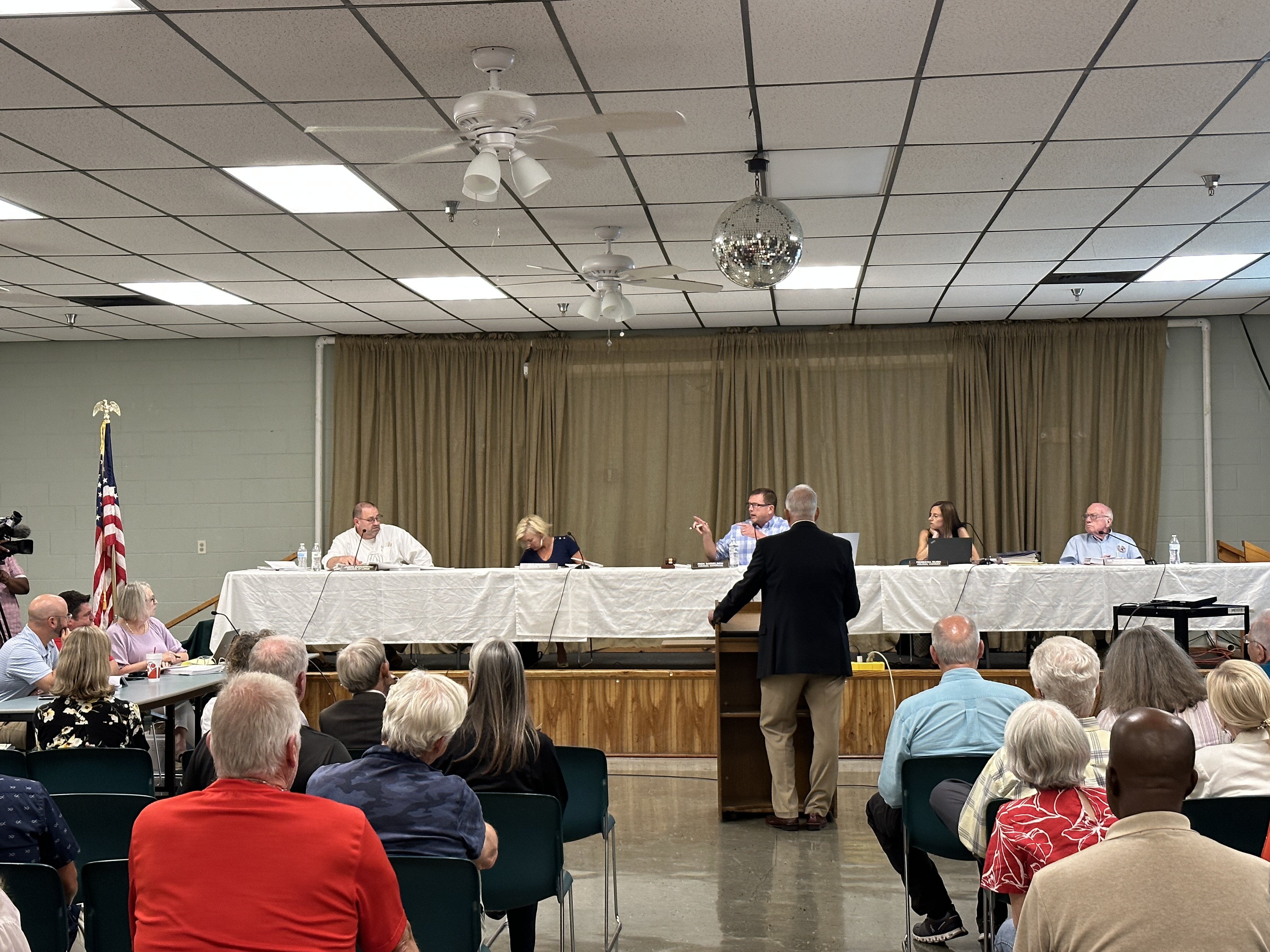
MANDEVILLE — An extended and intense exchange between council members, developers and city officials raises questions about details in the Sucette Harbor project ordinance which will be up for a vote later this summer.

Councilman at Large Jason Zuckerman and District III Councilwoman Jill McGuire had an often testy back and forth with City Attorney Elizabeth Sconzert and Planning and Development Director Cara Bartholomew over why the ordinance does not contain a conditional use permit for a parcel where boat slips and parts of a building and outdoor seating are included.

An examination of the proposed Sucette Harbor site plan reveals potential issues with the project as it is currently submitted to the City Council.

A raucous crowd at a special meeting to discuss the Sucette Harbor project showed their spirit, not just over the proposed development in Mariner’s Village but other concerns too. (Mandeville Daily)

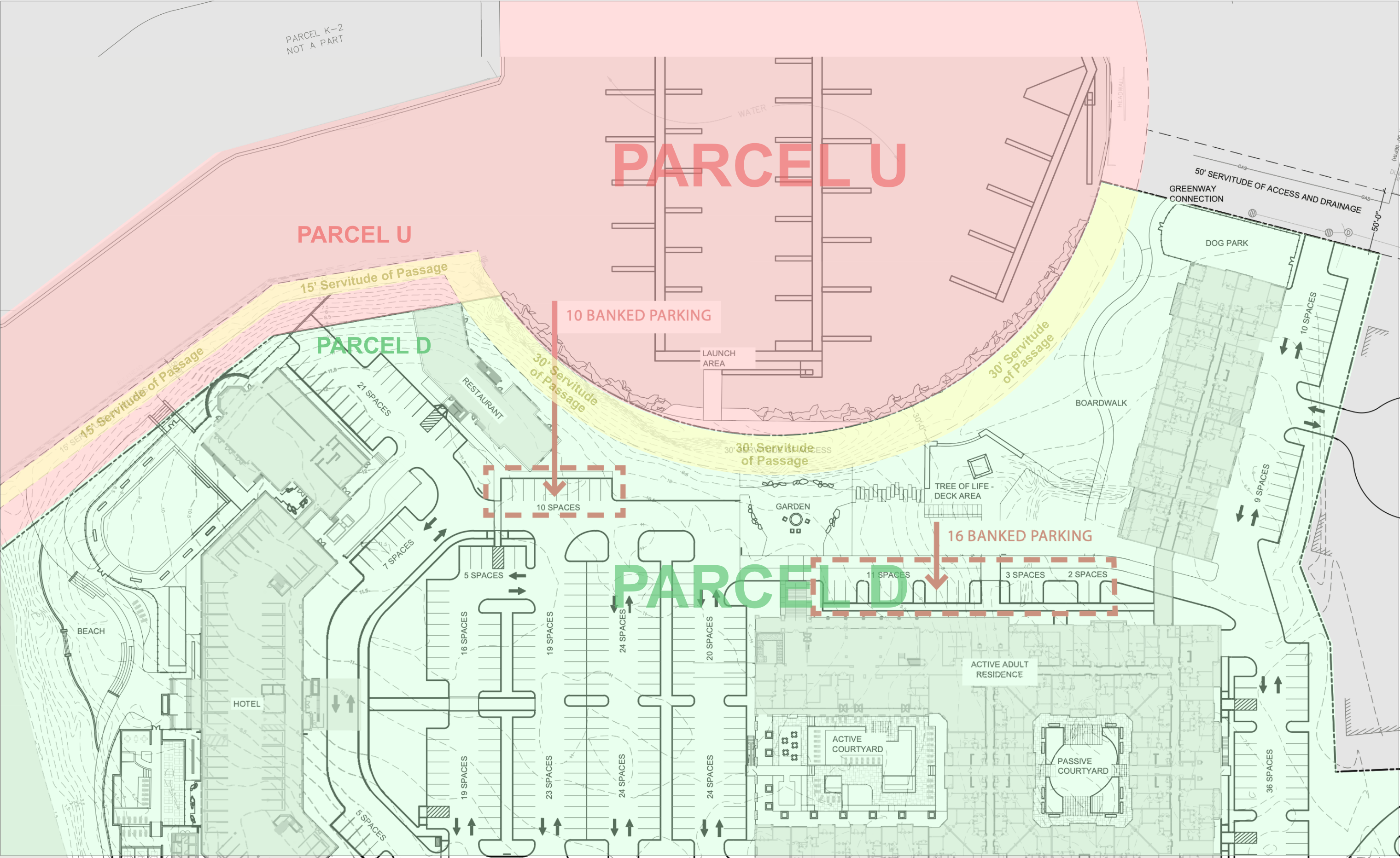
Ordinance 23-16 includes a conditional use permit only for Parcel D, which contains most but not all of the building structures in the latest plan (see slides below). The other Parcel U is not part of the ordinance, but contains the now demolished marina and current site plans show part of the restaurant building and outside seating on it.

What’s more, at the beginning of the meeting Bartholomew informed the council that there are updates to the current site plan but those changes would not be made available at the meeting.

“There was [sic] two buildings located on the west side of the property along the marina, one of those buildings were [sic] removed. … The square footage of that southern building was added on about 2,000 square feet to accommodate just the marina service operations,” Bartholomew said.

Zuckerman pressed Bill Hoffman, President of Woodward Interests, the developer of the project, for the latest plan. Hoffman said they did not have the latest site plan changes at the special meeting. “Maybe tomorrow,” Hoffman added.

When a flood elevation map is overlaid on the Sucette Harbor site plan, the so-called “servitude of passage,” which is required to remain as drawn, is in clear conflict with those plans. What’s more, when the parcels or property map is added to the mix, it becomes evident that several structures are indeed planned to be partially built on Parcel U. This is a problem because Parcel U is not part of the conditional use permit in proposed Ordinance 23-16, which would green-light the Sucette Harbor project.

Only Parcel D is specified in Ordinance 23-16. At previous City Council meetings where the proposed Sucette Harbor project was discussed, both Bartholomew and Sconzert stated that Parcel U is not part of the proposal as it is an existing marina and its designated use hasn’t changed.

However, Parcel U was removed from commerce years ago when it was donated by Al Copeland Jr. to the LSU Health Foundation, after the bulkheads and slips were demolished. While Parcel U is mostly water, it does contain a significant amount of dry land.

The most recent Sucette Harbor site plans provided by Woodward Interests, the project developer and partner of the LSU Health Foundation, shows buildings and structures planned to be built on the land portion of Parcel U.


The slides below illustrate the issues. The servitude of passage is drawn in yellow and is overlaid in multiple slides at its precise location. Parcels U and D are shown in red and green, respectively. All slides are to the same scale, except the last one which is an inset or magnification of previous slides:

Sucette Harbor: Elevation map with servitude of passage in yellow.
Sucette Harbor: Parcels U and D in red and green over the elevation map.
Sucette Harbor: Parcels U and D in red and green over the latest Sucette Harbor site plan.
Sucette Harbor: Servitude of passage and Parcels U and D over latest site plan.
Sucette Harbor: Magnification shows restaurant building and patio seating clearly on Parcel U.

-30-

ERNEST BURGUIÈRES: Sucette Harbor mailer deep dive

Developer mails out flyer to Mandeville citizens

By Ernest A. Burguières


Ernest A. Burguières is a Mandeville attorney who formerly served as District III Councilman. Mandeville Daily is honored to publish Mr. Burguières’ column with permission which is a combined reporting of the goings on in Mandeville government with his personal commentary.


When I first received the Sucette Mailer I immediately thought that it was the product of citizens who were opposed to the project.

Wrong.

Although it brings attention to some dubious claims as well as the unsuitability and incompatibility of the project for Old Mandeville, Sucette’s mailing may help promote the opposition to this project.

Ernest Burguières examines the Sucette Harbor mailer point by point below… (Mandeville Daily)

For example:

1. (LSU Medical School) will receive significant dedicated revenues for cancer research

  • I thought this idea had been abandoned some time ago. The last figures I saw suggest that in a perfect world there might be a few hundred thousand per year for cancer research, almost the cost of one doctor.

2. This low impact, low density development on property already properly zoned,…

  • The tallest building in Old Mandeville
  • The highest density in Old Mandeville
  • The largest parking lot in Old Mandeville
  • The most healthy live oak trees cut in Old Mandeville in decades
  • The current ordinance before the Council, Ordinance 23-16, seeks to re-zone the property
  • Up to 600+ more cars introduced to Old Mandeville on any given day
    These revelations are not in dispute and do not reflect a low impact, low density development on property already properly zoned.

3. Age restricted active adult apartments (average resident age 72-74)

  • Wow, they told Planning and Zoning that the age restriction was 55+. Why the change? Is that to try and externally adjust some of the traffic analysis assumptions?

4. A waterfront restaurant open to the public

  • Wow, they told Planning and Zoning that the restaurant was for residents inside Sucette so it would not add to the area traffic problem.
  • Which is it? Just insiders, or market the restaurant to everybody?
  • Is this one story for Planning and Zoning and one for the public?

5. Isolated from Old Mandeville and the Sanctuary

  • Is it part of Old Mandeville or is set apart?
  • Does it fit in with the fabric of Old Mandeville, or is it separate?
  • Are Old Mandeville and the Sanctuary somehow “negative” features of Mandeville?

6. Businesses will benefit from increased patronage from Sucette residents

  • An increased benefit would always be expected regardless of what they built or where they put it. But in a city that historically has run multi-million dollar surpluses, it is not in the same condition as other area communities that do not have the benefit of the same largess. The big question, at what cost?

7. No line-of-sight intrusion for local residents

  • Does this mean that the dreaded residents of “Old Mandeville” will not notice the largest glob of concrete and wood for miles? Why not just put up a sign that says Welcome to the Beau Rivage Casino!

8. $500,000 in new annual property taxes

  • Of which 10% or less goes to the City of Mandeville
  • The information on the City’s website presumably supplied by Sucette states that the annual property tax benefit for the City of Mandeville would be $27,000 – $34,000. Who to believe? What is the justification for paying with the numbers?
  • It is only the City of Mandeville that will be burdened by the presence of Sucette

9. $736,000 in new annual sales taxes

  • It is not known how this figure was derived, but again, less than 10% would go to the City of Mandeville.
  • The information on the City’s website presumably supplied by Sucette states that the annual property tax benefit for the City of Mandeville would be $40,000. A far cry from $736,000/ year. Who to believe? What is the justification for paying with the numbers?

10. Full time employment for 80 people

  • 80 new maids and waiters! Hasn’t anybody noticed that local restaurants are still struggling with staffing shortages? Where will they come from? Where will they park? How does it help to add to a manual / service labor shortage?

This does not include any details on compatibility, say for example, how that Sysco tractor trailer food supply truck (or any other commercial truck that would be expected to come in) would get up either Antibes (east or west) street without tearing up the curbs and grounds. Hint: there is no other way than Antibes.

Oh, and how does that wedding venue with 100-200 guests plus live music situated 100′ from Mariner’s Island residents fit into the residential environment? It doesn’t because it is the insertion of a loud commercial venture into a residential area. That is not a compatible use. This is not a mystery or a subtle conclusion, and more importantly, it is not fair to the residents of Mariner’s Island.

No, upon reflection, this mail out is a gift by Sucette to the beleaguered residents of that “Old Mandeville”. It highlights to a wider group of citizens all of the problems with this ill-conceived project. Take it to Slidell, Gulfport or Biloxi where it fits.

Property tax to stay same rate as previous 3 years

Proposed rate to stay at 8.86 mills

Same rate since 2020 when current council took office

Ordinance to be introduced and discussed June 22nd but not voted on yet

MANDEVILLE — The City Council will consider an ordinance that will keep the City of Mandeville’s property tax rate at 8.86 mills, unchanged from the previous three years, according to proposed Ordinance 23-22.

The rate was cut from 9.31 mills in 2020. The 8.86 millage is the lowest since 2002 when the rate was 20.25 mills.

Ordinance 23-22 will be introduced and discussed at the June 22nd regular City Council meeting. A vote will occur at a future meeting when it will be open for public comment again.

-30-


Related Links:
Mandeville City Council Agenda for June 22, 2023 Regular Meeting
Ordinance 23-22


FLASH: City Council to ‘discuss’ property tax ordinance upon introduction June 22nd

Unusual but not against Open Meetings Law

Gives public more time on issue

Council still must have public comment on night of vote

MANDEVILLE – The Mandeville City Council has scheduled the “introduction and discussion” of the upcoming property tax Ordinance 23-22 for the June 22nd regular meeting, an unusual move considering that agenda items — including resolutions and ordinances — are typically introduced under “new business” but not discussed until they come up for a vote under “old business” at the following or a future meeting.

This has been done in the past for complex issues, such as tax millages, so that the public has extra time to hear from the council and administration and ask questions.

The Louisiana Open Meetings Law still requires the council to allow public comment before a vote at the meeting where adoption is to be considered. This means that Ordinance 23-22 will get two public comment sessions at two different meetings.

Ordinance 23-22 sets the property tax millages for the fiscal year.

-30-


Related Links:
Mandeville City Council Agenda for June 22, 2023 Regular Meeting
Ordinance 23-22


Mariner’s Village Sucette opposition list grows with more disavowals submitted to City Council

Property list expands from 19 to 45

New signatures from Cayman Cove Homes, Harbor Oaks Condo Association, Tops’l Condominiums

Original list included 19 properties of Mariner’s Island

Also calls into question selection of MVMA board of directors

MANDEVILLE — A group of property owners and residents from the Mariner’s Village Master Association disavowing a so-called unanimous endorsement from its board of directors has grown from 19 to 45.

The five-member Mariner’s Village Master Association’s (MVMA) board of directors released a letter on May 25th from its president Eric McVicker, who also serves as a consultant for District II Councilman Dr. Skelly Kreller’s campaign. That letter was referenced at the May 25th Mandeville City Council meeting by Woodward Interests President William Hoffman when making his case for the Sucette Harbor project.

The 33 new signatures of disavowal come from properties in Cayman Cove Homes, Harbor Oaks Condo Association and Tops’l Condominiums, all a part of the MVMA, for a total of 26 properties (accounting for multiple signatures from the same address).

(Mandeville Daily)
(Mandeville Daily)

The original list was sent to the City Council by Larry Grundmann, claiming to represent Mariner’s Island Condominium Association (MICA) property owners, which is also a part of the MVMA.

According to the vote allocations found in the Master Association articles of incorporation, the LSU Health Foundation controls 89 of the 186 votes, or about 48 percent.

Woodward Interests is the developer behind the controversial Sucette Harbor project, in partnership with the LSU Health Foundation.

The new signatures come from Mariner’s Village rental homes investor and MVMA member Ellen O’Connell in a June 8th letter to the City Council. O’Connell’s letter, similar to Grundmann’s, calls into question the circumstances by which the MVMA’s current board of directors was selected.

According to McVicker, the current board was elected in and has served since 2021, even through the MVMA articles of incorporation call for annual elections.

Both O’Connell and Grundmann are challenging the legitimacy of the current board whose members, according to McVicker, are: Jason Dahlberg, Alex Edliamati, Gene Norton, Alejandra Guzman, and himself.

Guzman is the Executive Director of Business Ventures for the LSU Health Foundation, which is in partnership with Woodward Interests and Hoffman for the Sucette Harbor project. But when asked by Councilman At Large Jason Zuckerman at the May 25th council meeting who the MVMA board members were, Hoffman responded, “That, I don’t know.”

Grundmann’s letter contained the signatures of 23 individuals claiming to be a “super majority” of property owners of MICA. O’Connell’s letter contains 33 signatures from 26 different properties.

-30-


Related:

Sucette Harbor letter of endorsement challenged by Mariner’s Village residents

Mariner’s Village Master Association Articles of Incorporation

Mariner’s Village Master Association Bylaws


ERNEST BURGUIÈRES: A look at the Truitt case from West Feliciana Parish

By Ernest A. Burguières


Ernest A. Burguières is a Mandeville attorney who formerly served as District III Councilman. Mandeville Daily is honored to publish Mr. Burguières’ column with permission which is a combined reporting of the goings on in Mandeville government with his personal commentary.


This past week several citizens pooled resources and hired a New Orleans attorney, Justin Schmidt, who specialized in zoning matters. Mr. Schmidt submitted a report to the Mandeville City Council ahead of its Thursday, June 8th meeting. This 8 page report discussed many issues that most of us were familiar with and a few that we weren’t familiar with. A copy of this report is attached.

Of interest today is the attachment to this report of a recent case entitled Truitt v. West Feliciana Parish Government, 299 So3d 100 (La. App. 1 Cir. 2020) Mr. Schmidt handled this case on behalf of the plaintiffs (citizens) and against West Feliciana Parish Government.

There are several things that are interesting about this case. It is out of the First Circuit Court of Appeal which is located in Baton Rouge, Louisiana. The First Circuit includes the 22nd Judicial District Court which is in St. Tammany Parish. The First Circuit establishes case law for the First Circuit that is not otherwise governed by the Louisiana Supreme Court. The district Courts in the 22nd Judicial District Court are expected to follow the decisions of the First Circuit Court of Appeal.

The plaintiffs in Truitt owned property that abutted a parcel whose landowner sought to re-zone his property from residential agricultural to general commercial. From the description this contentious matter was not unlike what is occurring in Mandeville with Succette.

The West Feliciana Parish Planning and Zoning Commission and the West Feliciana Parish Council decided in favor of the re-zoning. A group of citizens appealed to the district court. The district court ruled against the citizens and the citizens appealed to the First Circuit Court of Appeal in Baton Rouge.

The First Circuit Court of Appeal overruled the Planning Commission, the Parish Council and the District Court finding that they had acted arbitrarily and capriciously in recommending approval of the Zoning Map Amendment.

There were numerous allegations made by the plaintiffs against the West Feliciana Parish Government through the Parish Council, the Commission and their respective staff to include:

  1. a select number of Commission members lacked the requisite number of training hours;
  2. a commissioner made a public misstatement of law at a commission meeting;
  3. a member of the Parish council and the Parish President made public statements in favor of the zoning map amendment;
  4. the Commission and Parish Council relied, inappropriately, on an oral promise from the zoning applicant about how the subject property would be used;
  5. a Council member worked with the zoning applicant in advance of the public hearing;
  6. the Commission failed to consider or suggest that a Planned Unit Development District be implemented;
  7. the Commission and Parish Council failed to consider review criteria relevant to the West Feliciana Parish Ordinances and a zoning map amendment; and,
  8. the Commission and Parish Council failed to consider the West Feliciana Parish Comprehensive Plan (“master plan”) in violation of La. R.S. 33:109(B).

The West Feliciana zoning regulations required that the Planning and Zoning Commission:

consider the recommendations of the administrator, Commission, relevant comments of all interested parties and the above-mentioned review criteria

Additionally, zoning regulations required that the Parish Council:

consider the recommendations of the administrator, Commission, relevant comments of all interested parties

The plaintiffs alleged that there was no evidence in the Planning and Zoning Department’s internal records on the proposed zoning map amendment and therefore the record was “completely devoid of any formal or informal notes, observations, written reports, minutes from internal discussions … or a more formal written preliminary staff report,” which would indicate that a good faith effort was made to comply with regulations, and that the Parish Council took action on the zoning map amendment without considering the review criteria.

When you read the 8 acts or omissions that the plaintiffs complained about you may see issues that are similar to Mandeville and Succette. Laymen (and attorneys) often have difficulty in tying a particular act or omission to arbitrary or capricious behavior. However, public statements in favor of the zoning map amendment, prior to the hearing, amount to pre-judging a matter which is a clearer example of arbitrary and capricious conduct.

If instances such as an elected official publicly proclaiming support for a project ahead of a hearing demonstrates a pre judging that constitutes arbitrary and capricious behavior in a subsequent vote, does that apply to Mandeville? See item 3 in the 8 West Feliciana issues above.

If it is arbitrary and capricious, how does the city of Mandeville deal with such an issue ahead of time to neutralize the issue? If the City Attorney is aware that a public official has made pre-judging statements that were published (https://neworleanscitybusiness.com/blog/2021/11/04/studies-underway-for-proposed-150m-mandeville-retirement-community/ ), and the City Attorney was also aware that such a pre judging public statement may have constituted arbitrary and capricious behavior on the part of the West Feliciana Parish Council in a recent case, what does the City Attorney of Mandeville advise? That the public official recuse themselves from the decision? I wonder what the city attorney’s advice would be?

Zoning issues are not something most people come into frequent contact with, even attorneys like myself. That said, all of these cases look to reasonable behavior. In looking at Mr. Schmidt’s letter to the council he points out several simple, straightforward issues that are not rocket science. They are common sense.

Mandeville Daily makes statement on ‘Social Media’ resolution, free speech to City Council

Read prepared comment at council meeting denouncing ‘social media’ resolution as attempt to quell dissent

Defended local activist attacked for over-the-top social media posts

Cited Supreme Court case law supporting ‘rhetorical hyperbole’

MANDEVILLE — The Mandeville City Council deferred action on a resolution that would ask citizens to limit their free speech in accordance with a set of rules laid out in the document, authored by Councilman at Large Rick Danielson.

The proposed Resolution 23-22 was deferred by a unanimous vote of the City Council after it met strong resistance from other members of the council, including Councilman at Large Jason Zuckerman and District III Councilwoman Jill McGuire.

Mandeville Daily editorialized against this perceived overreach and believe its intention was to have a “chilling effect” on dissent against the Sucette Harbor project.

Mandeville Daily believed it to be paramount to act against this attempted overreach by government in the long-standing tradition of other publications and media outlets that felt duty-bound to act when governments violated or attempted to violate or quell the freedom of the press and freedom of speech in general.

Danielson opened the discussion on the resolution by making an impassioned if not angry statement against social media posts that he described as being over-the-line and said his resolution offered a set of rules that it would be good if everyone abided.

Mandeville Daily’s editor and proprietor William Kropog read a statement during the public comment session. The statement was altered at the last minute to refute an argument that Danielson made moments earlier claiming that resolutions do not carry the weight of law. The reality is, resolutions are indeed binding. For example, the City Council’s rules for conducting its meetings are set by resolution. Mandeville Daily feared that this resolution would be used as an extension of those existing rules (including the three-minute time limit) to force people to apologize for social media transgressions before being allowed to participate at meetings.

The statement is as follows:

The three-minute speaking rule… that was set by resolution. The way the resolution reads, you could hold people inside (the council meetings) responsible for what they might say outside chambers.

It is my opinion that just the mere introduction of Resolution 23-22 is meant to intimidate the public from speaking or posting on social media in opposition to the Sucette Harbor project.

It’s one thing to have a rule governing public conduct inside Council Chambers, but to extend it to outside is unacceptable, even if it is just a so-called resolution.

This could have a chilling effect on dissent.

Remember, we already had a sitting councilman state on the record at the last City Council meeting (District II Councilman Dr. Skelly Kreller) that he is investigating anyone connected to an activist who made offending social media posts, and a lawyer for Sucette Harbor threaten a lawsuit against anyone “insinuating” things about his integrity. Both of these threats — allowed to go unchecked by the council chair — were in my opinion beneath the decorum.

Regardless of what anyone wrote on social media, it does not justify broad threats against everyone else in the chamber nor does it justify this resolution.

I feel the council chairman had an obligation to reign in the threat by Mr. Harrison as soon as it occurred. Again, this was beneath the decorum.

Though I disagree with it, I believe the activist’s body of comments on social media and the email they sent to the City Council are legally protected speech.

The activist accused Mr. Harrison of making campaign contributions, which are perfectly legal. The fact that the activist believes a legal campaign contribution is the same as a “bride” does not make it so. She described the offense in detail, further supported by a social media post by Dr. Kreller’s own campaign at his own fundraiser.

Rhetorical hyperbole is a First Amendment-based doctrine that often provides protection to exaggerated, over-the-top speech in defamation cases.

The doctrine provides breathing space to freedom of speech by ensuring that even heated and emotional rhetoric deserves free-speech protection in a free society.

The U.S. Supreme Court ruled in Greenbelt Cooperative Publication Association v. Bresler (1970) that the use of the term “blackmail” to refer to a developer’s negotiating style was rhetorical hyperbole more than an imputation of criminal conduct. The Court reasoned that “even the most careless reader must have perceived that the word was no more than rhetorical hyperbole, a vigorous epithet used by those who considered the developer’s negotiating position extremely unreasonable.”

The anti-Sucette-Harbor activist in question, did an eerily similar thing, again and again, describing and providing photos of a perfectly legal thing — that no one involved disputes happened as she described — except she applied the rhetorical hyperbole “bribe” to the act.

Protected speech. Ugly, maybe. Incendiary, sure. But Constitutionally protected nonetheless.

I respectfully ask that the resolution not be adopted.


-30-

ERNEST BURGUIÈRES: Entering the even stranger phase of Sucette

By Ernest A. Burguières


Ernest A. Burguières is a Mandeville attorney who formerly served as District III Councilman. Mandeville Daily is honored to publish Mr. Burguières’ column which is a combined reporting of the goings on in Mandeville government with his personal commentary.


Four and a half hours last night (June 8th). Went past 10:30.

What was accomplished? More sturm und drang (thunder and lightning)

As we stumble towards a conclusion on the Sucette matter some things start to come in to unmistakable focus. The room was packed. Except for the Sucette group (4-5), Liz Sconzert, the City Attorney and Cara Batholomew, the Director of Planning for the City of Mandeville, everyone present in the audience exhibited varying degrees of anger and fear.

The Council Chair decided that the Sucette portion would start with a recap of the traffic study, the buildout timeline and the use of the marina. It was at this point, for the first time that I recall, that it was revealed that there was all of this talk about a marina which is Parcel U, was not part of the consideration of the Sucette project. How can that be? Ordinance 23-16 goes on and on about slips, marina offices, parking for marina and bulk-heading, etc. for a piece of property that was not being evaluated. Strange.

In any event, the Chair decided that Sucette would be allowed to make unlimited comments on traffic study, the buildout timeline and the use of the marina before any citizen could ask questions or comment. This burned up 30-40 minutes. I asked the Chair and he stated he thought it was more efficient. Enough time passed that people either forgot their issue or they abandoned the meeting out of exhaustion. There was one recurring theme that carried over from prior Planning and Zoning hearings as well as this council hearing; citizens had dozens of questions and comments over the past 6-8 months, but they believed that their questions were never answered because there was no public record of what was asked or what the response was. The result was a feeling of being ignored. The council has just started making the council clerk’s email available for question and answer. The result of this is that that citizen make get a personal answer but the public is nonetheless unaware of the substance and direction of the questions and answers. Without feedback there is a further sense of isolation and dismissal by the citizens that further bred a “us vs. them” feeling. Where were OUR elected officials. How were they protecting US? Only two people exhibited behavior that suggested they were in this fight for the citizens; Jason Zuckerman and Jill McGuire.

Every novel point or question raised in opposition to Sucette was quickly dashed as being irrelevant. For some time now I have felt that Liz Sconzert, the City Attorney and Cara Batholomew, the Director of Planning for the City of Mandeville were sympathetic to the Sucette position. After last night’s meeting a number of people came up to me to ask whose side they were on. It kind of causes a sickening feeling in your stomach. Every point or question was immediately shot down.

Another thing, Ordinance 23-16, the Sucette ordinance, in addition to going into a discussion about what will happen in Parcel U without having Parcel U before them, there was reference to a whole bunch of exhibits, drawings and surveys, that up until a couple of days ago could not be found in City Hall. How can this be? Planning and Zoning, the Council and the City were being asked to consider a huge commercial development over the past 6-8 months without having a complete set of current plans? “Badges? badges? we don’t need no stinkin badges.” (a famous line of dialogue from the 1948 film The Treasure of the Sierra). In other words, don’t bother me kid, I’m busy.

Then into the traffic study. A traffic study is a technical exercise used by planners that generalizes and amortizes a traffic situation that is expected to be believed as gospel. It is written in stone but is wildly affected by which assumptions you plug in. No one understands them except planners. The analysis spreads out traffic counts (amortizes or averages) so that you mathematically minimize what the resident will be left to deal with. It does look good on paper. This is theory vs. reality. The reality is that Antibes east and west; THE ONLY WAY TO ENTER Sucette FROM THE NORTH are two unusually narrow streets that cannot even tolerate any parking. It is these two concrete goat paths that will tolerate hundreds of cars in unknown peak events (e.g. 200 person wedding = 100 cars at say 2:00pm on a Saturday). You owe it to yourself to drive these two streets. This is not compatible at all. Oh, and imagine if you will when Sysco Foods makes a delivery to the restaurant or hotel. They use tractor trailer trucks. You see them going down Girod to the restaurants on Lakeshore Drive. Now imagine a tractor trailer truck making that 90 degree right turn from Monroe onto Antibes west. It cannot happen without the tractor trailer cutting wide to the left and driving over curbs and grass. How much accommodation does Mandeville have to do to make Sucette a success? Before I forget, we were told that the City may have to solve this problem by narrowing the median between Causeway and Antibes west, and in the process cut down two live oak trees that form the gateway to Old Mandeville from Causeway. Think you sir, may I have another?

About 1/3 of the crowd left before they got the chance to comment or ask a question. Many asked why something this significant would not warrant a standalone meeting. We were faced again with an unusual “no time limit accommodation” for Sucette and a three-minute limit on hapless citizens, one of whom donated the balance of her time to her friend who had created a several minute video. Very creative. But the fact remains that the great mass of the unwashed, us lowly citizens, are nothing more than a backdrop for some very slick promoters.

The next meeting is tentatively set for Tuesday, June 20th as a standalone. A group of citizens pooled resources and hired an attorney who specializes in zoning matters. He has written a very interesting critique of this Sucette project which concluded with a copy of a reported case he recently won against West Feliciana Parish (the First Circuit Court of Appeal which includes Mandeville) for being arbitrary and capricious in their zeal to protect a re-zoning applicant.

Whew! Good luck pilgrims!

Sucette Harbor letter of endorsement challenged by Mariner’s Village residents

Mariner’s Island property owners submit disavowal notice to City Council, ask for investigation

MICA residents say they weren’t polled and there were no annual meetings

MVMA president says there weren’t quorums at previously scheduled meetings

Says many in MVMA support Sucette, afraid to speak up

MANDEVILLE — A group of property owners from the Mariner’s Village Master Association is disavowing any connection to a so-called unanimous endorsement of the Sucette Harbor project referenced at the last Mandeville City Council meeting by Woodward Interests President William Hoffman when making his case in favor of the project.

Woodward Interests is the developer behind the controversial Sucette Harbor project, in partnership with the LSU Health Foundation.

At the May 25th City Council meeting, Hoffman said he had a unanimous endorsement from the Mariner’s Village Master Association’s (MVMA) board of directors, which is a five-member body. Eric McVicker serves as president.

However, Larry Grundmann, claiming to represent Mariner’s Island Condominium Association (MICA) property owners, which is part of the MVMA, sent a letter on June 6th to the Mandeville City Council (see letter at end of story) disavowing the aforementioned endorsement, claiming his members were never polled on the issue. Grundmann is opposed to the Sucette Harbor project and is asking the Mandeville City Council to investigate the circumstances surrounding the MVMA endorsement and its presentation to the council and public May 25th.

Grundmann’s letter contains the signatures of 23 individuals claiming to be a “super majority” of property owners of MICA, each having endorsed a statement of disavowal which reads:

“To the Mandeville City Council: The undersigned is a property owner at and a member of the Mariners Island Condominium Association. No one from the so-called Mariners Village Master Association has contacted me about the Sucette Harbor development. Any representation that the development has unanimous approval or property owners in the area is false. I do not agree with the development as proposed for the many reasons given at the recent council meeting. Please vote against the zoning change required for this development to proceed. Best.”

His letter further states that it is unclear who the MVMA board members are, and the endorsement letter referenced at the last meeting could not be found among the Sucette Project materials.

Mandeville Daily received a copy of the endorsement letter from other sources (see letter at end of story). The letter does not name the members of the board of directors.

While the bold title of the letter reads, “Mariner’s Village Master Association Votes to Endorse Sucette Harbor Project,” the actual body of the endorsement letter only makes the claim that “the board of directors voted” and that “the vote was unanimous, 5-0.” The letter does not state that it represents a polling of the membership or residents of MVMA, but one could argue that the title implies it.

However, when contacted by Mandeville Daily, McVicker said “numerous conversations were had with many residents across Mariner’s Village before the vote. A lot of residents are in favor of the project but haven’t publicly spoken out of fear of retribution…”

He described the five board members as being: Jason Dahlberg, Alex Edliamati, Gene Norton, Alejandra Guzman, and himself. They were last elected in 2021, he said.

Guzman is the Executive Director of Business Ventures for the LSU Health Foundation, which is in partnership with Woodward Interests and Hoffman for the Sucette Harbor project. But when asked by Councilman At Large Jason Zuckerman at the May 25th council meeting who the MVMA board members were, Hoffman responded, “That, I don’t know.”

Grundmann’s letter to the council makes a number of other assertions, mostly involving Hoffman and District II Councilman Dr. Skelly Kreller’s display of unfamiliarity with McVicker’s relationship with the MVMA and its board of directors.

“And the Councilman in whose district the project is located (Kreller) certainly knows his campaign consultant’s association, but he did not say so either,” Grundmann wrote. McVicker serves as or has served as a consultant for Kreller’s campaign.

Grundmann also sent links to previous articles by the LSU Health Foundation and the Times-Picayune/Nola.com that quote McVicker, Kreller and even Councilman At Large Rick Danielson as being supportive of LSU Health Foundation’s proposed developments for the land.

As for Grundmann’s complaint concerning MVMA’s annual membership meetings not being held, McVicker said that meetings had been scheduled the last two years but quorums were not present.

Article II, Section 2 of the MVMA bylaws call for annual meetings of the membership and at those meetings “they shall elect by a plurality vote a board of directors, and officers and transact such other business as may properly be brought before the meeting.”

But according to McVicker, Guzman is empowered to proxy vote for the LSU Health Association’s 89-vote interest. That means that combined with the other four board members — if they are indeed property owners too — there would have been a quorum present for the May 23rd vote.

This raises two interesting points. If you have a quorum on May 23rd, why not have the annual meeting, and the vote by the five board members more accurately represents about 50 percent of the ownership. This seems to be Grundmann’s primary issue: The letter was painted as a ringing endorsement when it more accurately represents a 50-percent endorsement of the ownership in MVMA.

According to the vote allocations found in the Master Association articles of incorporation, the LSU Health Foundation controls 89 of the 186 votes, or 47.85 percent.

Parcel and vote breakdown in MVMA Articles of Incorporation (Mandeville Daily)

-30-


Related:

Mariner’s Village Master Association Articles of Incorporation

Mariner’s Village Master Association Bylaws


Letter from Larry Grundmann to Mandeville City Council dated June 6, 2023 (Mandeville Daily)
Mariner’s Village Master Association letter of endorsement for Sucette Harbor dated May 23, 2023 (Mandeville Daily)
Aerial view of Sucette Harbor site. (Mandeville Daily)

OPINION: ‘Social media’ resolution thinly veiled attempt to intimidate public

Seen as direct response to email, social media posts from activist opposing Sucette Harbor

Could have ‘chilling effect’ on future dissent

Editorial

Updated to expand argument concerning free speech and the word ‘bribe.’

The controversial Sucette Harbor project will likely see a final vote by the end of the summer, bringing to a close the often heated and nasty debate over whether the Mandeville lakefront will get a new multi-story hotel, a special events center and a supposedly age-restricted apartment complex.

The Mandeville City Council is in the process of holding several public “discussion” sessions stuffed into its regular meetings. The first was on May 25th when the embers of a social media firestorm spilled into Council Chambers when District II Councilman Skelly Kreller and Sucette Harbor attorney Paul Harrison threatened lawsuits against anyone daring to impugn his integrity, or in the case of Kreller, anyone connected to a particular activist on the social media platform Nextdoor.

I have retained counsel to fully investigate her claims (activist’s social media posts) and everyone connected to these, and that legal action against her and then, if necessary, against them.

— District II Councilman Dr. Skelly Kreller

So now Councilman at Large Rick Danielson, sponsor of the Sucette Harbor project legislation, has introduced Resolution 23-22 that would ask citizens to limit their free speech in accordance with a set of rules laid out in the document.

Some might argue resolutions don’t carry the weight of law, only ordinances do. Well, this is true, except when it comes to the council saying what it will do as a body and how it will conduct itself.

Resolutions generally express the will or sentiment of the council or request some action. They are used to authorize the mayor to enter into legal agreements with contractors, or, for example, ask the State Attorney General for an opinion on a matter.

And, it is a resolution adopted by this City Council that establishes the rules by which it conducts itself related to its meetings. In fact, the three-minute time limit for public comment that we are now all-too-familiar with is established in Resolution 20-14, adopted by this City Council in July 2020.

Excerpt from Resolution 20-14 (July 2020)  (Mandeville Daily/William Kropog)
Excerpt from Resolution 20-14 (July 2020) (Mandeville Daily/William Kropog)

Resolution 20-14 establishes rules by which the public must abide inside Council Chambers. State law allows entities that are subject to the Louisiana Open Meetings law to set “reasonable rules and restrictions” for public comment. It’s up to the courts to decide what “reasonable” might be.

Excerpt from La. R.S. 42:14 (www.legis.la.gov)

And that is precisely the problem with proposed Resolution 23-22, up for a vote at the June 8th council meeting.

Because proposed Ordinance 23-16 (Sucette Harbor) is only listed as being up for “discussion” and not “adoption” on the June 8th agenda, the City Council is under no obligation to let just anyone speak.

Technically, the council chair could pick and choose who is allowed to speak on Sucette Harbor as long as there is no vote on the issue. Louisiana state law only requires that public comment be allowed before an actual vote.

Considering that fact, combined with the wording of Resolution 23-22 which calls on people to “Apologize if Needed,” what is to stop the council from barring someone from speaking who made “personal attacks” on social media unless they are willing to apologize first? The answer is, nothing.

Excerpt from Resolution 23-22  (Mandeville Daily/William Kropog)
Excerpt from Resolution 23-22 (Mandeville Daily/William Kropog)

As council chairman, Danielson could probably do that now without this resolution (based solely on the aforementioned state law), but this resolution, if adopted, would provide political cover because it would become “the will of the council.”

Excerpt from Resolution 23-22  (Mandeville Daily/William Kropog)
Excerpt from Resolution 23-22 (Mandeville Daily/William Kropog)

It is the opinion of Mandeville Daily that just the mere introduction of this resolution is meant to intimidate the public from speaking or posting on social media in opposition to the Sucette Harbor project.

It’s one thing to have a rule governing public conduct inside Council Chambers, but it is part and parcel from a rule that puts the public on notice that they will be held responsible inside a public meeting for things they may have posted outside the meeting on social media, or in “small group discussions,” as the resolution states.

This could have a chilling effect on dissent with people feeling empowered to report their neighbors to the City Council for comments on social media or even among friends at a local tavern or other social gatherings.


Remember, we already had a sitting councilman — Kreller — state on the record at the last City Council meeting that he is investigating anyone connected to a person who made offending social media posts, along with a lawyer for Sucette Harbor threatening a lawsuit — also at the same council meeting — against anyone “insinuating” things about his integrity, presumably on social media. Both of these threats — allowed to go unchecked by the council chair — are beneath the decorum.

If someone defames me… online, you write it down. You will be sued the next day by my firm. Let’s be very clear about that… But you make an insinuation about MY integrity, you will get sued. That’s it.

— Paul Harrison, Sucette Harbor project attorney


It is the opinion of Mandeville Daily citizens should be held accountable only for what they say and how they behave inside Council Chambers and not on social media or in “small group discussions.” The people of Mandeville are owed an apology from Kreller, Harrison and Danielson. Regardless of what anyone wrote about them on social media, it does not justify broad threats against everyone else in the chamber nor does it justify this silly free speech resolution.

We particularly feel Danielson had an obligation to reign in the threat by Harrison as soon as it occurred, as it was broad and against everyone, not just the activist in question. Again, this was beneath the decorum.

While Mandeville Daily categorically disagrees with the language used by the activist in question on social media as it only serves to invite trouble and divert attention from the issue at hand, we do, however, believe the activist’s body of comments on social media and the email they sent to the City Council on the matter are legally protected speech. The only thing they accused anyone of in the email was giving a campaign contribution, which is perfectly legal. (See full email below.)

Let’s just consider that email, as it was the only thing up to that point that was part of the public record as far as the council is concerned, and it contained no use of the word “bribe.” It did, however, contain a screenshot of a prior social media post — presumably by the activist in question — of another social media post made by Kreller showing Harrison at his campaign event, thanking everyone for their “continued support.” The screenshot was captioned “Kreller Takes Campaign Donations from Sucette Development Team!” At worst, the activist in question had a misstatement of fact if Kreller did not actually receive campaign contributions from anyone connected to the Sucette Harbor project.

The activist’s political position that campaign contributions near a vote should be illegal and are the same as “bribes” is a separate matter.

The activist accused Harrison of making campaign contributions, which are perfectly legal. The fact that the activist believes a legal campaign contribution is the same as a “bride” does not make it so. She accused him of a perfectly legal act. Her evidence is a social media post by Kreller’s own campaign at his legal fundraiser.

It seems it would be difficult to make the case that an individual was defamed with provable damages (one of the legal requirements) by being accused of giving perfectly legal campaign contributions at a campaign event that no one disputes they actually attended. Harrison himself even said he attended the event during the council meeting.

The only remaining question is, did he actually make a contribution to Kreller’s campaign? After all the indignant posturing and threats by Harrison and Kreller, not to mention this ill-conceived social media resolution, if it later comes out that a campaign contribution was indeed made, what did the activist do that was so wrong? Wouldn’t somebody be owed an apology?

Mandeville Daily believes it was ill-advised for Kreller to post to social media a picture of Harrison at his event, regardless if any campaign contributions were made by Harrison. It was also ill-advised for Harrison to attend such an event under these circumstances, much less make a contribution, when his client is asking the City Council for a change that will likely be extremely profitable for his client. It’s a bad look. Kreller and Harrison created this problem — they were not the victims.

With that said, Mandeville Daily categorically believes that any such campaign contributions are constitutionally protected speech. Law requires public reporting of such contributions. The voters can judge at election time if they were inappropriate.

Sure, it would be nice if elected officials — out of a desire for transparency and openness — would disclose such legal contributions under these particular circumstances before such votes rather than waiting for the year-end legally required reports to be filed. We shall see.

Regardless, the adoption of this social media resolution would place the City Council amok of the long-established “Chilling Effect Doctrine.”

The so-called “chilling effect” is the concept of deterring free speech protected by the First Amendment as a result of laws or actions that appear to target expression.

If you don’t agree with the argument presented in this piece by Mandeville Daily, then ask yourself: What if the disparaging and bellow-the-belt remarks made by an activist on a silly website like Nextdoor had been about a councilperson who was against the Sucette Harbor project instead of in favor? Would there even be a Resolution 23-22?

Finally, Mandeville Daily is of the opinion that this resolution is an insult to the public and should be withdrawn.

Proposed Resolution 23-22, page 1 (Mandeville Daily/William Kropog)
Proposed Resolution 23-22, page 2 (Mandeville Daily/William Kropog)
Proposed Resolution 23-22 as PDF (Mandeville Daily/William Kropog)
Resolution 20-14, page 1 (Mandeville Daily/William Kropog)
Email from activist to Mandeville City Council, page 1
Email from activist to Mandeville City Council, page 2.

-30-

City Council to consider ‘social media’ rules resolution

Would adopt rules for acceptable social media ‘discourse,’ asking citizens of Mandeville to abide

Seen as direct response to local activist comparing ‘campaign contributions’ to ‘bribes’ on social media

Backs Sucette lawyer who warned he’ll sue those making ‘insinuations’ about his integrity

Rule calls on citizens to ‘Apologize if Needed’

MANDEVILLE — The Mandeville City Council will consider a resolution that would ask citizens to limit their free speech in accordance with a set of rules laid out in the document, which was authored by Councilman at Large and current Council Chairman Rick Danielson.

This is an obvious pushback to a local activist who repeatedly compared campaign contributions to bribes during a firestorm of back and forth on the social media platform Nextdoor over the proposed Sucette Harbor project. Again and again, they used the phrasing “campaign contributions (bribes)” or “campaign donations (bribes)” and even sent an email to the entire City Council advocating a change to city code concerning contributions and complaining about Sucette Harbor attorney Paul Harrison appearing at a campaign event for District II Councilman Dr. Skelly Kreller.

Resolution 23-22 has been added to the June 8th City Council meeting agenda, published yesterday (June 1, 2023) on the City of Mandeville official website.

It would adopt a set of rules referred to as “Basic Simple Rules of Speak Your Peace Principles” for behavior by citizens of the “Greater Mandeville Area” to follow at “public meetings, small group discussions and through all social media outlets” in conjunction with debate on issues before the City Council.

These proposed rules are:

1. Show Respect to others
2. Be open minded but agreeable even when you don’t personally agree with someone else’s viewpoint or opinion
3. Listen to Understand
4. Do Not Gossip or Spread False Information either verbally, in writing or through social media outlets
5. Apologize if Needed
6. Pay Attention
7. Be Inclusive
8. Give constructive criticism if or when needed
9. Take responsibility

While resolutions do not carry the weight of law, they can be used to set procedural rules and acceptable behavior inside Council Chambers during meetings.

The current body of rules that governs how the City Council conducts its meetings was adopted via Resolution 20-14, shortly after this council took office in July 2020.

This new resolution could be interpreted as an extension of those rules, attempting to hold citizens accountable not just for what they say during meetings but also outside the Council Chambers as well, specifically on social media.

Opponents fear that if this rules resolution is adopted, their posts on social media platforms, such as Nextdoor, Facebook and Twitter, could place them under council scrutiny and even invite their neighbors to report them, potentially leading to them being asked to apologize before being allowed to speak out.

What’s more, because proposed Ordinance 23-16 (Sucette Harbor) is only listed as being up for “discussion” and not “adoption” on the June 8th agenda, the council technically could pick and choose who it allows to speak. Louisiana state law only requires that public comment be allowed before actual votes occur.

Excerpt from La. R.S. 42:14 (www.legis.la.gov)

At the May 25th City Council meeting, the same activist’s posts were shown as part of a slide deck presentation made by the Sucette Harbor developers team.

In an earlier email sent to the City Council, that activist advocated for an ordinance that would make campaign contributions to a council member within a certain timeframe of a vote on a major issue illegal.

This email and the previous social media posts caused harsh reactions from Danielson and Kreller at the meeting, with Kreller saying he was taking legal action. The criticism directed at the activist was that they used the word “bribe” or “bribes” in their social media posts.

“I have retained counsel to fully investigate her claims and everyone connected to these, and that legal action against her and then if necessary against them,” Kreller said.

However, each reference that Mandeville Daily was able to find (the posts have been removed from Nextdoor) seemed to use the phrasing “campaign contributions (bribes)” consistently.

Mandeville Daily did find one reference, however, of the word “bribe” without the preceding “campaign contributions” qualifier, but that was a reply in a larger thread on the discussion where there was a lengthy and testy exchange between the activist and others on the platform.

Harrison appeared to become agitated at the meeting after the activist attempted to defend themself and justify their position.

Harrison warned: “If someone defames me… online, you write it down. You will be sued the next day by my firm. Let’s be very clear about that… But you make an insinuation about my integrity, you will get sued. That’s it.”

Proposed Resolution 23-22, page 1 (Mandeville Daily/William Kropog)
Proposed Resolution 23-22, page 2 (Mandeville Daily/William Kropog)
Proposed Resolution 23-22 as PDF (Mandeville Daily/William Kropog)
Resolution 20-14, page 1 (Mandeville Daily/William Kropog)

-30-

FLASH: ‘Just when I thought I was out, they pull me back in’

Mandeville Daily considers return, providing context for important issues only

Sucette Harbor causes heated debate in Old Mandeville

-Editorial-

I did it for a year. I was bothered by the demise of the small-town newspaper so I started Mandeville Daily. I’m a software developer by day, working from home full-time. I’m very blessed, no doubt. But in my youth I was a reporter and editor at a couple of small-town newspapers, including the now-defunct St. Tammany News-Banner in Covington.

And more recently, for about a year — from March 2021 to February 2022 — I conducted an experiment of sorts. I provided news coverage of the Mandeville City Council, just like I used to do as a kid in my early 20s, but this time it was for free and in my spare time. I’m not saying I was very good at it back in the day, nor would I claim to excel at it now, but I do believe I provided at least adequate coverage in 2021 and 2022.

During this time, I covered Mandeville City Council, distilling the roughly two-hour meetings down to five-minute reads as objectively as possible. Not an easy task. I received criticism from both supporters and detractors of Mayor Clay Madden, who was often in the spotlight at the time. I guess that means I was doing an OK job.

Alas, the experiment came to an end. I could no longer justify the personal and financial sacrifice just to fulfill some sense of civic duty.

While I truly wish Mandeville had real, consistent news coverage, there is a silver lining: the Information Age. These days one can watch every Mandeville City Council meeting on Facebook, not to mention the historic and planning & zoning commissions as well. Granted, the video production quality is inferior to that of other nearby municipalities such as Covington or Hammond, but nevertheless, it provides access to government that didn’t exist 30 years ago.

In the months after I ended my little project, I would occasionally encounter readers who expressed a desire that I continue my coverage. But the math really had not changed in my mind. I simply could not return to full-on City Council coverage.

However, in light of recent events where certain issues before the City Council have become legitimate hot-button topics, I have reconsidered my position… at least in part.

I will not return to providing contiguous Mandeville City Council meeting coverage. If you want that, watch the meetings on Facebook. In fact, why not show up at the meeting and express your dissent on issues you oppose?

But what I will do is consider writing stories on the most important and impactful issues coming before the City Council.

One such issue might be the red-hot Sucette Harbor project. It would be a complete makeover of the Mariner’s Village end of the lakefront, bringing a multi-story hotel, senior-living apartments, an events center, and a redesigned marina to the vacant site.

Critics say it would create a traffic nightmare and the project would ultimately be a bust, which they believe would later lead to officials changing the intended purpose of the facility rather than having it shutter. This, they say, could eventually open the door to gaming on the Mandeville lakefront.

Vocal detractors of the proposed project accuse the developers of having gaming in mind as their ultimate goal, while supporters of the venture say that charge is laughable and merely an attempt to gin up hostility.

Things became so heated at the May 25th City Council meeting in response to social media posts that someone made comparing alleged campaign contributions to “bribes” that Paul Harrison, an attorney representing the Sucette Harbor project developers, had strong language for those who might go too far in their opposition on social media:

“If someone defames me… online, you write it down. You will be sued the next day by my firm. Let’s be very clear about that… But you make an insinuation about MY integrity, you will get sued. That’s it.”

Sounds like the temperature is rising fast. Is Sucette Harbor good for Mandeville? It’s an interesting question and no doubt a firestorm has been ignited in the minds of many in the public. Maybe it is time that Mandeville Daily rise from its ashes.

-30-

OPINION: Handling of council clerk raise looked suspicious, ended in embarrassment for Mandeville

Jeopardized entire civil service pay package

Council clerk raise not part of salary committee recommendations: Zuckerman

Raise neither explained nor defended until after move to strike it

-Editorial-

The handling of a proposed raise for Council Clerk Kristine Scherer at the last Mandeville City Council meeting was an embarrassment, and it unnecessarily jeopardized a long-awaited and well-planned pay scale update for the city’s non-police, civil service employees.

Mandeville finally received a much-needed overhaul of police and civil service pay at the February 10th City Council meeting, resulting in significant raises across the board. The move — based largely on a city-sponsored salary survey conducted last year — puts Mandeville in a better position to retain and attract workers.

It was a big deal.

A salary survey committee, formed by Mayor Clay Madden, met four or five times from November to December, hammering out details for historic police and civil service pay changes.

The process was open and fair. It was a fine example of what happens when a city council and an administration work together for the greater good. The recommendations from that committee are what generated two ordinances — one for the police pay scale and the other for the civil service employees.

There was one big problem though. Scherer belongs to neither group. She is not a civil service employee and isn’t governed by either pay scale, yet for some reason the sponsor of the pay scale ordinances, Councilman at Large Rick Danielson, saw fit to tuck a nice 38-percent raise for Scherer into the civil service pay ordinance, which created a “poison pill” for others on the council, and rightfully so.

If you had read Ordinance No. 22-03 — for the civil service pay scale changes — you might not even have noticed that second primary clause wedged in there: “And to amend the salary of the council clerk.”

The Mandeville Home Rule Charter specifically says each ordinance must be limited to a single subject. This prevents a council member from tying a lesser-known and potentially more controversial item to a larger more popular measure with broad support, hoping other members won’t risk the political fight.

Article II, Section 2-11 or the charter reads in part:

Even by an amateur’s reading of the charter, a civil service pay scale change and a raise for one specific non-civil service employee are two separate things.

The title has two subjects, and the body of the ordinance is dealing with two different things. It’s painfully obvious.

To make the argument that because Ordinance No. 22-03 handles “raises” and they were trying to give Scherer a “raise” doesn’t pass the smell test. If that were the case then we could just have one big ordinance each meeting to handle whatever needs to be done under the subject “the people’s business.”

What’s more, city code specifically addresses how and when a raise for the council clerk is to be handled. There doesn’t seem to be a lot of wiggle room here except for maybe the date on which it happens:

Sources told Mandeville Daily that District II Councilman Skelly Kreller was involved in getting the council clerk raise added to 22-03.

So why did Danielson and Kreller do it this way?

What was really strange was the way in which Ordinance No. 22-03 was brought to the floor that night.

When an ordinance is brought to the floor, the council chairman reads the text of the subject and gives time to the sponsor to explain their proposal.

But with Ordinance No. 22-03, Danielson barely made mention of the fact that the council clerk raise was in there. His fumbling remarks gave those in attendance the impression that he himself wasn’t even sure it should be in there:

“It’s for non-police civil service employees, and as Mr. Zuckerman stated, the salary of the council clerk is part of this ordinance as well just because that really is a separate position you know from, uh, non-police civil service employees, so that’s why that’s part of this as well and being treated, you know, in this ordinance.”

And that was it. Those words — as mousy and conflicting as they were — was the first time the public at an open meeting had been informed or pitched the idea of a raise for the council clerk.

This wasn’t a pitch at all. Did he really want her to get the raise? He didn’t sound like it.

But he wrote the ordinance. Even if Kreller was a part of the effort, Danielson put his name on it.

Where was the bit about how great Ms. Scherer is, and that she deserves a 38-percent raise, and how this is good for Mandeville, and so on?

It only took District III Councilwoman Jill McGuire about five seconds after Danielson’s sheepish introduction to call a spade a spade, making a motion to strike the council clerk raise from Ordinance No. 22-03 so that the civil service pay scale changes would move forward.

Even when Madden proposed his “restructuring plan” early last year and was met with fierce resistance, he made a strong push and endured harsh questioning from several on the council, particularly Danielson and Kreller. Madden stood his ground, and arguably he eventually got the job done, even if it was through a different route.

And that right there, ladies and gentlemen, might be what this is really all about.

Was this a case of political retribution? Does that argument hold water?

Part of the mayor’s restructuring proposal in 2021 was to create a new position called “Director of Administration” with a salary of $90,000. He planned to tap mayoral Executive Assistant Trilby Lenfant for the new post.

Madden didn’t get his way, although he later found money in his salaries budget to give Lenfant a roughly $10,000 raise, bringing her to $83,827, about halfway to what would have been the salary for the ill-fated director of administration post.

When the council found out about this, Kreller demanded and got an opinion from the state Attorney General as to the legality of the raise. But the AG sided with Madden and even gently admonished the City Council for “ambiguity” in its budget ordinance, which allowed Madden to draw from a pool of salary money for Lenfant’s raise.

And there’s more evidence that this might have had everything to do with Lenfant and little to do with Scherer.

In Ordinance No. 22-03, Danielson included a side-by-side comparison for the proposed raise for Scherer with Lenfant’s pay:

Why on Earth would he bring Lenfant into this fight? It made no sense… unless there is more to this story than has been revealed to the public.

Based on on-the-record remarks by District III Councilwoman Jill McGuire and information from sources close to the situation, Scherer has made her case for a raise to council members privately and via email. Scherer reportedly expressed that she feels her current job duties are more akin to an executive assistant and not a clerk.

“There’s been new information that’s been brought to me, and I would like your assessment and I would like all the council members to see the JAQ (job assessment questionnaires administered as part of the 2021 salary survey). And there’s been lots of statements that Ms. Scherer’s emailed all of us and I’d like all of that addressed and I’d just would like it separate from the other employees,” McGuire said during debate at the meeting.

Fair enough. In the private sector, such lobbying is not only acceptable but often rewarded. So what that Scherer made a case to her “bosses” during a time when she saw that a number of other people were set to get big raises. Can’t really fault her for that.

It is worth mentioning, however, that group email chains present a huge problem for city councils everywhere, especially in Louisiana, which has one of the toughest open meetings laws in the country.

The instant there’s any kind of back-and-forth in a group email among a quorum of council members, there’s a serious problem as illustrated in this 2012 opinion by the Louisiana State Attorney General:

We’re not alleging this happened in Mandeville, but the City Council didn’t do themselves any favors with the way this was brought to the public. Perception matters in politics.

Mandeville Daily only found out about Scherer supposedly making her case to the council from off-the-record sources, which were indirectly corroborated by McGuire’s remarks at the meeting.

If Scherer’s alleged self-made comparison to the mayoral executive assistant was the real reason this side-by-side with Lenfant was included in the ordinance, why was that information not made public? Why didn’t Danielson just say that when he had the chance?

If this raise was so above-board, then why was it added to an unrelated civil service pay scale overhaul, an item that could have been sunk because of this poison pill?

This was McGuire’s finest moment as a council member. She quoted Section 2-7 of the City’s Code of Ordinances defining how raises and reviews for the council clerk are supposed to be handled. Section 2-7 spells out four conditions.

Maybe Danielson believed that sub-section (d) of Section 2-7 makes sub-sections (a), (b) and (c) null and void. Ordinance No. 22-03 only referenced sub-section (d). But City Attorney Elizabeth Sconzert didn’t seem to think so in her comments on the matter that night:

“I think the intent of the Section 2.7 is just to make sure there is a yearly evaluation for the council clerk and any changes are accounted for at that time.”

With that and a few other remarks she made at the meeting, Sconzert seemed to be saying that according to city code, you can give a raise to the council clerk before an evaluation takes place, and you can adjust the council clerk pay to meet market conditions.

So perhaps Danielson (and Kreller) is arguing that this particular raise is just a market adjustment, like with the police and civil service pay changes. That is indeed a valid point which can be debated.

But that’s the problem. There was no debate. There was no explanation… not until after McGuire moved to strike it.

McGuire was correct. Just like the charter seems to say, a raise for Scherer is a different subject than civil service pay scale changes.

Point, set and match, McGuire.

It was only when McGuire’s motion was about to be voted on did Danielson and Kreller speak up and mount any semblance of a defense for Scherer.

At one point, Danielson seemed to try to goad McGuire into altering her amendment in a manner that could only be described as unconventional.

“If this were to be amended, and pulled, that we would come back, and part of that, maybe Mrs. McGuire would consider, part of that motion would be that we would introduce an ordinance that addresses the salary of the council clerk and introduce an ordinance the first meeting in March,” Danielson said.

Sources close to the situation told Mandeville Daily they were surprised that Danielson even made such a suggestion — to put in one ordinance a “promise” to introduce another ordinance by a specific date — especially considering that as a council member, Danielson has the right to introduce ordinances or amendments himself. Why would he want McGuire to change her amendment?

But McGuire didn’t waiver. “They are two separate things and it needs to be separate,” she insisted.

If Danielson didn’t like her amendment, he could have voted against it and then offered his own. But he didn’t. In fact, he voted for McGuire’s amendment. And so did Kreller. Very telling.

Councilman at Large and Council Chairman Jason Zuckerman backed McGuire by pointing out that he served on the salary survey committee and a council clerk raise was never part of the discussions.

“I was on the salary survey committee… And we really didn’t discuss this. This proposal … is not really coming to the council with a recommendation that came out of the salary survey committee,” Zuckerman said.

The question here is not if Scherer deserves a raise. She does. Most on the City Council went on the record that night saying so. How big of a raise and when it should happen, that’s up to the council and should be debated in front of the people.

The recommendations concerning the police and civil service pay scales were handled in public meetings of the salary survey committee. It was no surprise when those items showed up on the agenda for a vote.

What was a surprise was that a council clerk raise was wedged into one of them when it was unrelated and had not been vetted in an open meeting.

Whether or not this was one-upmanship with the mayor for the way he handled Lenfant’s raise, the public is left to speculate because there is no official on-the-record evidence to the contrary — there was the side-by-side comparison to Lenfant in the ordinance and the dollar amounts were roughly the same.

But if the reality was that Danielson and Kreller were persuaded privately by Scherer that she really is more like an executive assistant and deserves the same pay as Lenfant, then they should have followed the appropriate path and made their case to the public.

There was plenty of time from November through January to have given a council clerk raise the attention it deserved which would have met the conditions spelled out in Section 2-7 of city code.

But they didn’t.

This was an unforced error, and sadly, it may have done irreparable harm to the city’s relationship with Scherer.

The citizens deserved better. Scherer deserved better.

-30-

UPDATE: Mandeville police, workers get raises in historic pay scale overhaul; City Council pumps brakes on 38% raise for council clerk

Provision that would have made council clerk more like executive assistant, equal in pay stripped from ordinance

Measure adds $744,172 to operating budget — 5.5% increase

Vast majority receive 10-40% bumps in pay

Officials cite recent salary survey, retention, recruitment concerns for system overhaul

City streamlines 30 pay steps down to 25

Mayor says last extensive pay increase was 2015

Raises to hit paychecks in late March

Police salary budget increases 10.26%

Sewer Dept. sees biggest percent change at 15.18% to address recruitment issues

Updated 2/13/2022 at 1:09 PM: Adds references to Kreller and Scherer in eighth and 10th paragraphs.

MANDEVILLE — The City Council adopted measures Thursday that will give police and civil service employees significant across-the-board raises as part of a broader effort to bring Mandeville in line with the surrounding market in attracting and keeping workers.

The changes stem from a comprehensive market salary survey contracted last year by Mayor Clay Madden and the City Council, which revealed that Mandeville was lagging behind nearby municipalities and area employers in its basic pay scales, which hadn’t been significantly updated since 2015.

One of the main takeaways from the report, conducted by SSA Consultants of Baton Rouge, is that by position, Mandeville’s entry-level pay — especially for police — is consistently below that of other municipalities and entities in the market region, including Covington, Slidell, Hammond, Tangipahoa Parish and the Louisiana State Police.

The raises will add $744,127, including benefits, to the city operating budget — a 5.5-percent increase — and streamlines Mandeville’s pay scales from 30 to 25.

Eighty-three of the roughly 100 employees — both police and civil service — will receive raises ranging from 10 to 40 percent, with only a handful above or below that range.

The overhaul was enacted via three ordinances — one to address the Mandeville Police Department, a second to address civil service employees, and a third to adjust the operating budget in order to pay for the raises.

The civil service pay change ordinance caused a minor dust-up during the meeting and the council had to scramble to amend the ordinance so that the civil service raises wouldn’t be held up.

Some on the council felt Ordinance 22-03 contained a so-called “poison pill” because it proposed a 38 percent pay raise for Council Clerk Kristine Scherer, who is not a civil service employee. The ordinance was introduced by Councilman at Large Rick Danielson, but sources say District II Councilman Skelly Kreller was involved in getting Scherer’s proposed raise included in the measure.

District III Councilwoman Jill McGuire offered an amendment to strip out the raise for Scherer, which would have put her at almost equal pay to Mayor Clay Madden’s Executive Assistant Trilby Lenfant, taking Scherer from $60,139 to $83,139. Lenfant is paid $83,827 after she received about a $10,000 raise last year.

Sources told Mandeville Daily that Scherer is unhappy with her pay and believes that her current role is more akin to the executive assistant than a clerk.

Scherer handles all City Council day-to-day operations, including intra-council communications, scheduling, publishing agendas, ordinances, and resolutions, researching city code and the home rule charter, among other duties. She also acts as the recorder and parliamentarian at council meetings.

Council members expressed strong support for Scherer during Thursday’s meeting, but stopped short of voting against McGuire’s amendment to remove the council clerk’s raise. The amendment passed unanimously despite Danielson and Kreller expressing support for the raise remaining part of the ordinance.

Kreller argued that even though 38 percent is a large raise, a handful a civil service and police employees will receive raises greater than 40 percent, and it wouldn’t be fair to single Scherer out by not including her in this pay scale overhaul.

Danielson said of Scherer, “I don’t know the perfect way to do this because of the process that we’ve gone through. I can justify all day a raise to our clerk based off of experience, based off of years, based off of scale, based off of all those things.”

But McGuire said that she is not opposed to considering a raise for Scherer but that such a raise is a separate and different issue than the civil service pay raises and should not have been tied to them.

“There’s a lot of things that have come up… a lot of comparisons… There’s questions of should the council clerk be considered as an executive assistant. I feel that is a discussion that should be held at a different time,” McGuire said.

Councilman at Large Jason Zuckerman agreed with McGuire, saying that a raise for Scherer was not a recommendation that came from the salary survey committee.

Madden formed a salary survey committee which met four times in December to hammer out details for the pay scale changes before making recommendations back to the mayor and the council as a whole. Zuckerman and Danielson both served on that committee along with others, including police and civil service representatives.

“I was on the salary survey committee… And we really didn’t discuss this (Scherer’s raise). This proposal … is not really coming to the council with a recommendation that came out of the salary survey committee,” Zuckerman said.

“I can support a raise all day long… Ms. Scherer has tremendous worth to the city and the City Council,” he added.

Former City Councilman Ernest Burguières made a brief presentation to the council during the public comment session that covered what he believed where a number of potential issues with the raises.

Burguières said he felt the salary survey was “a good starting point” but that it did contain some “flaws.” His main objection was that he believes the process largely bypassed public feedback and questioning of the survey’s author, SSA Consultants.

He also said that the pay raises were weighted heavily toward existing employees versus entry-level workers.

Burguières also cautioned that this increase to the budget could eventually burn through city surpluses.

After Scherer’s proposed raise was stripped from the measure, the civil service pay ordinance along with the police pay ordinance and the budget adjustment ordinance were adopted unanimously.

Finance Director Kathleen Sides told the council the raises should hit paychecks in the second half of March.

-30-

City Council meets in Chamber for first time since 2020

Meetings held in Spitzfaden Center for over a year due to COVID-19 Pandemic and renovations

MANDEVILLE — The City Council met in the Council Chamber at Mandeville City Hall tonight for the first time in over a year, marking the occasion with an uneventfully short meeting.

Council Chairman and Councilman at Large Jason Zuckerman has pushed for the return to the Chamber since he was installed as council chairman last July.

The old bulky courtroom-style desk has been been replaced with tables, creating more room, and the carpeting has been upgraded.

“I was disappointed when the Council meetings were relocated out of City Hall in the first place and have been pushing to move back into Council Chamber for some time. It took some doing but we got it done and I’m really glad to have the Council meetings back in an appropriate setting,” Zuckerman said.

The City Council started meeting regularly in the Paul R. Spitzfaden Community Center across the street from City Hall in March 2021, once in-person meetings were deemed safe again after a number of video-conference meetings during the height of the COVID-19 Pandemic. Prior to tonight, the last time the City Council met in Chamber was November 19, 2020.

Zuckerman said a new, larger and more modern Council Chamber is being designed to replace the existing one.

(Mandeville Daily/William Kropog)

In other business at tonight’s meeting:

OLD BUSINESS:
  1. Adoption of Ordinance No. 22-01; AN ORDINANCE FOR THE CITY COUNCIL OF THE CITY OF MANDEVILLE TO AMEND ORDINANCE NUMBER 21-20, THE OPERATING BUDGET OF THE CITY OF MANDEVILLE AND FOR OTHER MATTERS IN CONNECTION THEREWITH (Councilman Zuckerman, At-Large) This is for additional expenses from Hurricane Ida

    Adopted, 5-0.
NEW BUSINESS
  1. Approval of the special event application for the Mande-Gras Parade Tailgate party on Friday, February 18, 2022, starting at 6:30 pm located at The Shops at 1200 West Causeway. Tailgate will feature a musical performance by Jenna Hunt, free face painting, games to play & 2 food truck vendors. (Councilman Kreller, District II)

    Approved, 5-0.


  2. Introduction of Ordinance 22-02; AN ORDINANCE OF THE CITY COUNCIL OF THE CITY OF MANDEVILLE TO AMEND THE PAY SCALE RELATIVE TO COMPENSATION PLAN OF THE MUNICIPAL POLICE CIVIL SERVICE EMPLOYEES OF THE CITY OF MANDEVILLE AND PROVIDING FOR OTHER MATTERS IN CONNECTION THEREWITH (Councilman Danielson, At-Large)

    Introduced for Feb. 10, 2022 meeting.


  3. Introduction of Ordinance 22-03; AN ORDINANCE OF THE CITY COUNCIL OF THE CITY OF MANDEVILLE TO AMEND THE PERSONNEL POLICIES RELATIVE TO THE PAY SCALE OF THE NON-POLICE MUNICIPAL CIVIL SERVICE EMPLOYEES OF THE CITY OF MANDEVILLE AND TO AMEND THE SALARY OF THE COUNCIL CLERK AND TO PROVIDE FOR OTHER RELATED MATTERS IN CONNECTION THEREWITH (Councilman Danielson, At-Large)

    See related story: City Council to consider $23K raise for council clerk

    Introduced for Feb. 10, 2022 meeting.


  4. Introduction of Ordinance 22-04; AN ORDINANCE FOR THE CITY COUNCIL OF THE CITY OF MANDEVILLE TO AMEND ORDINANCE NUMBER 21-20 THE OPERATING BUDGET OF THE CITY OF MANDEVILLE AND FOR OTHER MATTERS IN CONNECTION THEREWITH (Councilman Zuckerman, At-Large)

    Introduced for Feb. 10, 2022 meeting.

-30-

City Council to consider $23K raise for council clerk

Matches pay of mayor’s executive assistant Lenfant

Would give council clerk 38% raise

Lenfant received $10K raise last year amid kerfuffle with council

Proposal to be introduced by council member who opposed Lenfant raise last year

Council meetings return to City Hall Thursday

UPDATED 1/26/2022 at 11:20AM: Corrects use of title for Trilby Lenfant to ‘executive assistant.’

MANDEVILLE — The City Council will consider an ordinance that would give Clerk of Council Kristine Scherer a $23,000 pay raise, putting her almost equal in pay to Mayor Clay Madden’s executive assistant Trilby Lenfant.

Lenfant received a controversial raise in June that was met with frustration by some on the council, so much so they requested an opinion from the State Attorney General’s office on the matter.

While the AG ultimately said the raise was legal and did not violate the city’s home rule charter, the office concluded the wording of the City Council’s 2021 budget ordinance was ambiguous and that future budgets should be better written to avoid such confusion.

Ordinance 22-03 is being introduced at the regular City Council meeting Thursday by Councilman at Large Rick Danielson who — along with District II Councilman Skelly Kreller and District III Councilwoman Jill McGuire — was critical of Lenfant’s $10,000 raise at an August meeting last year, leading to the AG opinion request offered by Kreller.

The proposed pay raise for Scherer would be debated and voted on at the February 10, 2022, City Council meeting, provided it isn’t removed or pulled from the agenda Thursday. It is only slated to be introduced at Thursday’s meeting.

Scherer’s current pay of $60,139 is just above the market maximum $59,342 revealed by SSA Consultants’ recent salary survey “An Evaluation of the City of Mandeville’s Compensation and Benefit Plan” conducted for the city in November 2021.

Lenfant’s current pay of $83,827, which includes last year’s $10,000 raise, is well below the SSA Consultants market maximum of $102,440 for that type of position.

Proposed Ordinance 22-03 uses the title “executive secretary” to refer to Lenfant’s position, but according to the City of Mandeville’s official website, her title is “Executive Assistant.”

Thursday’s council meeting is scheduled for 6 p.m. at the Mandeville City Hall council chamber at 3101 E. Causeway Approach. The meetings have been held at the Paul R. Spitzfaden Community Center for over a year, first due to the COVID-19 pandemic and then because of renovations to the council chambers.

-30-

Sign code review details revealed for vote by P&Z tonight

Approval of scope of work comes before Planning and Zoning Commission

Top-to-bottom review of Article 10 of CLURO could open door to return of ‘electronic message centers,’ critics say

MANDEVILLE — The Planning and Zoning Commission will consider a resolution defining the scope of work for a top-to-bottom review of the city’s sign code, or Article 10 of the Comprehensive Land Use Regulation Ordinance.

Mandeville’s sign code was a hot topic last year and electronic signs were killed by the council, which then later voted to authorize a review of the sign code. Tonight’s measure defines the scope of work for that review and opens the selection process for a contractor to perform the work.

The directive lays out eight areas of concern to be addressed by the would-be contractor:

  • Creating regulations that provide a means of implementing the policies & goals of the City of Mandeville Comprehensive Plan and other related long-range planning policy documents;
  • Creating regulations that address market trends, incorporate best practices and address contextual issues throughout the City;
  • Removing or amending outdated or inappropriate standards;
  • Removing redundancies and conflicts;
  • Creating clear definitions and terminology;
  • Ensuring all regulations and prohibitions are compliant with the Louisiana and United States Constitutions, including but not limited to content neutrality and other 1st Amendment considerations;
  • Providing graphics and illustrations to supplement, replace and/or clarify written regulations; and
  • Crafting regulations that provide for effective administrative enforcement;

The proposed scope of work reads in part:

“Mandeville’s focus is [to] establish clear, responsible sign regulations with appropriate design criteria that will provide opportunities for innovative and creative approaches to sign usage while maintaining its status as an economically viable and sustainable wooded coastal community that exists in harmony with its abundant environmental resources, preserves its rich cultural history and endeavors to enhance of the quality of life for future generations.”

The proposal also calls for participation from the community:

“The Sign Code review process should engage and encourage the involvement of community leaders, key stakeholders, business owners, economic development partners and interested citizens. Public engagement is expected from the consultant, though substantial base vision data already exists in the various adopted long-range plans.”

The city will accept sealed responses from consultants interested in performing the review, after which the city will make and negotiate its final selection.

Read the proposed resolution for the scope of work for the review of the sign code here.

Read the Planning and Zoning Commission meeting agenda here.

The Planning and Zoning Commission meeting is scheduled for 6 p.m. tonight at the Spitzfaden Community Center.

-30-