
Requiring employees to pay retirement share not viable option: Strong-Thompson
Tax renewal referendum looms for 2029, so fix revenue imbalance with same vote: Zuckerman
Committee votes to add 2 citizen members
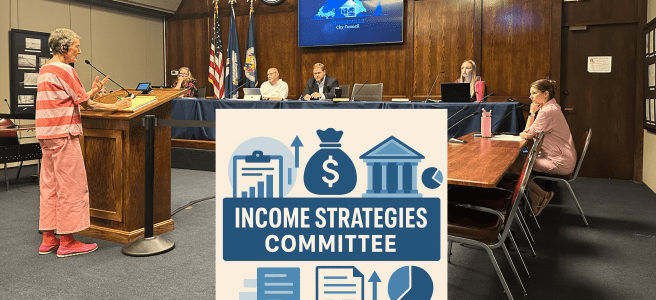
MANDEVILLE — The City Council’s new Income Strategies Committee held its first meeting Monday, September 15th, examining both the city’s revenue picture and cost-saving challenges while weighing options for addressing long-standing imbalances in the city budget.
The committee — comprised of Mayor Clay Madden, Councilman at Large Jason Zuckerman, District I Councilwoman Cynthia Strong-Thompson and Finance Director Jessica Farno — is tasked with recommending both new revenue sources and cost-saving strategies to the council. Farno opened with a presentation showing that property taxes are expected to generate about $2.18 million in 2025, while sales taxes — the city’s dominant income source — are projected to bring in $22.3 million in fiscal 2026. The city currently holds a combined $65 million across its general, special, street, and enterprise funds, though restricted balances continue to climb faster than the general fund.
During the recent budget hearing process, Zuckerman had raised the concern that while the general fund is languishing, the so-called restricted funds are on an overflowing upward trend. At the July 23rd budget hearing, he told the council: “The city is already collecting $3.4 million per year more than it spends.”
Cut employee benefits?
One of the committee’s most pointed discussions centered on retirement costs. Mandeville participates in the Municipal Employee Retirement System of Louisiana (MERS), Plan A. In addition to its 28-percent employer contribution, the city also covers the employees’ 10-percent share — a practice most other municipalities do not follow. According to the MERS website, the FY2026 employer contribution rate is dropping to 27 percent, which would mean an additional savings to the city.
Critics such as former efficiency consultant Glen Runyon has recently advocated for “a gradual reduction of the City’s contribution of the employee portion of the pension obligation” in addition to eliminating the annual cost of living adjustment (COLA) and increasing the employee contribution to their health insurance plan.
But it is unclear if those are viable options for the city. “We are really hamstrung on employee benefits of what we can do legally,” said Strong-Thompson. She explained that the city is limited in changing retirement benefits.
She continued: “Under ERISA [The Employee Retirement Income Security Act of 1974] rules, having some employees on one benefit and not offering to others is considered discrimination. However, the MERS [Municipal Employees Retirement System] system is under state guidelines and a municipality cannot unilaterally stop paying the employee portion if they have elected to do so in the past as it would most likely be a violation of state law and contractual agreements. The benefits are protected. So we truly have to look at other options.”
Revisit COLA and salaries?
Farno told the committee that SSA Consultants — the firm that conducted the city’s 2021 salary survey — will soon begin an updated study to show where Mandeville stands today compared with neighboring municipalities.
Madden, Zuckerman, and District II Councilman Kevin Vogeltanz have all questioned whether the city may have “over-shot” in recent years with either salaries or cost-of-living adjustments (COLAs). That concern could open the door to slowing or reducing future COLAs to keep pay more in line with other parish agencies and cities.
The 2021 survey found Mandeville’s pay was significantly below that of peer municipalities following more than a decade of generally stagnant pay, prompting the council to boost salaries to address morale and retention problems identified in Glen Runyon’s 2021 efficiency study. Farno said the city expects the updated survey results by year’s end.
Raise property taxes?
Looking at the revenue side, members discussed whether property taxes should be adjusted. Though the city is authorized to levy more than 15 mills, it currently imposes just over half that amount. In Mandeville, the owner of a $400,000 home in 2025 pays roughly $4,000 to St. Tammany Parish but only about $300 to the City of Mandeville.
Mandeville is estimated to collection about $2.18 million in ad valorem property taxes this fiscal year, while sales taxes are projected to bring in around $22.3 million. This means that even if the council were to vote to collect the maximum authorized millages, it would only bring in about another $2 million.
Rebalance sales taxes?
Another option on the table is the rededication of sales taxes, which would require voter approval. Runyon expressed opposition to that approach at a recent City Council meeting. However, Zuckerman noted that with 1.5 percent of Mandeville’s 2.5 percent in sales taxes (not including District 3 sales tax) set to expire starting in 2029, the renewal referendum would be an opportunity to rebalance how revenues are distributed among the city’s funds, addressing the restricted funds overflow problem.
“This isn’t an income problem,” Zuckerman said at a recent budget hearing. “It’s an accounting restriction problem. We’re taxing citizens, then tying up their money in funds we legally can’t use for basic operations.”
And now Zuckerman is calling attention to what he describes as an “opportunity” to address the problem. “We know that 90 percent of the city’s income [sales taxes] is set to expire within five years, therefore it is the perfect opportunity to rebalance, realign and reduce sales taxes,” Zuckerman told the committee at Monday’s meeting.
Taxes Breakdown:
Sales taxes
• 1959: 1% [General Fund]: In perpetuity (no expiration).
• 1986: 1% [50% General Fund, 50% Special Sales Tax Fund (restricted)]: Expires Dec. 31, 2029.
• 2001: 0.5% [Street Construction Fund (restricted):] Expires July 1, 2031.
• District 3 sales tax fund: Expires Dec. 1, 2031.
Ad valorem millages
• Police department 1: (5.08 mills authorized, 2025 levy 5.08 mills): Authorized through 2031.
• Police department 2: (3.38 mills authorized, 2025 levy 0.34 mills): Authorized through 2031.
• General alimony: (6.87 mills authorized, 2025 levy 2.79 mills): No expiration listed.
The committee also debated whether restricted funds — particularly the District 3 tax fund dedicated to infrastructure — might be tapped for broader use. Farno said there may be some room but cautioned that any savings would likely be negligible.
In its only vote of the night, the committee unanimously added two citizen members: Becky Rohrbough, a former banker and past president of the Old Mandeville Historic Association, and Michele Avery, a forensic CPA and partner at Carr, Riggs & Ingram.
-30-

 Mandeville Daily
If we have to vote to renew the sales taxes before they expire, don’t we want to do that early just in case it won’t pass the first time? Look what happened to the parish! If so, then let’s renew next year early and fix the percentages so that we don’t have to start running off our good cops! JMO
LikeLike