
Operating at loss for decades, state forcing end to subsidized water, sewage
Rates unchanged since 2016 failed attempt to stop operating losses
Bills expected to drop significantly during fall, winter months
Neighboring Covington faced similar billing shift in 2020
MANDEVILLE — Mandeville’s long-awaited overhaul of its water and sewer billing system has left many high-volume users experiencing a rate jolt, as the first round of statements reflected not only new tiered rates but also an unusually long billing cycle tied to the rollout process.
That was the message at the September 25th City Council meeting, where officials faced a handful of frustrated residents in person but said they have fielded calls from many more since the bills went out.
Officially adopted by the City Council in January, the switch to the new metered water and sewer billing system had been in the works for years, dating back to the early days of Mayor Clay Madden’s administration.
The higher charges stem from the city’s 2023 state-funded rate study, which found that Mandeville’s water and sewer enterprise fund had been operating at a loss for decades, extending back into former Mayor Donald Villere’s administration, which implemented a council-adopted rate hike that failed to fix the issue.
Mandeville has in effect been partially subsidizing residents’ water and sewer services, and it is not alone in facing pressure to align utility rates with actual costs. In 2020, Covington ended a decade of subsidies by raising rates, with its City Council redirecting the savings toward priorities such as higher police pay.
As of August 31, 2024, the enterprise fund owed more than $5.6 million to the general fund. Without rate adjustments, Finance Director Jessica Farno said, the city risked losing about $2.2 million in state Water Sector Program funding.
Officials attempt to add context to changes
Farno on Thursday sought to calm residents rattled by sharp increases in their September water and sewer bills, telling the City Council the spike reflected both a new rate structure and an unusually long 48-day billing cycle.
The City Council implemented the study’s recommendations in January through Ordinance 24-40, the first comprehensive rate update since 2016, according to Farno. Under the new structure, residents pay a fixed demand charge based on meter size — $10.40 for most households — covering the first 3,000 gallons of water. Usage above that is billed in tiers, with higher rates applied to higher consumption levels. Sewer billing was simplified to a fixed demand charge plus $3.25 per 1,000 gallons.
Public Works Director Keith LaGrange said additional incremental increases are planned over the next five years, each to be well-advertised and reviewed based on how the first adjustment performs. Officials said those hikes are not expected to be as steep as this year’s, since the largest impact came from shifting residents from a flat monthly rate to usage-based billing — a change that also coincided with peak summer usage.

Farno stressed that the system is designed to shield typical households while placing greater costs on high-volume users, such as homes with irrigation systems or pools. “About 86 percent of our customers still used 25,000 gallons or less, even in this longer billing cycle,” she said. The department also set up an online bill estimator to help residents break down their charges.
Council members weigh in
Councilman at Large Jason Zuckerman said he sympathized with residents but noted that the city had little choice once the state required utilities to prove they could pay their own way.
“I was very good paying $48.08 a month for trash, water and sewer forever from my house in Old Mandeville,” Zuckerman said. “But I had to suck it up. It was a difficult decision [for the city].”
Zuckerman recalled that for years, the city’s general fund and other accounts had quietly supplemented the utility, a practice made easier by the city’s heavy reliance on sales taxes, much of which comes from shoppers outside the city limits. “It was like that forever,” he said. “Nobody tackled the real problem until the state of Louisiana came and said, guess what? If you want to continue to operate your system at such a discount, at such a loss, you can’t come to the state for projects anymore.”
The rate study, he said, showed Mandeville’s charges were “drastically low compared to everybody else,” even neighboring subdivisions such as Greenleaves. “Ask anybody to go grab a Greenleaves water bill and compare it to Mandeville’s,” he said.
District II Councilman Kevin Vogeltanz struck an optimistic note, saying residents will see bills ease when seasonal demand falls. “Everyone’s rates are gonna go down,” he said. “I water my lawn. I have a pool. I’m using 25,000 gallons in the summer. In the winter I’m using 4,000 gallons. These summer months will be expensive, but we’re basically over the hump.”
Mayor Clay Madden reminded residents that the enterprise fund’s problems stretch back nearly two decades. “When I first ran for council back in 2012, I went back and looked at budgets from 2006 and 2007,” he said. “One of the things I noticed was the enterprise fund was not paying for itself, as it says in our city charter. This has gone back at least that far.”
He acknowledged the political difficulty of addressing the issue sooner. “The reason why nothing was done about it before is it wasn’t politically popular,” Madden said. “Nobody wanted to do what we’re doing right now.” Still, he said the state’s Water Sector Program left the city no choice, and neighboring cities such as Covington have already undergone similar adjustments.
District I Councilwoman Cynthia Strong-Thompson praised staff for their work and said the changes should prompt residents to think more carefully about water use. “When I ride my bicycle in the morning and we’ve been in a drought for six months and people have water standing in their ditches, we may have a problem,” she said. “We as homeowners also have to take personal responsibility.”
Strong-Thompson also thanked Madden for agreeing to host a town hall Oct. 6 where department heads will answer questions directly. “I cannot express how much I appreciate that y’all are taking your evening to come do that,” she said.
District III Councilwoman Jill Lane emphasized that the overhaul had been years in the making and said communication remains a challenge. “We’ve been working on this about four years,” she said. “However, I understand the shock and awe, especially doing it in August and it being six weeks instead of four weeks.”
She said residents often miss important information because they pay bills online or through auto-draft. “The water bill is a little archaic. A lot of people don’t even look at their water bills,” Lane said. She suggested exploring text alerts similar to school notification systems to give residents a heads-up about major changes.
Operating fund net position explained
Farno said the “loss from operations” shown in the city’s financials does not mean the enterprise fund was simply left uncovered year after year. Instead, operating revenues from water and sewer fees consistently fell short of operating expenses such as salaries, utilities and maintenance — but the gap was offset by other sources.
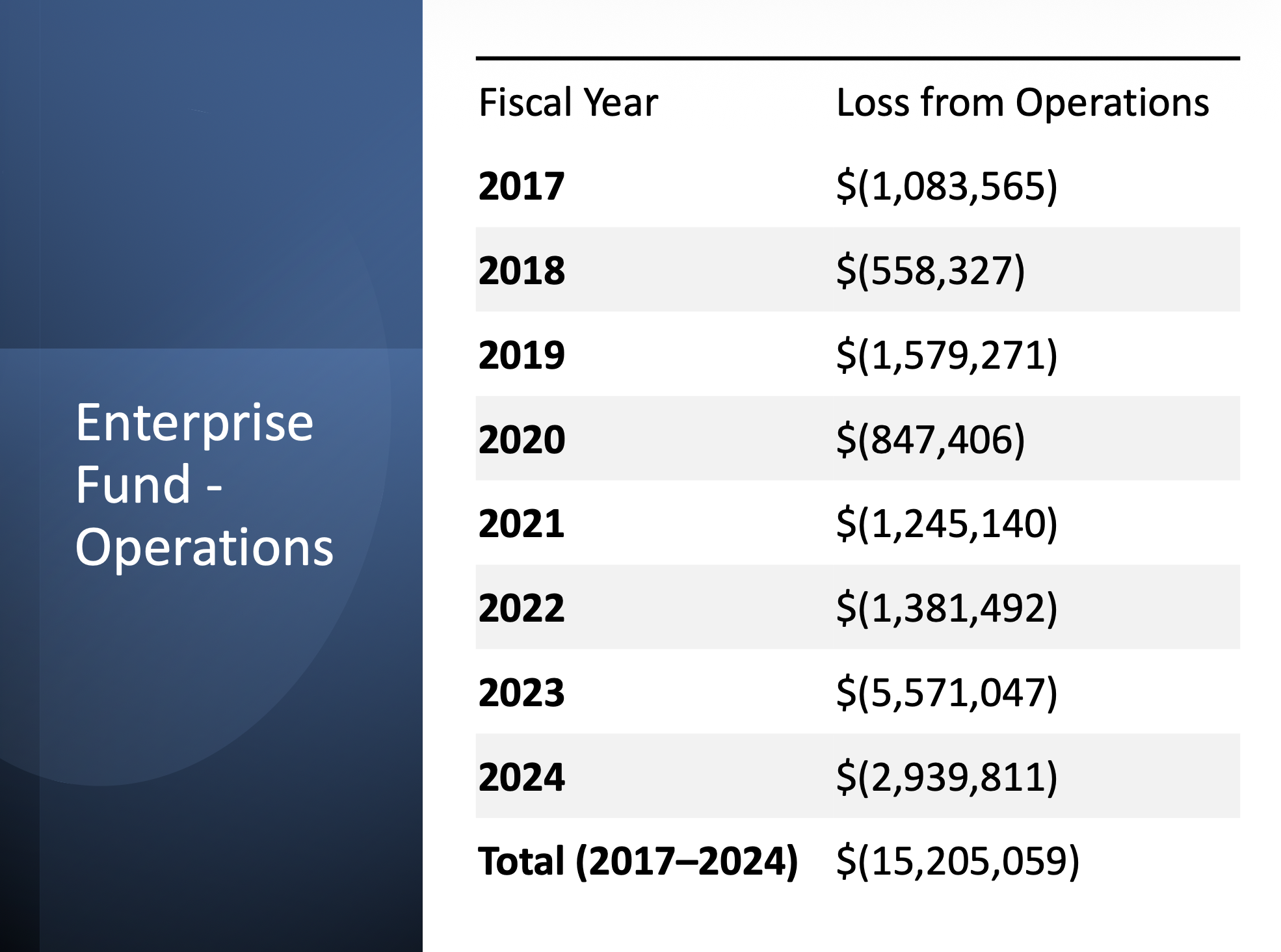
Farno explained that the Enterprise Fund’s overall “net position” remained positive because of transfers from the special sales tax fund, grant funding, and investment income. Those non-operating revenues, while not available for day-to-day costs, boosted the fund’s balance sheet and masked the operating shortfall.
She pointed to fiscal year 2022 as an example: the fund recorded an operating loss of about $1.38 million, but a $4.9 million transfer from the special sales tax fund — restricted to capital projects — and other non-operating revenues pushed the overall net position up by about $3.5 million.
The general fund was only mentioned, Farno said, because it sometimes lent cash on a short-term basis when the enterprise fund’s expenses outpaced available cash. Those inter-fund loans are recorded as “due to” and “due from” and must be repaid; the general fund is not directly paying the utility’s operating costs.
Farno added that 2017 was used as the starting point in the city’s presentation because that was the last time rates were adjusted, making it a clear window to show how revenues and expenses trended under the same structure.
Addressing concerns while moving forward
Farno said the city temporarily suspended automatic withdrawals for customers enrolled in ACH or EFT payments directly with the city to avoid “surprising anyone” as the new rates took effect. No late fees will be assessed for this month, and auto-drafts are expected to resume with the next billing cycle. Customers can still pay online, by phone, in person, or by mail, she added.
The finance department is reviewing bills on a case-by-case basis, and she thanked her staff for handling more than 400 calls and in-person inquiries from residents.
Farno said her office may issue credits where the 48-day billing cycle pushed customers into higher usage tiers than their typical average. She urged residents to use the city’s new online bill estimator and said staff will keep monitoring the system closely in the coming months. “It’s not an overnight fix,” she said, “but we’re working case by case to make sure the bills are fair.”
-30-

 Mandeville Daily
Good article! The Administration made a significant error by billing a six week period instead of the usual monthly period. Dumb error! Regardless of the situation, you only get one chance to make a first time impression. Poor Planning = Poor Result. Instead of wasting space on entertainment news in the subject utility bill the Administration should have used this space to explain the new billing format. Priorities? I still do not understand the details of the sewer charge. I am certain that I am not the only one. This fiasco has resulted in many unhappy voters and lots of mistrust.
LikeLike
Councilman Zuckerman may want to take another look at Greenleaves’ water billing. Our bills have been averaging over $120 a month for years now! If the Mandeville bill includes garbage pickup then thats a steal!
LikeLike